
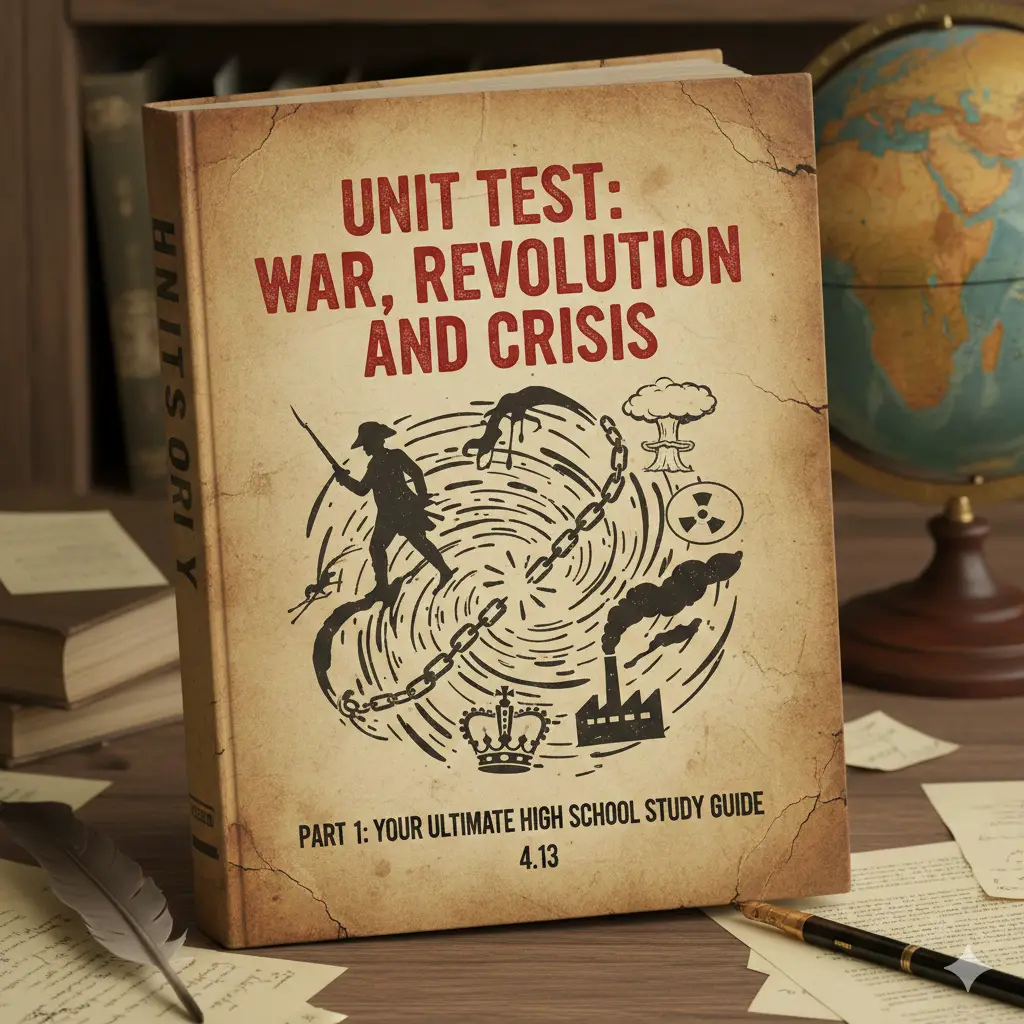
You sit down for your history test. Your heart goes thump-thump! You open the test. It is about big, scary stuff from a long time ago (around 100 years ago).
The test name is “War, Revolution, and Crisis – Part 1.” It talks about:
- How World War I started (like a tiny spark that made a HUGE fire)
- The Russian Revolution (people got super mad and changed their whole country)
- The years after the war, when everything was still wobbly and messy
Europe was like a box full of fireworks. Countries were proud, had big armies, and made secret promises to help each other fight. One little match… BOOM! Everything exploded.
This test has lots of names and dates. It can feel too big and hard. But don’t worry!
This guide is your helper. We will use short, easy stories, fun little facts, and fast quizzes. Everything is in tiny bites—like eating cookies one at a time.
When you finish, you will feel happy and brave. You will be ready to answer questions about the Bolsheviks or what happened when the war stopped in 1918. Let’s turn those nerves into confidence—one fact at a time.
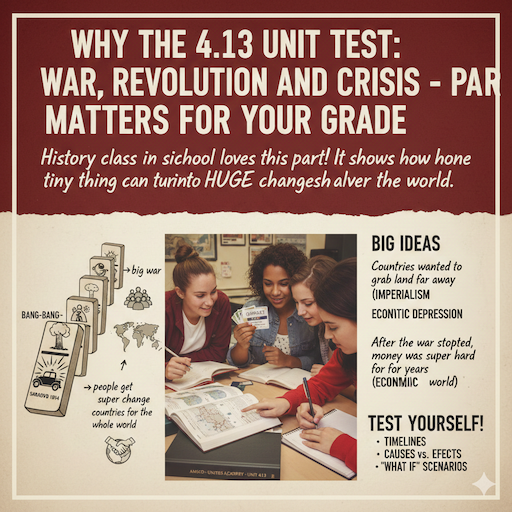
Why the 4.13 Unit Test: War Revolution and Crisis – Part 1 Matters for Your Grade
History class in high school loves this part! It shows how one tiny thing can turn into HUGE changes all over the world.
It is like dominoes falling: One bang-bang in a city called Sarajevo in 1914 → big war → people get super mad → countries change → new rules for the whole world. Even the world you live in today!
Your test will probably have 20 or 30 pick-one-answer questions. Maybe you can also write a short story about why the fights happened.
Kids use fun tools to study:
- Quizlet cards (flip-flip and remember fast!)
- Big books like AMSCO
Those help a lot because they tell the facts AND why they are important.
We will do the same easy way here: Big words at the top (headings), fat dark words for important names, and we will tell you how it connects to today. That keeps it fun!
This part of history connects to big ideas:
- Countries wanted to grab land far away (which made everyone fight)
- After the war stopped, money was super hard for many years
Teachers use books from schools like Connections Academy or FLVS. Unit 4.13 is the start of all the scary and exciting stuff from 100 years ago.
You are going to do great! Keep reading, and it will stick in your brain! Expect questions on timelines, causes versus effects, and “what if” scenarios. Ready? Grab a notebook, and let’s charge ahead.
WWI Causes and Effects: The Spark That Lit the Fire
World War I timeline starts with tension brewing long before the first shot. Imagine Europe a long, long time ago, around 1900 to 1914.
Kings and bosses were like this: “Look how strong we are!” Factories went brrr-brrr all day, making guns and big ships. People waved flags and shouted, “My country is the BEST!” The big war did not just pop out of nowhere. It grew slowly, like a snowball getting bigger and bigger. Smart historians use a magic word to remember why the war started. The word is MAIN. It is super easy!
M = Militarism. Everyone wanted the biggest army and the most guns.
A = Alliances Countries made secret promises: “If someone hits you, I will help fight!”
I = Imperialist Countries grabbed far-away lands and said, “This is mine now!”
N = Nationalism. Everyone loved their own country SO much that they thought it was better than all the others.
Then one tiny thing happened (we will talk about it next), and BOOM! The whole snowball crashed, and the war began.
MAIN = the four big reasons. Say it with me: M-A-I-N! Let’s unpack each one, step by step, so you can spot them on your test. Check this set1
Breaking Down Militarism and Alliances: Armies on Steroids
Militarism: Who has the biggest muscles?
Countries acted like kids on the playground: “My army is bigger than yours!” They spent tons of money on soldiers, guns, and giant ships.
- Germany had more than 2 million soldiers ready to go.
- Britain built scary huge ships called dreadnoughts. They were like floating metal monsters!
Leaders said, “A big army keeps us safe.” But really, it made everyone nervous and ready to fight.
Alliances: Best friends forever… who fight!
Countries made secret promises. It was like saying, “If someone picks on you, I will punch them too!”
There were two big teams:
Team 1 (Triple Alliance):
- Germany
- Austria-Hungary
- Italy
Team 2 (Triple Entente):
- France
- Russia
- Britain
If one friend got in a tiny fight, ALL the friends had to jump in. One little problem became a GIANT war!
Example: Austria-Hungary was mad at little Serbia. Russia said, “Hey, Serbia is my little brother!” Then everyone started fighting because of the promises.
Quick tips for your test
Question you might see: “What did militarism and alliances do before World War I?”
Best answer: They made a big net. One pull and the whole world got stuck in war!
Super fact to remember: From 1900 to 1914, countries spent 50% more money on guns and armies. Wow!
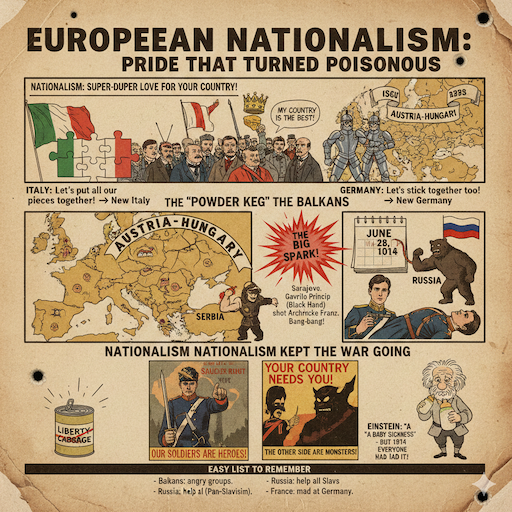
European Nationalism: Pride That Turned Poisonous
Nationalism: Super-Duper Love for Your Country!
Nationalism is when people shout, “My country is the best!” They want their own flag, their own king, and their own land.
In the old days (1800s),
- Italy said, “Let’s put all our pieces together!” → New Italy!
- Germany said, “Let’s stick together too!” → New Germany!
But in a place called the Balkans, it was messy. Many little groups lived under big Austria-Hungary. They said, “We want to be free!” People called the Balkans the “powder keg.” That means one tiny spark → KABOOM!
Little Serbia wanted to be big and strong. Russia was like Serbia’s big brother.
The Big Spark!
June 28, 1914, in a city called Sarajevo. A young man named Gavrilo Princip loved Serbia SO much. He was in a secret club called Black Hand. He shot the Prince of Austria-Hungary, Archduke Franz Ferdinand. Bang-bang! The prince died.
Austria got super mad at Serbia. One month later → Austria attacked Serbia. Then everyone jumped in because of the teams we learned about.
Nationalism Kept the War Going
Countries made posters:
- “Our soldiers are heroes!”
- “The other side are monsters!”
In Britain, posters said, “Your country needs YOU!” More than 2.5 million guys ran to sign up! People even changed food names because they hated the other side. Sauerkraut became “liberty cabbage” in America!
Easy List to Remember
- The Balkans were full of angry little groups.
- Russia wanted to help all Slavic people (Pan-Slavism).
- France was still mad at Germany from a long time ago.
- Einstein later said nationalism is like a baby sickness—but in 1914 everyone had it!
After the War
Big old empires broke into little new countries. Austria-Hungary disappeared! New places like Czechoslovakia were born.
This super love for countries started World War I and left angry feelings that helped start World War II later. View the doc2
Imperialism in Europe: Colonies as Chess Pieces
Don’t forget imperialism in Europe—the scramble for overseas turf that amped rivalries. Imperialism means big countries took land far away and said, “This is mine now!”
- Britain had the biggest piece. They ruled one-fourth of the whole world!
- France grabbed big parts of Africa.
- Germany came late to the game. They felt left out and wanted more too.
In 1884, the big countries had a meeting in Berlin. They drew lines on Africa’s map like cutting a cake. They didn’t even ask the people who lived there!
This made everyone mad and caused little fights:
- 1905 and 1911 → trouble in Morocco. Germany said, “Hey, France, share!” France said, “No way!”
Germany’s boss, Kaiser Wilhelm II, bragged: “We want our place in the sun!”
What Happened Because of This?
- Countries spent tons of money on ships to guard their new lands.
- When World War I started, people from the colonies had to fight: → More than 1 million soldiers from India helped Britain. → 500,000 African soldiers helped France.
A Scary Almost-War
In 1911 (Agadir Crisis), Germany sent a big warship to Morocco. Everyone got ready to fight! Luckily, they stopped… but it showed how angry everyone was.
The Immediate Trigger and War’s Bloody Toll
That assassination? It was the match. Austria, with Germany’s blank check, declared war on Serbia on July 28, 1914. Russia mobilized on August 1, Germany invaded Belgium on August 4—drawing Britain in. The Armistice 1918 ended it November 11, but not before devastation.
Effects Snapshot:
- Human Cost: 40 million casualties; the U.S. alone lost 116,000.
- Economic Ruin: Europe’s GDP dropped 20%; war debts hit $200 billion.
- Social Shifts: Women entered factories (inspiring suffrage); Spanish Flu killed 50 million in 1918-1919, worsening chaos.
Practice Question (Like on Your Test): Which event directly triggered WWI? A) Sinking of Lusitania B) Assassination of Franz Ferdinand C) Bolshevik takeover D) Versailles signing. (Answer: B)
This section alone could be half your test. Review with a timeline: Draw it out—1914 spark to 1918 silence. You’ve got this; these causes aren’t abstract—they’re why maps changed forever.
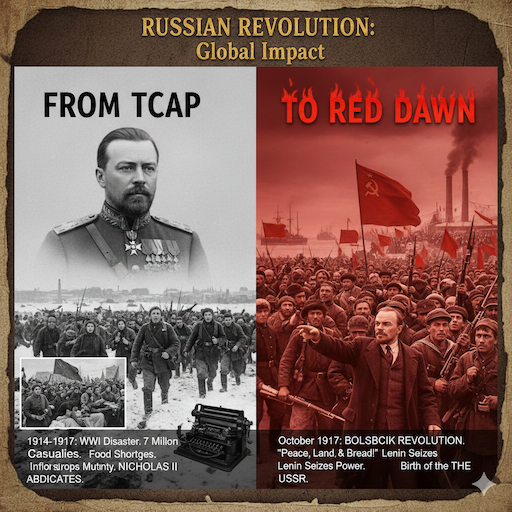
Russian Revolution: From Tsar to Red Dawn
Shifting gears to global revolutions, the Russian Revolution stands out as WWI’s wild child. While trenches bogged down in mud, Russia boiled over. By 1917, Tsar Nicholas II’s empire—once vast as the world’s largest—cracked under war’s weight. This wasn’t one revolt; it was two: February’s liberal push and October’s radical grab. Let’s timeline it simply, like flashcards from your “flashcards for Russian Revolution and global impact.”
Roots of Unrest: War and Want
Russia entered WWI allied with France and Britain, but it was a disaster. Poorly equipped troops faced 7 million casualties by 1917. Food shortages hit cities; bread riots erupted in Petrograd (now St. Petersburg). Workers struck—over 300,000 in January 1917 alone. The Tsar, advised by mystic Rasputin (poisoned and drowned that year), ignored reforms. Political upheaval brewed: Liberals wanted parliamentary power; peasants craved land; Marxists dreamed of worker rule.
Key Stat: Russia’s economy shrank 20% from 1914 to 1917; inflation soared 400%. No wonder soldiers mutinied.
February Revolution: Goodbye, Tsar
On March 8, 1917 (February in the old calendar), International Women’s Day sparked protests. “Peace and Bread!” they chanted. Troops joined, not shot. Nicholas abdicated on March 15, ending 300 years of Romanov rule. A Provisional Government took over, led by Alexander Kerensky, promising elections and continuing the war. But they dithered—land reforms stalled, war dragged.
Fun Fact: The Tsar’s train was sidetracked by strikes; he learned of his fall from a telegraph. Exiled to Siberia, he and his family were executed in 1918.
October Revolution: Bolsheviks Storm In
Enter Vladimir Lenin, exiled revolutionary with a goatee and sharp ideas. Smuggled back via Germany’s help (they wanted Russia out of the war), he preached “All Power to the Soviets!”—workers’ councils. His April Theses demanded peace, land, and bread. By October, the Bolsheviks (meaning “majority”) had army support.
On November 7, 1917 (October old-style), Red Guards seized Petrograd’s Winter Palace. Minimal bloodshed—just 10 deaths. Kerensky fled. Lenin declared a socialist government. “We shall now proceed to construct the socialist order,” he said.
Effects on WWI: Russia signed the Treaty of Brest-Litovsk in March 1918, ceding land to Germany (one-sixth of its territory). This freed German troops for a western push, but the Allies feared communism spreading.
Aftermath: Civil War and Global Ripples
The Bolshevik Revolution ignited Russia’s Civil War (1918-1922). Reds (Bolsheviks) vs. Whites (anti-communists, backed by 14 Allied nations). Up to 10 million died from fighting, famine, and disease. Lenin won, forming the USSR in 1922. Collectivization began; the secret police (Cheka) crushed dissent.
Global Impact: Scared the West—U.S. Red Scare deported 500 radicals. Inspired colonies like India. Stalin later twisted it into total control, with Five-Year Plans industrializing at human cost (millions starved in 1930s famines).
Student Tip for “practice test on European nationalism and militarism”: Link Russian unrest to WWI nationalism—war exposed Tsarist weaknesses, like failed offensives killing 2 million.
Numbered Timeline for Easy Recall:
- 1905: Bloody Sunday massacre sparks the first revolution; Tsar promises the Duma (parliament).
- 1914: Russia mobilizes for Serbia, enters WWI.
- 1917 Feb: Riots topple Tsar; Provisional Government forms.
- 1917 Oct: Bolshevik coup; Lenin in charge.
- 1918: Brest-Litovsk Treaty; Civil War starts.
- 1922: USSR born; Lenin dies in 1924, Stalin rises.
Quote to Impress: “A revolution is not a dinner party,” Mao later echoed Lenin—messy, but world-changing.
This revolution flipped the script on kings and capitalists. For your test, remember: It weakened the Allies mid-war, paving for totalitarian regimes like Stalin’s.
Treaty of Versailles: Peace That Sowed More War
Fast-forward to 1919: Leaders gather in Paris to carve up the postwar world. The Treaty of Versailles, signed on June 28 in the Hall of Mirrors, aimed to punish Germany. U.S. President Woodrow Wilson pushed his Fourteen Points: self-determination, free trade, League of Nations. But France’s Clemenceau wanted revenge: “Germany will pay.” Britain and Italy haggled for colonies.
Key Terms: The Harsh Hangover
Germany got the blame via Article 231—”war guilt clause.” Punishments?
- Territory Losses: 13% of land, 10% population. Alsace-Lorraine to France; the Polish Corridor splits East Prussia; colonies to Allies.
- Military Caps: Army to 100,000; no air force, subs, tanks. Rhineland demilitarized.
- Reparations: $33 billion (about $500 billion today)—crippling debt.
Germany signed under protest, calling it a “diktat” (dictated peace). No seat at the table fueled resentment.
Stats Alert: Reparations equaled Germany’s entire pre-war GDP. Hyperinflation hit: A loaf of bread cost 200 billion marks by 1923. Access the PDF here3
Impact on Interwar Period Conflicts
The treaty didn’t heal; it festered. Germany’s Weimar Republic struggled—unemployment soared, extremists rose. Adolf Hitler railed against it in Mein Kampf: “Versailles is a Jewish plot!” By 1933, the Nazis shredded it: Rearmed in 1935, remilitarized the Rhineland in 1936.
Globally, it birthed the League of Nations—Wilson’s baby for collective security. But the U.S. Senate rejected it (isolationism won), hobbling the group. Failures? Ignored Japan’s Manchuria grab (1931), Italy’s Ethiopia invasion (1935). Economic depression impact from 1929 amplified woes—global trade crashed 66%, and unemployment hit 30% in Germany.
Understanding Treaties and Conflicts After World War I: Versailles ignored root causes like nationalism. New states like Yugoslavia mixed ethnic groups, sparking future fights. It also redrew the Middle East (Sykes-Picot ignored Arabs), sowing conflicts there.
Bulleted Effects for Quick Review:
- Economic: War debts chained to reparations; the U.S. loaned $10 billion to Europe, creating dependency.
- Political: Rise of totalitarian regimes—Mussolini in Italy (1922), Hitler exploiting grievances.
- Social: 6 million Germans in “lost territories” felt betrayed; fueled revanchism (revenge drive).
- Global: Mandates system (not colonies, wink) prolonged imperialism.
Practice MCQ: What was a major flaw of the Treaty of Versailles? A) It included all Fourteen Points. B) Harsh terms bred resentment. C) Ended all alliances. D) Boosted the German economy. (Answer: B)
For “key events in the interwar period for students,” see Versailles as the domino: Treaty → Depression → Dictators → WWII.
Interwar Period Conflicts: The Calm Before the Storm
Between 1919 and 1939, the world licked wounds but picked new scabs. Interwar period conflicts weren’t all-out war, but skirmishes and slumps that tested the peace. Your test might quiz “modern world crises 1914–1939 review materials,” so let’s map the mess.
Economic Depression Impact: The Great Crash Hits Home
October 1929: Wall Street crashes. Overproduction, speculation, and war debts triggered it. U.S. GDP fell 30%; Europe followed. Germany, already Versailles-burdened, saw 6 million unemployed by 1932. Hoovervilles—shantytowns—popped up; Dust Bowl farmers fled Oklahoma.
Global Tie: Smoot-Hawley Tariff (1930) hiked U.S. import taxes, slashing trade by 60%. Japan, an export-dependent country, invaded Manchuria for resources.
Tip: Remember the chain—WWI debts → reparations moratorium (1920s Dawes Plan helped briefly) → Crash → Extremism.
Rise of Totalitarian Regimes and Global Revolutions
Totalitarian regimes filled power vacuums. In Italy, Mussolini’s Fascists marched on Rome in 1922, promising glory. “Believe, obey, fight!” his youth drilled. Soviet Russia under Stalin collectivized farms—Ukraine’s Holodomor famine killed 3-5 million (1932-1933).
Japan’s militarists grabbed Manchuria, renaming it Manchukuo. Spain’s Civil War (1936-1939) pitted Franco’s fascists against Republicans—a preview of WWII tactics, with Hitler testing bombs.
League of Nations Flops: No army, U.S. absence. Kellogg-Briand Pact (1928) banned war—signed by 62 nations, enforced by… wishes.
Social and Political Reforms: Positives emerged. U.S. New Deal (1933) built dams, roads—FDR’s “fireside chats” reassured. Women’s rights advanced post-suffrage (1920). But reforms were patchy; the Harlem Renaissance celebrated Black culture amid Jim Crow.
List of Flashpoint Events:
- 1923: Beer Hall Putsch—Hitler’s failed coup, but a fame boost.
- 1931: Mukden Incident—Japan stages an attack to justify Manchuria.
- 1935: Nuremberg Laws strip Jewish rights in Germany.
- 1938: Munich Agreement—Britain/France appease Hitler over the Sudetenland.
Quote: “The treaty was a scrap of paper,” Weimar leader Gustav Stresemann said of Versailles’ fragility.
This era’s conflicts were proxy wars for ideology—capitalism vs. communism vs. fascism. For your World History assessment, analyze how imperialism in Europe lingered, with colonies chafing under mandates.
Historical Conflict Analysis: Lessons from Crises and Reforms
Tying threads: Early 20th century crises like WWI’s total war (home fronts mobilized fully—women in munitions, rationing everywhere) led to social and political reforms. Versailles’ League inspired the UN, but its failures taught that enforcement needs teeth.
Imperialism’s Shadow: Post-war, mandates like Iraq (British) bred revolts—the 1920 Iraqi uprising killed thousands.
Bolshevik Revolution Global Echo: Inspired China’s communists; scared U.S. into immigration quotas (1924 Act cut 80%).
Test Tip: Essays ask causation—e.g., “How did militarism and alliances contribute to WWI causes and effects?” Use PEEL: Point, Evidence (stats), Explain, Link to bigger picture.
Sample Short Answer: Describe Armistice 1918. (It halted fighting but sowed resentment—no surrender, just truce; flu pandemic followed, killing more than battles.)
FAQs
What’s the biggest WWI takeaway?
Countries were too proud and had secret teams. One tiny fight started a huge war. The war changed maps, broke money, and made everyone super sad.
How did Russia quit World War I?
New bosses in Russia said, “We stop!” They gave Germany lots of land with a paper called the Brest-Litovsk. Russia left the war but got a new fight at home.
Why did the Treaty of Versailles not work?
It was too mean to Germany. Germany lost land and had to pay a lot of money. People got poor and mad, so they liked Hitler later.
Best way to study for this test?
Draw a simple timeline and make flashcards. Look on Quizlet for “War Revolution Crisis” – easy cards are there!
How did bad leaders take over later?
The mean treaty + no money in the Depression made people scared. Angry people said yes to strong bosses who promised to fix everything.
Conclusion
We just finished the big test about wars and big changes! Long ago, countries loved showing off their armies and made secret friend groups (alliances). That started World War I – boom! Millions of people died (about 20 million!), and everyone was super sad. In Russia, the king (the tsar) was kicked out. New bosses, called Bolsheviks, took over and made very strict rules. After the war, the winners made Germany pay a LOT of money (33 billion dollars!). Germany felt mad and poor. They also started the League of Nations to keep peace… but it was too weak and didn’t stop the next bad guys. All these things were like dominoes – one pushed the next and helped start even bigger problems later.
It wasn’t just history – it was real families who lost everything. That’s why we learn it: so we don’t make the same mistakes again! You got this!
This unit shows history’s web: One alliance pulls another thread. You’ve got the tools—timelines, lists, and quotes—to ace your exam. Feel that reassurance? You’re not just memorizing; you’re understanding why the world spins as it does.