
You work hard for your money. The last thing you want is to lose it all because one stock or one sector crashed. This is where diversification in finance becomes your best friend. Diversification in finance simply means spreading your money across many different investments instead of putting everything in one place. Think of it as the famous saying: “Don’t put all your eggs in one basket.” When you practice financial diversification, losses in one area can be balanced by gains in another. This easy yet powerful idea has helped millions of everyday investors sleep better at night for decades.
What Is Diversification in Finance? A Clear Definition
What is diversification in finance? It is the strategy of investing in a mix of assets so that the poor performance of one investment does not hurt your entire portfolio too much. The definition of diversification in finance is straightforward: spread risk by owning different types of investments that do not move up and down together at the same time.
Experts at Investopedia describe it this way: “Diversification in finance is a risk management strategy that mixes a wide variety of investments within a portfolio.” The diversification in finance meaning has stayed the same since Nobel Prize winner Harry Markowitz introduced Modern Portfolio Theory in 1952. His work proved that a diversified basket of assets can give you better returns for the same level of risk – or the same returns with much less risk.
Why Diversification in Finance Really Works
The main job of diversification in finance is to reduce risk diversification in finance. There are two kinds of risk in investing:
- Unsystematic risk – problems that affect only one company or one industry (a factory fire, a bad CEO, or a new competitor).
- Systematic risk – problems that affect the whole market (recession, inflation, war).
Diversification in finance wipes out most unsystematic risk. If you own only Tesla stock and the company has a bad quarter, you lose big. But if Tesla is just 5% of your portfolio and you also own bonds, real estate funds, and healthcare stocks, one bad quarter barely moves the needle.
Studies back this up. Vanguard research shows that a globally diversified portfolio of stocks and bonds cut volatility by up to 30% compared to owning only U.S. stocks between 1970 and 2023.
Real-Life Example Example of Diversification in Finance
Meet Sarah, a 35-year-old teacher saving for retirement. Instead of buying only tech stocks (which did great in 2021 but crashed in 2022), she built a simple diversified portfolio:
- 40% U.S. total stock market ETF
- 20% international stock ETF
- 30% bond ETF
- 10% real estate ETF
When tech stocks fell 30% in 2022, her bonds and real estate rose, so her whole portfolio dropped only 12%. That is how diversification is used in finance in everyday life.
Benefits of Diversification in Finance You Can Feel
- Lower risk without giving up growth – You still catch market gains, but big drops hurt less.
- Smoother ride – Your account balance does not swing wildly each month. This helps you stay calm and avoid panic selling.
- Better sleep – Risk-averse investors love knowing one bad event won’t wipe them out.
- Works for any budget – Even $100 a month into a diversified target-date fund does the job.
Morningstar found that investors who stayed diversified from 2000 to 2023 earned almost the same return as the S&P 500 but with far fewer scary drawdowns.
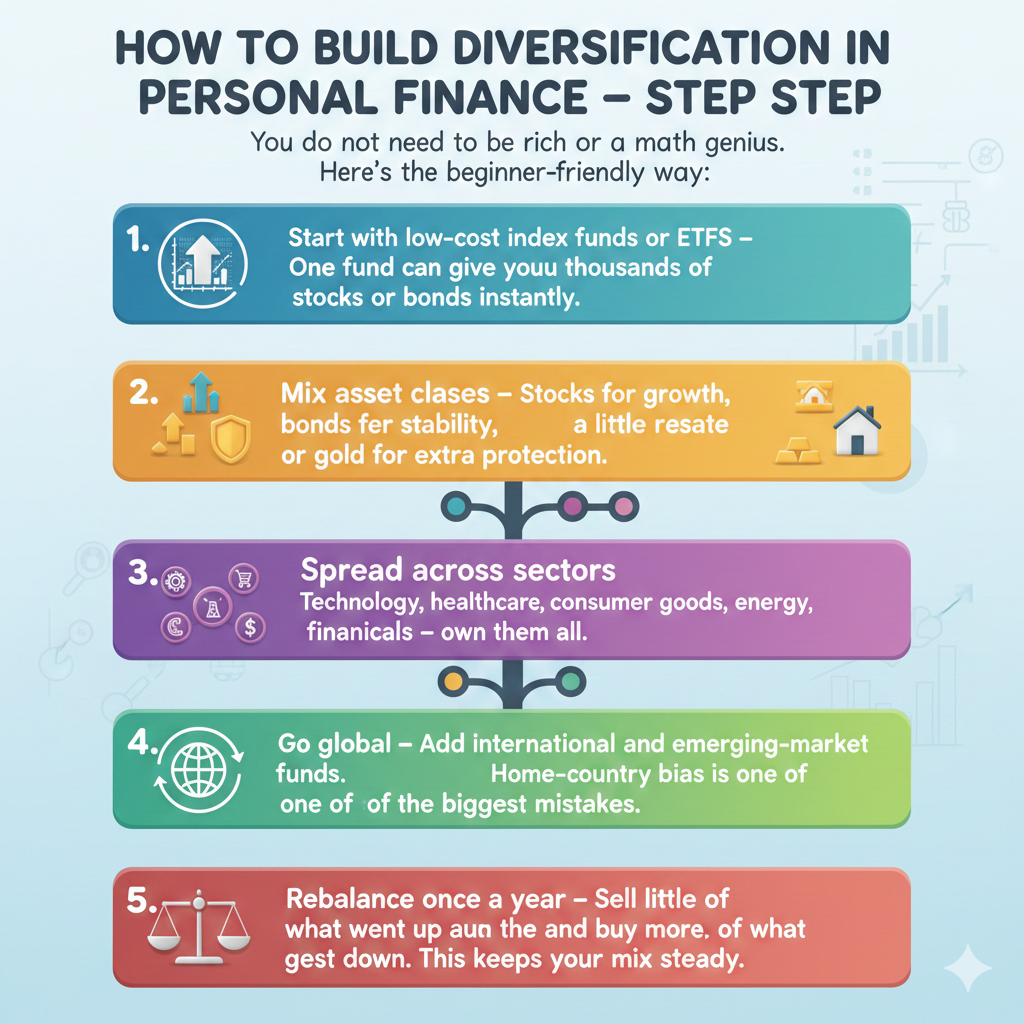
How to Build Diversification in Personal Finance – Step by Step
You do not need to be rich or a math genius. Here’s the beginner-friendly way:
- Start with low-cost index funds or ETFs – One fund can give you thousands of stocks or bonds instantly.
- Mix asset classes – Stocks for growth, bonds for stability, a little real estate or gold for extra protection.
- Spread across sectors – Technology, healthcare, consumer goods, energy, financials – own them all.
- Go global – Add international and emerging-market funds. Home-country bias is one of the biggest mistakes.
- Rebalance once a year – Sell a little of what went up and buy more of what went down. This keeps your mix steady.
A simple three-fund portfolio (U.S. stocks, international stocks, bonds) has beaten most active investors over the last 50 years, according to studies from Vanguard and Fidelity.
Common Myths About Diversification in Finance
Myth 1: “Diversification means lower returns.”
Truth: Over long periods, diversified investors often end up ahead because they avoid huge losses and stay invested.
Myth 2: “I need 100 stocks to be diversified.”
Truth: 20–30 well-chosen stocks or just a few broad ETFs already remove most unsystematic risk.
Myth 3: “Diversification protects me from all losses.”
Truth: It cannot stop market crashes (systematic risk), but it makes recovery faster and less painful.
When Diversification in Finance Can Hurt You
Yes, there are small downsides:
- You will never have the very highest return in a single year (the person who owned only Nvidia in 2023 beat everyone).
- Too many holdings can raise fees and make tracking harder.
- Over-diversification dilutes great ideas.
The sweet spot for most people is 4–12 different funds or 20–40 individual stocks.
Start Your Diversification in Finance Journey Today
Ready to take action? Open a brokerage account and buy your first broad-market ETF. Many platforms let you start with just $1. Set up automatic monthly investments and watch diversification in finance work its quiet magic over the years.
For a deeper academic explanation, read the full entry on Wikipedia – Diversification (finance)1.
For practical portfolio examples, check the excellent guide at Corporate Finance Institute2.
Investopedia’s plain-English article is perfect for beginners: What Is Diversification?.
Who Needs Diversification in Finance the Most?
- Beginners who are scared of losing everything on one stock
- Parents saving for college in 10–15 years
- Anyone nearing retirement who cannot afford a 50% drop
- Busy professionals with no time to watch the market daily
- Moderate-risk takers who want steady growth
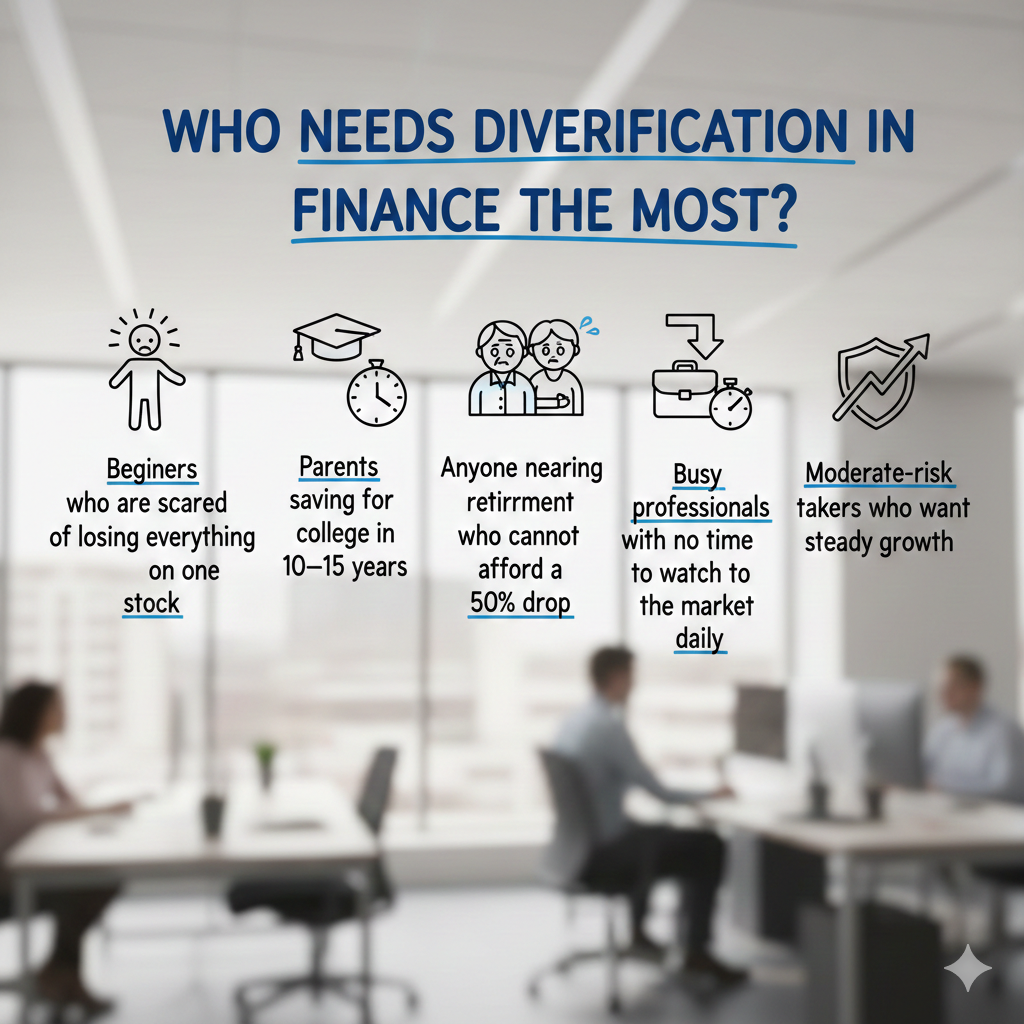
If you fit any of these, diversification in personal finance is made for you.
Quick Diversification Checklist (2025 Version)
- Own stocks AND bonds
- Own U.S. AND international investments
- Own large AND small companies
- Own growth AND value sectors
- Keep fees under 0.20% per year
- Rebalance once a year or when allocations drift more than 5%
FAQs About Diversification in Finance
What is diversification in finance?
Diversification in finance means spreading your money across many different investments (stocks, bonds, real estate, etc.) so that one bad performer cannot hurt your whole portfolio too much.
What does diversification mean in finance?
It is the simple idea of “not putting all your eggs in one basket.” The diversification in finance meaning is all about lowering risk by owning things that don’t move together at the same time.
Why is diversification important in finance?
It protects you from big losses. The benefits of diversification in finance include lower risk, smoother returns, and more peace of mind without giving up long-term growth.
What is an example of diversification in finance?
Instead of putting $10,000 only in Apple stock, you put $4,000 in a total stock ETF, $3,000 in bonds, $2,000 in international stocks, and $1,000 in real estate. That’s a real example of diversification in finance.
What is diversification in personal finance?
Diversification in personal finance is the same idea applied to your own savings, retirement accounts, or emergency fund—mix different assets so your personal money stays safer.
How many investments do I need to be diversified?
Just 3–5 low-cost ETFs or 20–30 individual stocks already give you most of the benefits of diversification in finance. More than that often adds little extra protection.
Can diversification completely remove risk?
No. Diversification in finance removes company-specific risk (unsystematic risk), but you still face market-wide risk (systematic risk) that affects everything.
Conclusion: Make Diversification in Finance Your Superpower
Diversification in finance is not exciting, but it is one of the few free lunches in investing. It lowers risk, smooths returns, and gives you the confidence to stay invested through good times and bad. Whether you are just starting with $50 a month or managing a six-figure nest egg, spreading your money wisely remains the smartest move you can make.
What is the very first step you will take today to add more diversification in finance to your own money? Share in the comments – let’s help each other build stronger portfolios!
References
- Wikipedia.com – Diversification (finance): Complete academic history and theory behind the concept. ↩︎
- Investopedia.com – Diversification: Beginner-friendly definitions and real-world scenarios used by millions of retail investors each month. ↩︎