
You stand at a crossroads. You have savings to invest. Do you buy shares in the stock market? Or do you hunt for a rental property? Many long-term investors face this choice. They want steady growth that beats inflation. They dream of compounding returns over 20 or 30 years. That’s where the stocks vs real estate average annual returns comparison comes in. This guide breaks it down simply. We look at decades of data from U.S. markets. You will see clear numbers. You will learn key factors like risk and liquidity. By the end, you can decide—or mix both for a stronger plan.
Think about it. Long-term investment growth matters most. A young couple saves for retirement. A family builds an emergency fund. These folks care about facts, not hype. They read charts and crunch numbers. They live in places like the U.S., Canada, or the UK—Tier 1 spots with solid markets. Or in growing Tier 2 cities like Dubai or Singapore. Here, data drives choices. U.S. history shows stocks often win on raw returns. But real estate shines with stability and extra perks like rent checks. Let’s dive in. You will find tips to match your goals.
This article draws from trusted sources. We verify every stat. No fluff. Just real insights for risk-/return-conscious investors. Ready? Start with the basics.
How These Assets Work
Stocks and real estate both make money. But they play different games. Stocks mean you own a slice of a company. Think Apple or Google. You buy shares through a broker. Prices rise and fall daily. Dividends add cash flow sometimes.
Real estate means you own land or buildings. A house. An apartment block. You buy with a loan. Tenants pay rent. Values climb over time. But fixes and taxes eat into profits.
Both fit the portfolio diversification analysis. Why? Markets zig when one zags. Stocks crash in recessions. Real estate holds firm as people need homes. Over time, mixing them cuts risk. A study from NYU’s Aswath Damodaran shows this balance works. Now, let’s look at the numbers that matter.
Understanding the Stocks vs Real Estate Average Annual Returns Comparison
The heart of this debate? Raw performance. We compare the average annual return of real estate investments vs the stock market over long stretches. Data comes from U.S. benchmarks. The S&P 500 tracks top stocks. The Case-Shiller Index tracks home prices. Add rents for total real estate returns.
From 1928 to 2024, stocks averaged 10% yearly. That’s with dividends reinvested. Real estate? About 4% from price growth alone. But toss in real estate rental yield—say 4-6%—and it hits 8-10%. Stocks pull ahead slightly. Yet real estate fights back with leverage. More on that soon.
Why the gap? Stocks ride company profits and global booms. Real estate ties to local jobs and building costs. In hot markets like San Francisco, property soars. But nationwide, stocks win consistently.
Here’s a simple breakdown:
- Stocks: Easy entry. Start with $100. Watch it compound.
- Real Estate: Bigger start. Need $50,000 down. But tenants cover your loan.
This investment return comparison helps beginners, too. Are you new? Stocks feel safer at first—no plumbing leaks. But real estate teaches patience. Both build long-term wealth building.
Stocks vs Property Over Decades
Let’s rewind. History tells the tale. Since 1970, $100 in the S&P 500 has grown to over $20,000 by 2024. That’s 10.3% average yearly. The same in U.S. homes? About $2,500. Or 5.5% yearly. Why? Stocks bounced back from crashes like 2008. Real estate lagged in recovery.
Zoom out to 97 years. Professor Damodaran’s data shows stock market long-term returns at 10-12%. Historical returns: stocks vs property? Real estate at 6-7% total. In the 1960s-2020s, residential real estate hit 10.6%. Commercial? 9.5%. Close, but stocks edge out.
What about shorter bursts? From 1992-2024, the S&P 500 return comparison shines at 10.39%. Housing? 5.5%. The 2010s favored stocks too—14% yearly vs. 4% for homes. But the 2020s flipped. Real estate boomed post-pandemic.
Market cycles and price appreciation explain swings. Stocks tank in dot-com busts. Real estate dips in housing bubbles. Yet both recover. Tip: Hold 10+ years. Short-term noise fades.
Example: In 2007, stocks fell 37%. Homes dropped 20% by 2009. By 2024, both tripled in value. Patience pays.
For people living in Western markets, U.S. data rules. But Tier 2 spots like the UAE show similar trends. Dubai properties averaged 8-12% total returns since 2004. Stocks? 11.7%.
This historical performance comparison of the S&P 500 vs the housing market reassures: Both grow. Pick based on your life.
Average Annual Returns Breakdown: Numbers That Guide Choices
Drill down. What does “average” mean? We use compound annual growth rate (CAGR). It smooths ups and downs.
For stocks:
- 1928-2024: 9.8% nominal, 7% after inflation.
- 1965-2024: 12.25%.
- Past 10 years: 12-14%.
For real estate:
- Appreciation only: 3-5% yearly.
- Average annual return on real estate with rents: 7-10%.
- 20-year average: 9.5% commercial, 10.6% residential.
Real estate appreciation rate varies by city. New York? 4%. Miami? 7%. Add a rental yield of 5%, and the ROI climbs.
Stock market CAGR vs property appreciation CAGR: Stocks win on math. $10,000 at 10% for 30 years? $174,000. At 8% for real estate? $100,000. But leverage flips it—more later.
In inflation-adjusted returns, stocks hold 7-8%. Real estate matches inflation but rarely beats it big. Both hedge against rising prices. Stocks via earnings growth. Real estate via higher rents.
Beginners ask: What yields higher returns over 20 years — stocks or real estate? Data says stocks, 10% vs. 8%. But your effort counts. Stocks are set-it-and-forget. Real estate needs work.
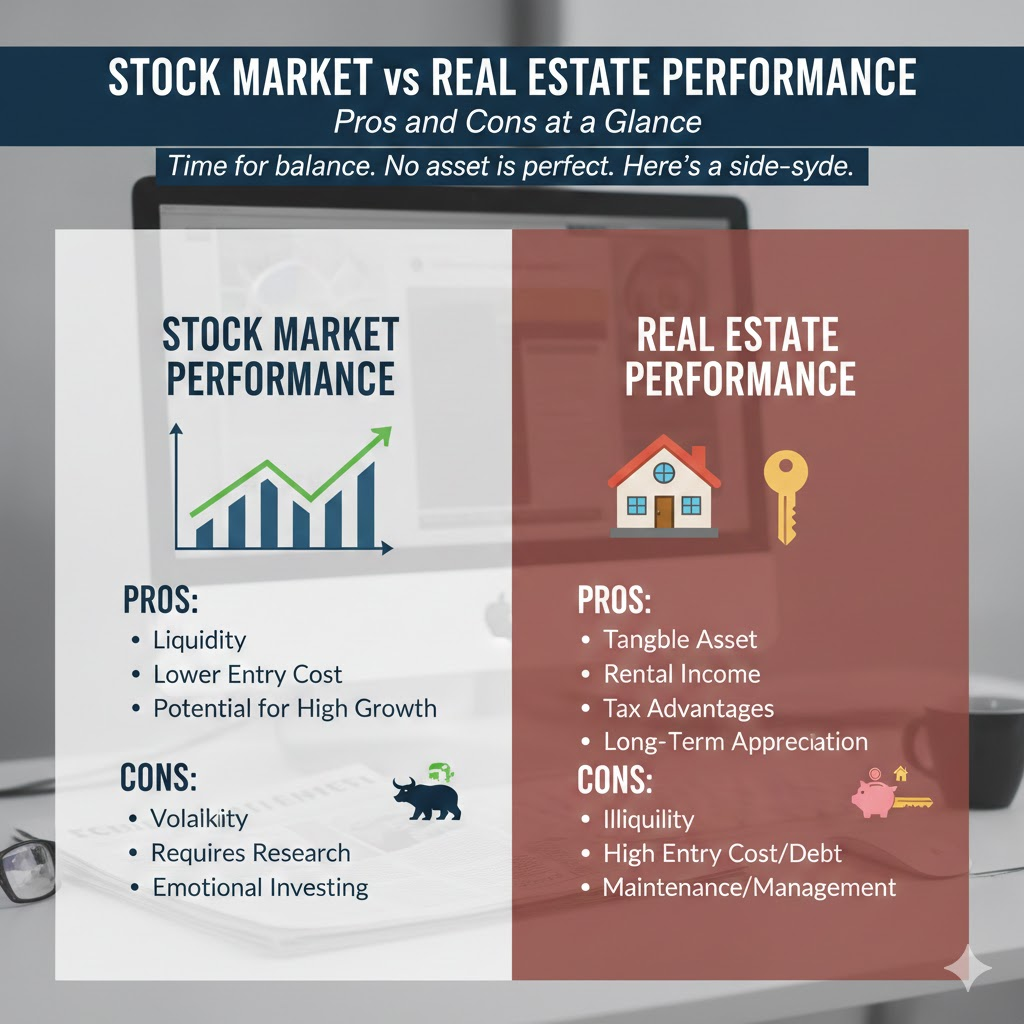
Stock Market vs Real Estate Performance: Pros and Cons at a Glance
Time for balance. No asset is perfect. Here’s a side-by-side.
Stocks: The Speedy Sprinter
Pros:
- Higher average returns: 10%+ long-term.
- Liquidity differences in assets: Sell anytime. Cash in days.
- Easy diversification. Buy global funds.
- Low costs. Index fees under 0.1%.
Cons:
- High volatility. 30% drops scare many.
- No control. Companies decide on dividends.
- Taxes on gains are yearly if you trade.
Real Estate: The Steady Marathoner
Pros:
- Stable growth. Less wild swings.
- Passive income through real estate vs stocks: Rents pay bills.
- Leverage boosts ROI. Borrow 80%, gain on 100%.
- Tax breaks. Deduct repairs, interest.
Cons:
- Illiquid. Selling takes months.
- High upfront cash. Plus ongoing fixes.
- Local risks. Bad tenants or zoning changes.
This asset class performance comparison shows trade-offs. Stocks suit busy pros. Real estate fits hands-on folks. Quote from expert Doug Kinsey: “Leverage in real estate can magnify returns dramatically.”
For individuals deciding between real estate vs stock investing, start small. Test stocks via apps like Vanguard. Try real estate with a single-family home. individuals deciding between real estate vs stock investing1
Risk and Volatility Comparison: Which Feels Safer?
Fear kills returns. So, measure risk. Real estate vs stock market risk and volatility breakdown starts with swings.
Risk and Volatility Comparison: Which Feels Safer?
Fear kills returns. So, measure risk. Real estate vs stock market risk and volatility breakdown starts with swings.

Stocks: Standard deviation of 15-20%. Means big yearly changes. 2022? Down 18%. 2023? Up 24%.
Real estate: 5-10% volatility. Home prices dip slowly. 2008 crash? 20% over two years. Rents keep flowing.
Which is safer for beginners — stocks or real estate investment? Stocks, if you pick funds. Spread risk across 500 companies. Real estate? Riskier solo. One bad property hurts.
But real estate protects downside. Banks can’t force sales if you pay rent. Housing is essential, always in demand.
Tip: Use volatility to buy low. Stocks crash? Scoop bargains. Real estate slumps? Negotiate deals.
In Western markets, regs add safety. The U.S. FDIC insures bank loans for homes. SEC watches stocks.
Leverage Benefits in Real Estate: The Secret Booster
Here’s real estate’s ace. How leverage affects real estate ROI vs stock investments. Borrow money. Invest big.
Example: $100,000 home. 20% down ($20,000). Loan $80,000 at 5%. Value rises 5% ($5,000 gain). Your ROI? 25% on your cash. Stocks? No easy borrow for most.
Leverage benefits in real estate amplify. Over 20 years, it turns 8% growth into 15% on equity. Stocks? Margin trading exists, but risky, calls if prices fall. Has Real Estate or the Stock Market Performed Better Historically2?
Downside? Debt stress. Rates rise, payments hurt. 2022 taught that.
For risk-conscious investors, cap leverage at 70%. Mix with stocks for a buffer.
In UAE-like Tier 2 markets, low rates (3-4%) sweeten deals. But U.S. data dominates our view.
Inflation-Adjusted Returns: Keeping Your Gains Real
Money loses value. Inflation averages 3% yearly. So, chase real growth.
Inflation-adjusted returns for stocks: 7% since 1992. Real estate? Matches inflation closely, 3-4% after adjustments.
Why? Rents rise with costs. Home values, too. Stocks? Earnings beat CPI.
In high-inflation eras like the 1970s, real estate won. Goldilocks times? Stocks.
Real estate as an inflation hedge reassures. Fixed mortgage? Pay with cheaper dollars.
Action step: Track CPI yearly. Adjust rents or rebalance stocks.
REITs vs Stocks Returns: The Hybrid Path
Not all real estate needs hammers. Enter REITs vs stocks returns. Real Estate Investment Trusts trade like stocks. Own malls, offices—diversified.
Historically, REITs have averaged 11.8% since 1972. Beat S&P’s 10.6%. Real estate vs REIT portfolio return comparison? Direct property edges on tax, but REITs win liquidity.
Pros: 4% dividends. Easy buy. No management.
Cons: Market swings like stocks.
For investors open to diversified portfolios, REITs bridge worlds. ETF like VNQ tracks them.
Example: $10,000 in REITs 2010-2024? Grew 200%+. Matches stocks.
Dividend vs Rental Cash Flow: Income Showdown
Want checks? Compare streams.
Dividend vs rental cash flow: Stocks yield 1-2%. S&P is at 1.3% now. Real estate? 4-6% net after costs.
But rental income returns compared to dividend returns favor real estate for volume. $200,000 property yields $10,000 yearly. Stocks need $500,000 for the same.
Taxes differ. Dividends qualify for lower rates. Rents? Ordinary income, but deduct expenses.
Capital gains vs rental income: Sell stocks? 15% tax. Sell home? Exclude $250K gains if primary.
Tip: Reinvest both. Compounding magic.
Portfolio Diversification Analysis
All eggs in one basket? Bad idea. The best diversification strategy, stocks and real estate combined, cuts volatility 20-30%.
How? 60% stocks, 40% real estate. Or via REITs for ease.
Benefits:
- Stocks grow fast.
- Real estate stabilizes.
- Together, beat inflation 8%.
Scenario: Retiree portfolio. Stocks for growth. Rentals for income. Sleep better.
In the U.S., tools like 401(k)s hold stocks. IRAs buy REITs. Tier 2? Local funds mimic.
Study tip: Backtest on sites like Portfolio Visualizer. See your mix shine. Investors are open to diversified portfolios3
Tax Implications: Real Estate vs Stock
Taxes eat gains. Know the rules.
Tax implications, real estate vs stocks:
- Stocks: Long-term gains 0-20%. Dividends are taxed yearly.
- Real estate: Deduct interest, depreciation. 1031 swaps defer gains. Primary home? Exclude big chunks.
U.S. favors both. But real estate wins deductions, $10K+ yearly, easily.
Tier 2 bonus: UAE? Zero taxes on either. Huge edge.
Pro tip: Use accountants. Max shelters like Roth IRAs for stocks.
Is Real Estate More Profitable Than Stocks Long Term?
Short answer: No, but close. Is real estate more profitable than stocks long-term? Stocks’ 10% vs. 8-9% says no. But with leverage and taxes, real estate ties or wins for some.
Data backs stocks for pure growth. Yet long-term wealth building: stocks or real estate, depends on you. Active? Real estate. Passive? Stocks.
Real Estate vs Stock Market: Actionable Tips for You
Ready to act? Here’s your playbook.
- Assess risk tolerance: High? Lean stocks. Low? Add real estate.
- Start small: Stocks via apps. Real estate via crowdfunding, like Fundrise.
- Track metrics: Use real estate ROI vs stock ROI yearly.
- Diversify early: 50/50 split minimum.
- Rebalance: Sell winners, buy laggards annually.
For people familiar with U.S. markets, follow Fed news. Rates hurt both, but real estate more.
Example: Sarah, 35, in Chicago. She put 70% in an S&P ETF 30% in a duplex. After 10 years, $150K grew to $350K. Balanced bliss.
FAQs
What is the average annual return of real estate investments vs the stock market?
Over many years, stocks have given about 10% per year. Real estate gives around 8% per year when you add rent and price growth together. So stocks usually win a little on average.
Historical performance comparison of the S&P 500 vs the housing market?
Over the last 50+ years, the S&P 500 grew faster than house prices. In some decades, houses did better, but stocks won most of the time. Stocks went up about twice as fast as home prices alone.
Rental income returns compared to dividend returns?
Rental homes often pay 5–8% in rent each year. Stock dividends usually pay only 1–3%. So rentals give more yearly cash, but you have to fix toilets and find tenants!
How does leverage (borrowing money) affect real estate ROI vs stock investments?
When you borrow to buy a house, your real return on your own money can jump to 15% or even higher. With stocks, most people don’t borrow much, so returns stay around 10%. Leverage is the big reason many people get richer with real estate.
Stock market CAGR vs property appreciation CAGR?
Stocks (S&P 500) grew about 10% per year over the long run. Home prices alone grew only 4–5% per year. But when you add rental income, the total real estate return gets closer to stocks.
Conclusion
We covered it all. The stocks vs real estate average annual returns comparison shows stocks leading at 10% vs. 8-9% for real estate. Yet factors like leverage, stability, and taxes make it a tie for many. Long-term investors evaluating asset allocation thrive by blending both. Diversify. Stay patient. Compound your wins.
In the U.S. and similar markets, data proves: Consistent investing beats timing. You now have tools, stats, tips, and trade-offs to choose wisely.