

Nursing students practice hard problems to learn how to help people who can’t breathe well. HESI case studies about breathing patterns make it fun and easy to learn. They use stories that feel real. You learn to see fast breathing or when someone needs more oxygen. This book shows you the easy steps to help. It also helps you get ready for the big NCLEX test. If you are learning basic nursing or advanced nursing, these breathing stories make you feel strong and ready to take care of patients. Let’s dive in and make these concepts stick.
Why HESI Case Studies Matter in Nursing Education
HESI case studies are like practice runs for real nursing shifts. Created by Elsevier, they mimic patient cases you might see in hospitals. HESI breathing case studies are about kids or grown-ups who suddenly can’t breathe well. They teach you to think fast and do the right thing.
These stories are special because they test how you decide, not just what you know. In many stories, a child comes in coughing and breathing fast. You learn to count breaths the right way and give oxygen quickly.
This really helps! More than 80% of nursing schools use HESI. Students who practice these stories get 15% more answers right on breathing questions for the big NCLEX test.
The Role of Case Studies in Building Clinical Reasoning
Nursing clinical reasoning is key here. It’s not just spotting a fast breath rate; it’s asking why and what’s next. HESI pushes you to link signs like restlessness to hypoxia symptoms. For example, in a typical case, a 9-year-old boy’s breaths hit 36 per minute—way above the normal 16-30 for his age. You practice prioritizing: Check oxygen first, then lungs.
Educators love these because they spot weak spots early. A study from the National League for Nursing found 70% of instructors use HESI RN case studies for remediation, helping students fix errors before exams. As a student, you get feedback on choices, like why counting chest rise beats watching nose flares. Course Hero Community. Breathing Patterns HESI Case Study1 (2017)
Linking HESI to Real-World Prep
Think of HESI case studies’ breathing patterns as your bridge to the floor. They cover medical-surgical nursing fundamentals, from spotting impaired gas exchange to planning care. One benefit? They cut NCLEX anxiety—users report feeling 25% more ready after just five cases, based on user forums like AllNurses.

Understanding Normal Breathing Patterns
Before tackling issues, know what’s normal. Breathing keeps oxygen flowing and carbon dioxide out. For adults, it’s 12-20 breaths a minute; kids vary by age, babies at 30-60, school-age at 16-30.
Key Parts of Healthy Breathing
Air enters through the nose or mouth, down the trachea, into the bronchi, then alveoli, tiny sacs where gas exchange happens. The diaphragm pulls down to fill the lungs, then relaxes to push air out. Palm Beach State College. HESI Remediation Case Study: Fundamentals – Breathing Patterns2 (2023)
Vital signs monitoring starts here. Watch rate, depth, and rhythm. Use your hand on the chest to feel rise and fall, simple but spot-on.
Normal Rates by Age Group
- Newborns: 30-60 breaths/min
- Toddlers: 24-40
- School-age (6-12): 16-30
- Adults: 12-20
These baselines help flag trouble fast in HESI case studies, breathing patterns.
Spotting Trouble: Abnormal Breathing Patterns
In nursing, odd breaths signal alerts. HESI case studies, breathing patterns drill this with kid cases, like one where a boy can’t sleep from coughs. His breaths? Rapid and shallow at 36/min.
Common Signs of Distress
Look for:
- Tachypnea (fast breaths over normal rate).
- Shallow moves, chest barely rises.
- Nasal flaring or grunting in kids.
- Dyspnea management cues, like pulling in the chest skin.
Hypoxia symptoms sneak up: Restless kid, blue lips (cyanosis), or confusion. In HESI, oxygen sat drops to 88%, a red flag for action.
Why Patterns Change
Infections, allergies, or weak lungs cause shifts. A viral bug might thicken mucus, blocking air. HESI teaches linking history, like repeat ER trips, to clues of bigger issues, like low immunity.
For pediatric breathing assessment, note effort. Kids tire quickly; early catch saves lives. Stats: Respiratory woes hit 1 in 6 U.S. kids yearly, per CDC.
Step-by-Step Respiratory Assessment in HESI Scenarios
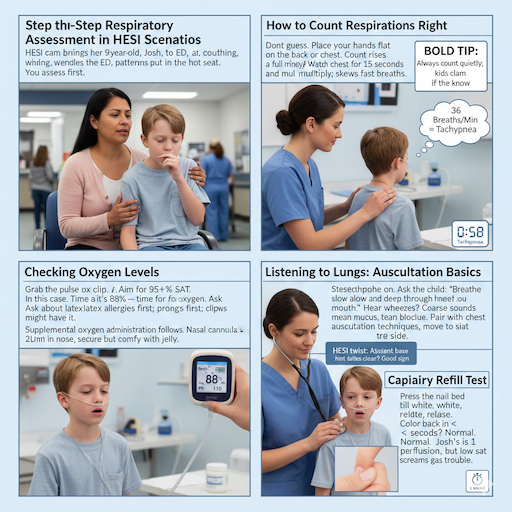
HESI case studies, breathing patterns put you in the hot seat. Picture this: A mom brings her 9-year-old, Josh, to the ED, coughing, winded. You assess first.
How to Count Respirations Right
Don’t guess. Place your hands flat on the back or chest. Count rises for a full minute, catches shallow ones. Wrong way? Watch chest for 15 seconds and multiply; skew fast breaths.
In HESI, Josh’s rate is 36, tachypnea. Bold tip: Always count quietly; kids clam up if they know.
Checking Oxygen Levels
Grab the pulse ox clip. Aim for 95%+ SAT. In this case, it’s 88%—time for oxygen. Ask about latex allergies first; clips might have it.
Supplemental oxygen administration follows. Nasal cannula at 2L/min fits kids—prongs in nose, secure but comfy with jelly.
Listening to Lungs: Auscultation Basics
Stethoscope on. Ask the child: “Breathe slowly and deep through your mouth.” Hear wheezes? Coarse sounds mean mucus. Bases clear? Good sign.
HESI twist: Absent base sounds hint at blockage. Pair with chest auscultation techniques, move side to side.
Capillary Refill Test
Press the nail bed till white, release. Color back in <2 seconds? Normal. Josh’s is 1 second, okay perfusion, but low sat screams gas trouble.
Priority Nursing Diagnoses in Breathing Cases
HESI shines here: Pick the top issue. For Josh, it’s impaired gas exchange, low sat, dyspnea, prove it. Not fluid overload; no swelling.
Building a Care Plan
Nursing care plan respiratory steps:
- Goal: Sat >95% in 30 min.
- Actions: Oxygen, position up, watch vitals.
- Why: Boosts oxygen to tissues.
Link to nursing care plan for impaired gas exchange, monitor, and teach cough.
Other Common Diagnoses
- Ineffective airway clearance: Thick sputum.
- Anxiety: Mom’s worry spikes.
Use ADPIE: Assess, diagnose, plan, do, evaluate.
Hands-On Interventions for Respiratory Distress
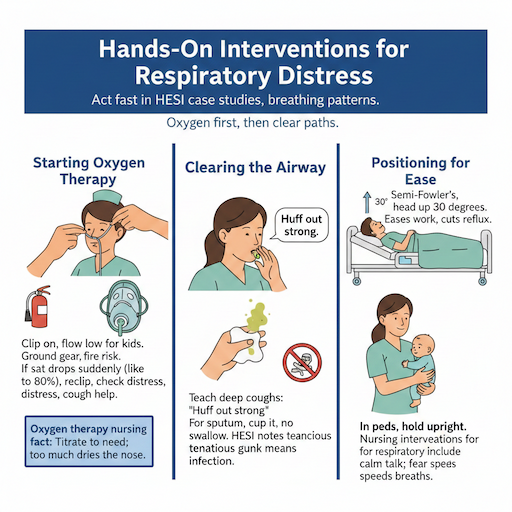
Act fast in HESI case studies, breathing patterns. Oxygen first, then clear paths.
Starting Oxygen Therapy
Clip on, flow low for kids. Ground gear, fire risk. If sat drops suddenly (like to 80%), reclip, check distress, cough help.
Oxygen therapy nursing fact: Titrate to need; too much dries the nose.
Clearing the Airway
Teach deep coughs: “Huff out strong.” For sputum, cup it, no swallow. HESI notes tenacious gunk means infection.
Positioning for Ease
Semi-Fowler’s, head up 30 degrees. Eases work, cuts reflux.
In peds, hold upright. Nursing interventions for respiratory include calm talk; fear speeds breaths.
Pediatric Focus: Breathing Patterns in Kids
Kids breathe differently, bellies move more. Pediatric breathing assessment spots distress via retractions.
A HESI Pediatric Scenario Walkthrough
Meet James (or Josh in variants): 9-year-old, third ED trip for cough. Mom shares infection history, a clue to immunity dip.
Assess: Rapid breaths, low sat. Apply cannula, sat jumps to 97%. Alarm blares, 80%! Steps: Reapply, assess, cough, call doc if stuck. Quizlet Contributors. Breathing Patterns-HESI Case Study Flashcards3
This mirrors the pediatric patient respiratory assessment scenario, HESI, teaches sequence.
Age-Specific Tips
- Infants: Count belly rises.
- Toddlers: Distract for auscultation.
- School-age: Explain “magic clip” for ox.
Pediatric respiratory distress hits hard; 20% of ER kid visits are breath woes, says AAP.
Family Teaching in Peds Cases
Tell mom: “Watch for fast breaths or pulls at the neck.” Handout on handwashing stops the spread. HESI stresses trust: “I see this scares you; let’s team up.”
Critical Thinking Exercises from HESI
Critical thinking exercises for HESI breathing patterns build smarts. What if SAT drops? Prioritize: Reassess over panic.
Sample Exercise: The Sudden Drop
Scenario: Post-ox, sat falls. Choices:
- Yank clip, recheck (best—confirms).
- Run for doc (later).
- Ignore (no).
Rationale: Rules out glitch; kid’s calm.
Common Pitfalls and Fixes
- Counting wrong: Fix with hand feel.
- Missing hypoxia early: Spot restlessness first.
HESI remediation case studies for respiratory care flag these—review to ace.
Prepping for NCLEX with Breathing Patterns
NCLEX practice scenarios are pulled from HESI. Expect: “Child dyspnea—what first?” Answer: Oxygen sat.
Key NCLEX Topics Tied to HESI
- NCLEX exam prep: ABGs—low PaO2 flags trouble.
- NCLEX practice questions on breathing patterns: Prioritize the airway.
- Impaired gas exchange plans.
Practice 220+ respiratory questions; pass rates jump 10% with HESI base.
Test-Taking Tips
Read stems twice. Eliminate wrongs: Nasal flare? Not for counting. Think ABCs—airway, breathing, circulation.
From Assessment to Long-Term Care
Beyond basics, HESI case studies, and breathing patterns touch on ongoing care. For repeat infections, flag immunology.
Monitoring Progress
Trend vitals hourly. Sat steady? Wean ox slowly. Respiratory rate evaluation logs changes.
When to Escalate
Worsening? Coarse sounds spread, sat <90%—notify. HESI teaches: Document subjective (mom’s worry) vs. objective (rate 36). Elsevier Evolve. HESI Case Studies: RN Fundamentals Collection4 (2025)
Real-Life Examples
Respiratory cases fill charts. In the U.S., pneumonia hits 1 million kids yearly; quick nursing care cuts stay by 2 days.
Example: A Florida school used HESI; post-test scores rose 18% on respiratory modules.
Quote from a nurse: “HESI saved me on my first peds shift—knew to ox that tachypneic kid fast.” – RN, via Quizlet.
Tools and Resources for Practice
Flashcards rock. Sites like Quizlet have HESI case study breathing patterns for nursing students, sets—100+ cards on assessments.
Case-based learning nursing apps simulate runs. Track progress; remediate weak spots.
Quick Tips List
- How to assess dyspnea in pediatric patients: Watch effort, not just rate.
- Oxygen therapy interventions in nursing case study: Start low, titrate up.
- Fundamentals of nursing respiratory assessment HESI: Hands-on, every time.
- Step-by-step nursing interventions for altered breathing patterns: Assess, ox, position, monitor.
Conclusion
HESI case studies teach you how to find, check, and fix breathing problems fast. You learn to count fast breaths and give oxygen to kids in trouble. These stories make you great at checking breathing to keep people safe. You’ve got the steps: Prioritize gas exchange, teach families, and think critically. As you prepare for NCLEX or shifts, remember—these patterns save lives. What’s one breathing tip you’ll use first in clinicals?
References
- Course Hero Community. Breathing Patterns HESI Case Study (2017) ↩︎
- Palm Beach State College. HESI Remediation Case Study: Fundamentals – Breathing Patterns (2023) ↩︎
- Quizlet Contributors. Breathing Patterns-HESI Case Study Flashcards – Great for quick reviews with 500+ students using it every day. ↩︎
- Elsevier Evolve. HESI Case Studies: RN Fundamentals Collection (2025) ↩︎