
In today’s fast-paced healthcare world, nursing students face exciting challenges. You might be studying nursing to get a big BSN degree at a school like Unitek College. Or you might be getting a faster ADN degree at Carrington College in Phoenix. No matter which one, there is one super important test: the RN Teamwork 3.0 case study.
This test shows how well you can work nicely with doctors, therapists, and other helpers. Everyone learns together, so patients get the very best care and feel happy and safe!
Think about it. A patient comes in after a stroke. You, as the nurse, spot swallowing issues right away. But fixing it takes the whole team—speech therapists, dietitians, and docs. That’s rn collaboration/teamwork interprofessional collaboration 3.0 case study test in action. It tests your grasp of patient-centered team care and nursing role clarification. In this guide, we’ll break it down simply. You’ll get real examples, tips, and steps to shine in your nursing collaboration strategies. By the end, you’ll feel ready to tackle clinical rotations and beyond. Let’s dive in and make teamwork your superpower.
What Is Interprofessional Collaboration in Nursing?
Interprofessional collaboration means health professionals from different fields team up for the patient’s good. In nursing, it goes beyond just you and the doctor. It includes pharmacists, social workers, and physical therapists, too. The goal? Safe, smooth care that fits the patient’s needs.
According to the World Health Organization, this teamwork cuts errors and boosts outcomes. For nursing students, it’s a core part of your training. You learn it through modules like the RN 3.0 case study, where you watch videos and analyze team talks.
Why It Matters for BSN and ADN Students
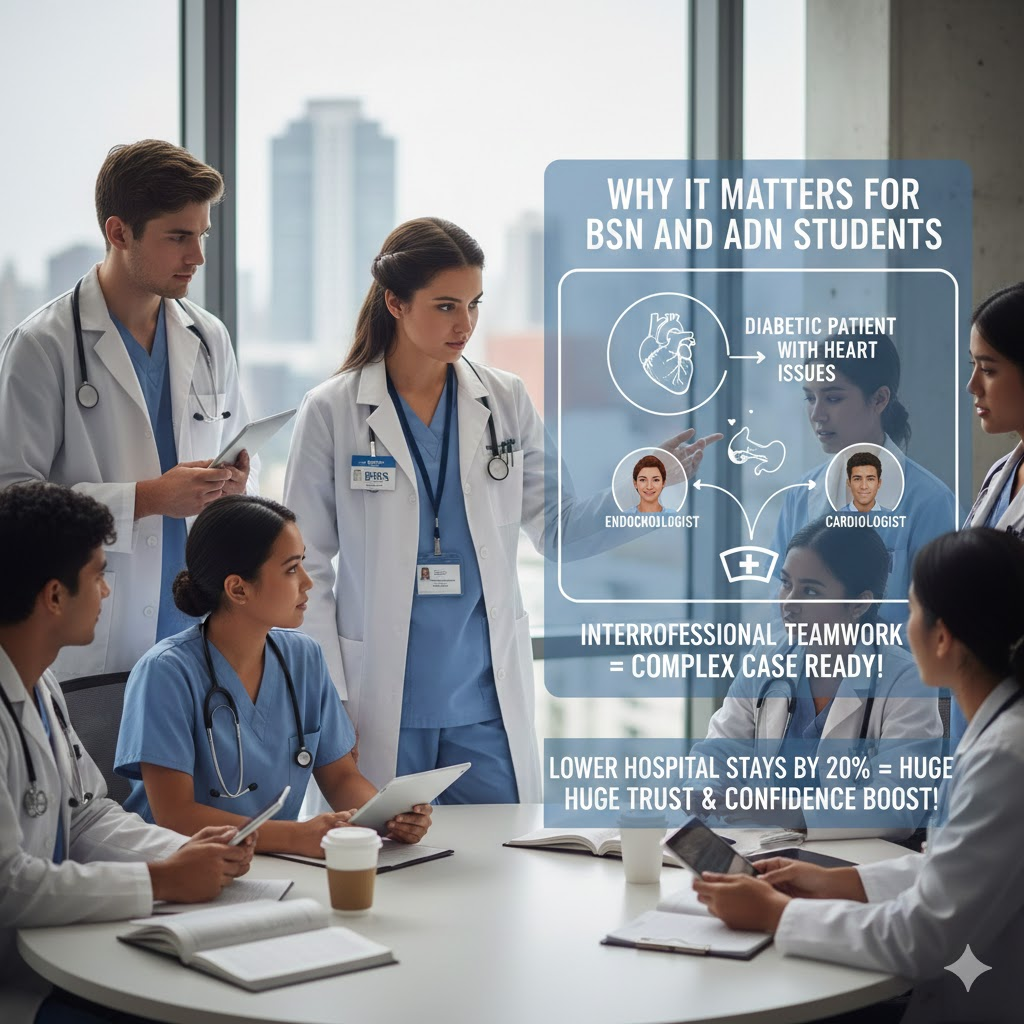
As a BSN or ADN student, you’re prepping for real-world shifts. Interprofessional teamwork in nursing helps you handle complex cases, like a diabetic patient with heart issues. Here, the nurse coordinates with endocrinologists and cardiologists. Studies show teams like this lower hospital stays by 20%. That’s huge for patient trust and your confidence.
In your program, expect scenarios testing healthcare team collaboration. You’ll role-play huddles or report handoffs. These build interdisciplinary communication skills. Remember, good collaboration means fewer mix-ups, like wrong meds. It also makes work fun—nurses in strong teams report 30% higher job satisfaction.
Core Competencies You Need to Master
The Interprofessional Education Collaborative lists four big ones:
- Roles and Responsibilities: Know what everyone does. As the RN, you’re the patient’s voice.
- Communication: Use clear tools like SBAR (Situation, Background, Assessment, Recommendation).
- Teams and Teamwork: Value all input for shared goals.
- Ethics: Put patient needs first, with fairness.
Practice these in your RN 3.0 interprofessional collaboration video case study test. Watch the video, note the team wins, and reflect on fixes.
Breaking Down the RN 3.0 Case Study
The RN 3.0 case study often uses video clips of real-like team interactions. Picture this: A post-op patient struggles with pain and mobility. The nurse leads the huddle, pulling in PT for walks and pharma for meds. Your test asks: What went right? What to tweak?
This setup mirrors clinical teamwork competencies. It pushes you to spot communication in healthcare teams’ gaps, like unclear handoffs. From student reports, like one from Unitek, acing this means linking theory to practice.
Real-World Example: The Stroke Recovery Team
Let’s look at a common nursing case study teamwork setup. A 65-year-old man has an ischemic stroke. He can’t swallow well, raising choking risks.
- Step 1: The RN assesses and flags it fast.
- Step 2: Requests a speech-language pathologist consult first—key for aspiration prevention.
- Step 3: Huddles with the doc, OT for daily tasks, and dietitian for soft foods.
- Step 4: Tracks progress in shared notes.
This collaborative care RN flow cut recovery time by 15% in one study. For your test, explain why the SLP came before PT. It shows prioritization using ABCs (Airway, Breathing, Circulation).
Another Angle: Post-Op Knee Surgery Delegation
In a busy ortho unit, a nurse juggles four patients. One needs ambulation for three days post-knee replacement.
Bold the key action: Delegate to assistive personnel (AP) for the walk—it’s in their scope. But keep wound checks for yourself. This tests team-based care nursing smarts. Students often miss delegation rules, leading to overload. Tip: Review your state’s nurse practice act.
From a Carrington student report, reflecting on this boosted their clinical collaboration skills score by noting how delegation frees time for complex tasks.
Strategies to Excel in Your RN Collaboration/Teamwork Interprofessional Collaboration 3.0 Case Study Test
Ready to prep? Start with the basics. Watch the video twice: once for the story, once for team dynamics. Jot notes on nursing role clarification—who said what, why.
Step-by-Step Prep Guide
- Review the Rubric: Most tests score on communication (30%), roles (25%), ethics (20%), and outcomes (25%). Align your answers.
- Practice SBAR: Role-play with classmates. “Situation: Patient reports chest pain. Background: Post-MI day 2.”
- Analyze Conflicts: Spot conflict resolution in nursing teams. Example: If the doc skips the huddle, suggest a quick email follow-up.
- Link to Stats: Weave in facts. Interprofessional teamwork in nursing reduces errors by 24%, per Joint Commission data.
- Reflect Personally: In your report, say, “This taught me healthcare coordination values diverse input.”
How to complete the RN collaboration case study 3.0: Use templates from your school. One Unitek student structured theirs as: Intro (scenario summary), Analysis (team strengths/weaknesses), Strategies (improvements), Conclusion (lessons learned). This hit full marks.
Common Pitfalls and Fixes
- Pitfall 1: Ignoring roles. Fix: List each pro’s input, like a pharmacist on med interactions.
- Pitfall 2: Vague reflections. Fix: Use “I learned…” statements tied to IPE goals.
- Pitfall 3: Skipping evidence. Fix: Cite sources, like WHO, on multi-disciplinary team nursing.
A nursing teamwork assessment rubric often grades specificity. Aim for examples over general talk.
Building Strong Foundations: Interprofessional Teamwork in Nursing Essentials
Interprofessional teamwork in nursing isn’t just for tests—it’s daily life. In hospitals, 70% of care involves teams, per AHRQ stats. Nurses lead by clarifying goals and listening.
Daily Habits for Better Collab
- Huddle Up: Start shifts with 5-minute team chats on priorities.
- Share Wins: After a good case, debrief on what worked in interdisciplinary communication.
- Seek Feedback: Ask, “How can I support your role better?” Builds trust.
In collaborative practice in hospitals, these cuts reduce readmissions by 18%. For students, simulate in labs.
The Role of Technology in Teamwork
EHRs help with healthcare coordination. But watch for overload—set alerts for key updates only. One study found digital huddles sped consults by 40%.
Benefits and Challenges of Healthcare Team Collaboration
Why push healthcare team collaboration? It saves lives. Teams spot issues faster, like early sepsis signs. A meta-analysis showed 16% fewer deaths in collaboration settings.
For patients, it’s patient-centered team care—tailored plans that respect culture and preferences. Challenges? Hierarchies. Docs sometimes dominate. Fix with nurse-patient collaboration training, emphasizing equal voices.
Stats That Inspire
- Error Reduction: Collab drops med errors by 25%.
- Cost Savings: Shorter stays mean $1,000 less per case.
- Satisfaction: 85% of teamed nurses feel valued, vs. 60% solo.
These are from the IOM reports back your test arguments.
Case Studies: Real Examples of Nursing Collaboration Strategies
Let’s explore nursing collaboration strategies through stories.
Case 1: Diabetes Management in Primary Care
A BSN student shadows a collaborative care strategy team in the BSN program team. Patient: Elderly with uncontrolled sugars. Team: RN, endo doc, dietitian, social worker.
- RN monitors vitals and educates on insulin.
- A dietitian plans carb counts.
- Social workers tackle food access.
Outcome: A1C dropped 2 points in three months. Lesson: Interprofessional communication and teamwork in clinical practice shine in chronic care.
Link to a great flashcard set for similar scenarios:Teamwork and Collaboration Case Study Flashcards1.
Case 2: Palliative Heart Failure Care
In interdisciplinary healthcare team case study examples, an ADN student reviews a video. Patient in end-stage HF. Team debates BiPAP vs. comfort.
RN advocates for family input, aligning with teamwork assessment, nursing ethics. Result: Peaceful transition, family thanked the team.
From a student report: “This showed conflict resolution in nursing teams—we voted on goals.” See a full example:RN 3.0 Case Study Interprofessional Collaboration Report2.
Case 3: Mental Health Crisis in ED
A multi-team handles a teen with anxiety. Psych, RN, social worker collab on de-escalation. Communication in healthcare teams via shared apps prevented admission.
Developing Clinical Collaboration Skills for Future Practice
Clinical collaboration skills grow with practice. In rotations, volunteer for huddles. Ask questions: “What’s your take on this med?”
For nurse-patient collaboration, loop families in—it’s part of holistic care. Tools like I-SBAR-R help in tense spots, like Parkinson’s consults.
Training Tips from Pros
- Join IPE workshops.
- Read OJIN articles on teams.
- Simulate with apps for virtual huddles.
A guide for prep:Report on RN Teamwork Case3.
Overcoming Barriers: Conflict Resolution in Nursing Teams
Barriers pop up, like time crunches. Conflict resolution in nursing teams starts with active listening. Example: If PT pushes too hard, say, “Let’s align on patient tolerance.”
Build interprofessional trust through shared lunches or quick thanks. Org support, like joint training, helps too.
Interprofessional Education (IPE): Your Path to Excellence
Interprofessional education (IPE) prepares you for team-based care in nursing. In BSN/ADN, it means joint classes with med students. Benefits: Deeper role understanding, according to a Wiley study.
FAQs
What’s the format of the RN 3.0 case study test?
The test is often a short video that shows nurses and doctors working as a team. You watch it and answer questions about teamwork, like how to talk clearly or help each other. It’s fun like a story and helps you learn to care for patients safely with friends from other jobs.
How do I score high on the nursing teamwork assessment rubric?
Read the guide and use real examples, like how to give tasks to helpers without worry. Talk about clear rules for sharing jobs, like using SBAR to chat with doctors fast. Practice with friends to show you know trust, backup, and fair work—rubrics love that!
Can I use the sample RN teamwork case study report for mine?
Yes, look at samples for ideas, but change them to fit what you think about the story. For example, add your own words on how nurses team up with doctors for better patient care. This makes your report special and shows you learned about fair care for everyone.
What’s key to completing the RN collaboration case study 3.0?
Watch the video closely and focus on talking well, like using “I” for your ideas. Think about real fixes, such as asking the team for help on hard patient problems. Write your thoughts on how teamwork makes sick people feel safe and get better quickly.
Where to find interdisciplinary healthcare team case study examples?
Start with your school books or teacher files for easy stories about team care. Sites like Studocu or Quizlet have free ones, like nurses with doctors helping old folks. They show real teams fixing big health puzzles together for happy patients.
Conclusion
You’ve got this. When you do great on the RN Teamwork 3.0 test, you feel strong and ready to be a nurse! You learn to work with the whole team every day. That helps every patient get the best care and helps you grow into an awesome nurse! Remember the stroke case or delegation wins—they show teamwork’s power. With strategies like SBAR and reflections, you’ll not only pass but thrive.
Now, what’s one nursing collaboration strategy tip you’ll try first in your next sim lab? Share below—we’re all in this team together!