

In the world of buying and selling investments, there are special rules about who is called an “accredited investor.” These rules come from a set called National Instrument 45-106, or NI 45-106 for short. They started in January 2021, and a group called the Ontario Securities Commission (OSC) watches over them.
What do these rules do? They let companies sell shares or other investments without writing a very long and hard paper called a prospectus. A prospectus is like a big book that explains every single detail about the investment. But if the company only sells to accredited investors, they do not have to make that big book.
Who counts as an accredited investor? These are people or groups who have a lot of money saved up, make a lot of money every year, or really understand how investments work. The rules say these people know enough about the risks, so they do not need as much help and protection from the government.
Why do these rules matter? Companies, like new startups, can raise money faster and easier from the right people. Lawyers who help with investments use these rules every day to keep things legal. Investors check if they fit the rules so they can buy these special investments.
Understanding National Instrument 45-106
National Instrument 45-106, or NI 45-106, governs prospectus exemptions across Canada. It lets companies sell securities without the cost and time of a public offering. The OSC enforces it in Ontario, focusing on investor protection and market fairness.
NI 45-106 covers various exemptions, but the accredited investor one stands out. It assumes these investors have the knowledge or wealth to handle risks. They don’t need the same disclosures as retail buyers.
Regulators update NI 45-106 to match market changes. In January 2021, a key report from the Capital Markets Modernisation Taskforce suggested expansions. This aimed to include more people with business smarts, not just high wealth.
Exempt market securities Canada thrive under these rules. In 2019, over 90% of the exempt capital raised used the accredited investor path. This shows its importance for private companies and funds.
Securities lawyers advise clients to verify status before deals. Wrong classification can lead to fines or voided sales. Compliance officers track updates to keep firms safe.
Key Principles of Prospectus Exemptions
Prospectus exemptions let issuers skip detailed filings. They rely on buyer sophistication. NI 45-106 lists who qualifies, from individuals to institutions.
The instrument applies nationwide but with provincial tweaks. In Ontario, some entity categories differ. For example, banks and governments must qualify differently.
Issuers file reports after sales, like Form 45-106F1. This tracks exempt distributions and ensures transparency.
Private placement investor requirements demand proof of status. Investors sign forms acknowledging risks. This step reassures everyone involved.
Regulatory bodies like the OSC review these to spot issues. They issue guidance through companion policies, explaining how to apply rules.
Who Benefits from These Definitions?
This information serves several groups. Securities lawyers use it to draft opinions and advise on deals. They break down thresholds for clients.
Regulatory compliance officers build internal checks. They train teams on NI 45-106 exemptions to avoid errors.
Legal analysts in financial services research trends. They compare Ontario rules to other provinces.
Startups and private companies raise funds through exempt offerings. Founders learn accredited investor criteria Ontario to target buyers.
Investment fund managers select investors carefully. They ensure funds meet exempt market offering rules.
High-net-worth individuals evaluate their status. They seek private deals with higher returns but more risk.
Financial advisors explain options to clients. They highlight income and asset thresholds for investors.
Wealth managers’ guide on investor eligibility NI 45-106. They help build portfolios using exempt securities.
Accredited Investor Definition Ontario NI 45-106 January 2021
The accredited investor definition Ontario NI 45-106 January 2021 appears in section 1.1 of the instrument. It includes people and entities able to assess investments without full prospectus protection.
For individuals, four main tests apply:
- Financial assets test: You own financial assets worth more than $1 million before taxes, net of related debts. This includes cash, securities, and insurance. Count your spouse’s assets as one unit.
- High financial assets test: Your financial assets top $5 million alone, without spousal combination.
- Income test: Your net income exceeded $200,000 in the last two years, or $300,000 with your spouse. Expect the same this year.
- Net assets test: Your net assets hit $5 million, alone or with spouse. Include your home’s value minus mortgage.
These thresholds act as bright lines. Meet them exactly at purchase time.
Entities qualify differently. A corporation needs $5 million in net assets per recent financials. Banks, governments, and pension funds often fit, but Ontario excludes some.
The definition assumes these investors understand risks. They access deals not open to everyone.
In January 2021, the Taskforce report pushed for changes. It recommended adding people with finance credentials, leading to self-certified categories later.
Link to official details on the OSC website for full text.
Criteria for Individual Accredited Investors
Individuals must prove sophistication through wealth or income. Regulators set these to filter capable buyers.
Break it down:
- Gather documents: Collect bank statements, tax returns, or appraisals.
- Calculate financial assets: Add cash, stocks, and bonds. Subtract debts tied to them. Exclude home or cars.
- Check income: Review the last two years’ taxes. Project the current year reasonably.
- Assess net assets: List all assets minus all liabilities. Fair market value counts.
- Involve spouse if needed: Combine for some tests to qualify more easily.
High-net-worth individual definition ties to these numbers. Over $1 million in liquid assets or $5 million total nets you in.
Examples help. A tech executive earning $250,000 yearly qualifies via income. A retired couple with $6 million in property and investments meets net assets.
Advisors verify this before deals. They use questionnaires to confirm.
Accredited investor rules Canada align provinces, but Ontario adds risk forms for individuals.
Entity Qualifications Under NI 45-106
Entities like companies or trusts have their paths.
Key categories:
- Corporations with $5 million net assets.
- Financial institutions or banks (but not always in Ontario).
- Pension funds are regulated federally.
- Trusts set by accredited investors for family.
- Investment funds advised by registered pros.
Ontario skips some bank and government slots. They must use other criteria.
For example, a private equity firm qualifies if all owners are accredited.
Private capital raising regulations require issuers to check entity status. Review financials or charters.
This broadens the pool for exempt sales. Funds raised from institutions without prospectus hassles. Venture Law Corporation – Accredited Investor Definition Canada1
Ontario-Specific Applications and Differences
Ontario tailors NI 45-106 through the OSC. It emphasises investor protection.
Differences include:
- Excluded entities: Banks and governments can’t use certain paragraphs.
- Risk acknowledgements: Form 45-106F9 is mandatory for individual tests.
- Self-certified option: Born from 2021 recommendations, it adds an education-based entry.
Ontario Securities Commission updates often lead Canada. The OSC reviews distributions closely2.
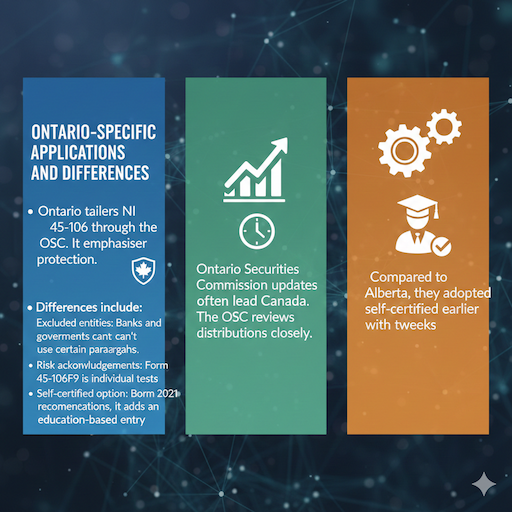
Compared to Alberta, they adopted self-certified earlier with tweaks.
Securities regulatory compliance Ontario demands accurate filings. Miss them, face penalties.
Lawyers navigate these nuances. They ensure Ontario deals follow local twists.
The January 2021 Taskforce Recommendations
January 2021 marked a shift. The Capital Markets Modernisation Taskforce released its report. It noted 90.5% of the 2019 exempt raises used accredited paths.
Recommendations:
- Expand to include pros with credentials like CFA or CSC.
- Based on knowledge, not just wealth.
This addressed gaps. Many educated investors missed financial cuts.
The OSC acted later with Instrument 45-507 in 2022. It created a self-certified investor Ontario.
Qualify by:
- Holding a degree like an MBA in finance.
- Passing exams like the Canadian Securities Course.
- Signing risk forms.
Cap at $30,000 yearly per investor.
This update reassures issuers. It widens pools safely.
See theStikeman Elliott analysis for expert views3.
Self-Certified Investor Exemption Explained
Self-certified investor exemption Ontario explained stems from 2021 ideas. It lets non-wealthy but knowledgeable people invest.
Criteria include 16 qualifications:
- CFA Charter.
- CPA designation.
- Finance degrees.
- Business valuation certs.
Sign a confirmation and risk acknowledgement. Issuers benefit: More buyers for exempt offerings. Investors gain access to private markets.
Differences from accredited:
- Knowledge over money.
- Annual cap.
- Ontario-only for now.
Differences between accredited investor and self-certified investor in Ontario matter. Accredited has no cap; self-certified does.
Advisors explain this to clients. It opens doors for mid-level pros.
Step-by-Step Guide to Qualifying as an Accredited Investor
Qualifying takes preparation. Follow these steps:
- Review definitions: Read NI 45-106 section 1.1.
- Assess finances: Calculate assets and income.
- Collect proof: Get statements and returns.
- Consult pros: Talk to lawyers or advisors.
- Sign forms: Acknowledge risks if needed.
- Update yearly: Re-check for ongoing deals.
A step-by-step guide to accredited investor status in Canada helps avoid mistakes.
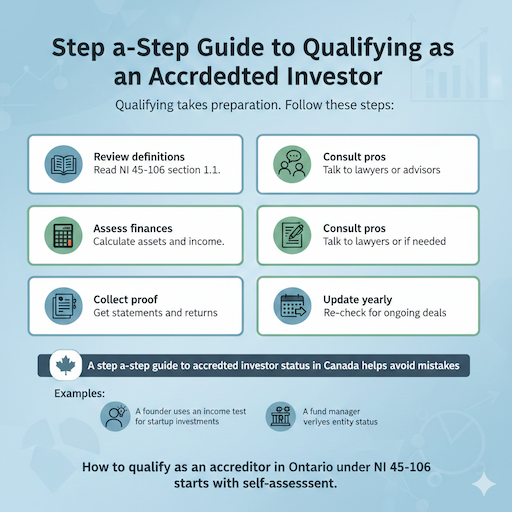
Examples: A founder uses an income test for startup investments. A fund manager verifies entity status.
How to qualify as an accredited investor in Ontario under NI 45-106 starts with self-assessment.
Legal Implications for Issuers and Capital Raisers
Issuers must verify buyers. Wrong steps lead to rescission rights. Exempt market offering eligibility criteria for investors in Ontario guide sales.
Startups raise seed rounds this way. They target accredited investors for efficiency. Private companies issue shares to employees or partners. Investment funds sell units to qualified buyers.
Private capital raising regulations require reports within 10 days. Compliance officers audit processes. They train sales teams. Penalties for breaches include fines up to $5 million. Reassuringly, proper checks protect everyone.
Advice for Prospective Investors
Investors check eligibility first. Investor eligibility NI 45-106 demands honesty. High-net-worth folks review thresholds yearly. Sophisticated investors seek private placements for growth.

OSC guidelines for accredited and self-certified investors provide clarity.
Tips:
- Diversify to manage risks.
- Read offering memos carefully.
- Consult advisors.
This path offers rewards but demands caution.
Role of Financial Professionals
Investment advisers interpret rules for clients. They explain income and asset thresholds for investors. Exempt market dealers facilitate deals. Wealth managers build exempt portfolios. They ensure compliance with OSC investor exemptions. Professionals reassure clients with expert guidance.
Common Challenges and Solutions
Challenges include proving assets. Solution: Use appraisers. Spousal combinations confuse. Clarify with lawyers. Updates like 2021 changes require staying informed. Subscribe to OSC alerts. Legal definition of accredited investor Ontario NI 45-106 evolves; track it.
Statistics on Exempt Market Activity
In Ontario, exempt distributions topped $100 billion yearly. Accredited path dominates, per OSC data. The 2021 report highlighted the need for inclusivity. This drives economic growth through private capital.
Examples from Real-World Applications
A Toronto startup raised $2 million from accredited angels. They verified via questionnaires. A hedge fund sold to institutions qualifying as entities. Self-certified pros joined post-update. These show practical use.
FAQs
What is the accredited investor definition in Ontario, NI 45-106 from January 2021?
In Ontario, the accredited investor rule comes from National Instrument 45-106. It says who counts as a smart or rich enough buyer to get special investments without extra paperwork. The January 2021 version lets people qualify by having lots of money, high income, or special knowledge about money stuff.
How do NI 45-106 exemptions work?
These rules let companies sell investments without making a big official paper called a prospectus. They only sell to people who are seen as smart or wealthy enough to understand the risks. This makes it faster and easier for companies to raise money from the right buyers.
Who qualifies as a self-certified investor in Ontario?
A self-certified investor is someone who knows a lot about finance because of their job or training. They can prove it with special degrees, licenses, or work experience in investments. They must sign a form saying they understand the big risks and do not need extra protection.
What are the income and asset thresholds?
You can qualify if you make $200,000 a year by yourself or $300,000 with a spouse. Or you can have $1 million in financial things like stocks, bonds, or savings that you can sell fast. There is also a $5 million net worth option, but it must not count your house.
How has Ontario securities regulation 45-106 changed?
In 2021, they added a new way to qualify based on knowledge and experience. Before, it was mostly about how much money you had. Now, people with real finance skills can join as self-certified investors even if they do not have huge wealth.
Conclusion
The accredited investor definition Ontario NI 45-106 January 2021 provides a framework for safe private investments. It balances access with protection through clear criteria and updates like self-certified options. Legal pros, issuers, and investors all benefit from understanding these rules. Stay updated to comply and thrive in Canada’s markets.
What challenges have you faced in qualifying as an accredited investor?