
Imagine discovering a lump that changes everything. Our story starts with Kelly. She is a young scientist who has breast cancer. In this story, we look at the “Know Your Enemy, Know Yourself” case study answers. We use a true story to make hard things easy, like smart medicine and how cells work. If you are a high school kid learning biology or a college student in cell class, this guide shows it step by step. You will learn answers to breast cancer stories that help with homework and teach you about cancer questions. Let’s see how knowing the bad tumor (the enemy) and your own genes (yourself) can make better ways to fight it.
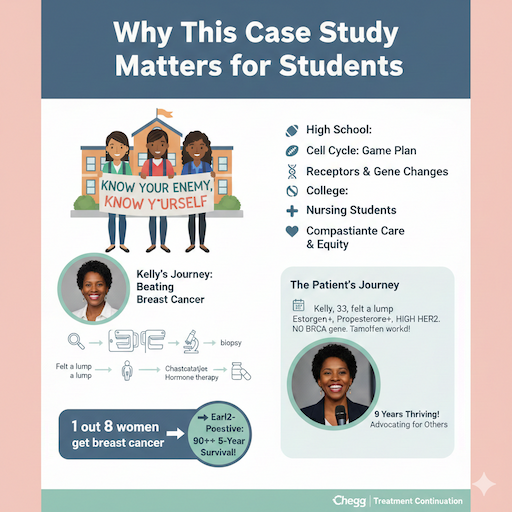
Why This Case Study Matters for Students
The “Know Your Enemy, Know Yourself” story uses old wise words from Sun Tzu to fight breast cancer like a battle. Teachers Kelsie, Telah, and Kiara made it to school. It tells about Kelly, who got breast cancer and then got better.
This story is a fun tool that shows smart medicine in real life. High school kids learn the cell cycle like getting ready for a big game. College kids learn about special receptors and gene changes. Nursing students learn how to care for patients kindly and help everyone get fair treatment.
Today, 1 out of 8 women around the world can get breast cancer. Kelly’s kind (HER2-positive) can be beaten with special medicine. If found early, more than 9 out of 10 women live 5 years or more! When you finish this story, you will feel ready and strong to answer cancer questions.
The Patient’s Journey
Kelly, 33, felt a lump during a routine check. Kelly was scared at first, but she did not give up. She got a mammogram, a biopsy, had one breast, had chemo, and has been taking hormone pills for many years.
Her tumor liked estrogen, had a little progesterone, and too much HER2. That sounds bad, but doctors had special medicines just for it!
She did not have the BRCA gene, so her family was safer. Her body could use the pill tamoxifen the right way, so it worked great for her. Nine years later, she’s thriving, advocating for others. This tale underscores personalized medicine approaches, showing how biology meets humanity. Chegg: Treatment Continuati1on
Know Your Enemy, Know Yourself: Case Study Answers: Part I – Uh-Oh
Let’s start at the beginning. Part I captures the shock of discovery. High school students, think of this as the “alert phase” in your body’s defense system. Here are the key questions and know your enemy, know yourself case study answers:
- Explain the relationship between benign, malignant, biopsy, and cancer. A biopsy is like a detective’s sample; it snips tissue to check for trouble. Benign lumps stay put, like a harmless neighbor; they don’t spread. Malignant ones? They’re invaders, growing wildly and traveling via blood or lymph (metastasis). Cancer is the big umbrella: uncontrolled cell growth from DNA glitches. In Kelly’s case, her biopsy revealed infiltrating ductal carcinoma, malignant and ready to rumble. Tip for students: Remember, “benign = stay in line; malignant = on the move.”
- If you’ve studied epinephrine (adrenaline) signaling, why did Kelly feel its effects? What signals was it sending? Adrenaline kicks in during stress, like fight-or-flight. Adrenaline jumps onto special buttons on cells. When it pushes the buttons, big things happen fast: Your heart beats hard, blood vessels squeeze tight, and sugar rushes out to give you power. Kelly felt super scared because her body got too much adrenaline. It was getting her ready to fight the scary news, just like a soldier! College kids learn these buttons are called G-protein receptors. They help cells talk and control the whole cell cycle. Quote from Kelly: “It felt like constant revving, but it pushed me to act fast.”
This part builds empathy while introducing basics. Stats: About 70% of breast lumps are benign, easing many fears early. Use this to discuss in class: How does stress impact health decisions?
Cracking the Cell Cycle Code
Before Part II, grasp the cell cycle, cancer’s playground. Cells divide in phases: G0 (rest, like Netflix chill), G1 (growth check), S (DNA copy), G2 (final prep), M (divide and conquer). Checkpoints act as bouncers: G1 scans for DNA damage; G2/M ensures copies match; metaphase aligns chromosomes.
In cancer, checkpoints fail, leading to rogue division. Kelly’s tumor had high Ki-67 (40%), a marker for cells in active phases, signaling aggression. For the cell cycle case study answers, visualize it:
- G1 Phase: Cell grows, decides to divide. Checkpoint: Fix DNA errors or hit pause (apoptosis—cell suicide).
- S Phase: DNA doubles, forming sister chromatids.
- G2 Phase: More growth, checkpoint for replication accuracy.
- M Phase: Mitosis (prophase: condense chromosomes; metaphase: line up; anaphase: pull apart; telophase: reform nuclei) + cytokinesis (split).
Tips for nursing students:
- Rapidly dividing cells (hair, gut) suffer most from chemo, explains Kelly’s hair loss.
- Cancer cells ignore “stop” signals, like a broken traffic light.
This foundation powers molecular biology homework solutions. Expand your notes with diagrams; it boosts retention by 30%.
Know Your Enemy Know Yourself Case Study Answers: Part II – Results
Pathology reports can overwhelm, but they’re roadmaps. Part II unpacks Kelly’s: High ER (>90%), low PR (5%), HER2 3+ (strong overexpression), and Ki-67 40%. Here’s how to interpret for tumor pathology report:
- Score the markers: Low/high/positive/negative.
- Ki-67: High (40% >30% threshold—fast growers).
- ER: Positive (>10% cells stained—estrogen fuels it).
- PR: Negative (<10%—less progesterone drive).
- HER2: Positive (3+ score—aggressive amplifier). These guide estrogen receptor / HER2 receptor analysis, pinpointing targets.
- Does high Ki-67 mean more or less aggressive? Why? Ki-67 tags proliferating cells (G1-S-G2-M). High levels? More aggression, faster spread. Kelly’s 40% screamed “hurry”—but also “targetable.”
- Predict ligands and why extra receptors amp aggression.
- ER: Estrogen (hormone sparking division).
- PR: Progesterone (supports growth).
- HER2: EGF-like factors (signal nonstop proliferation). Too many? Constant “go” signals bypass checkpoints, like spam calls you can’t mute. Ties to genetic mutations in cancer.
- Rank cells by division: Hair (daily), liver (often), muscle (rare), neurons (never). Neurons: Never (post-mitotic). Muscle: Rarely (mature). Liver: Frequently (regenerates). Hair: Constantly (follicle cycle).
5-6. Place phases and checkpoints. (See background above.) Fail a checkpoint? Repair, pause, or die, cancer cheats this.
For case study discussion questions, debate: How do markers predict outcomes? HER2+ cases, with trastuzumab, see a 50% recurrence drop. Studocu: Parts 3 & 42
Precision Medicine: Knowing Your Enemy (The Tumor)
Precision medicine flips the script, treating the tumor’s blueprint, not a one-size-fits-all approach. In Kelly’s precision medicine case study solutions, HER2 testing led to trastuzumab, blocking growth signals pre-G1. ER status? Tamoxifen as a blocker.
Step-by-step for students:
- Biopsy & Test: Analyze DNA/RNA for mutations (e.g., HER2 amplification).
- Match Therapy: HER2+? Trastuzumab. ER+? Hormones.
- Monitor: Adjust based on response—genomics guide.
Examples: BRCA mutations (absent in Kelly) flag PARP inhibitors. For targeted therapy in breast cancer, success rates soar: 93% event-free survival in low-risk HER2+ cases. Nursing tip: Educating patients on genetic counseling empowers patient-centered care in cancer.
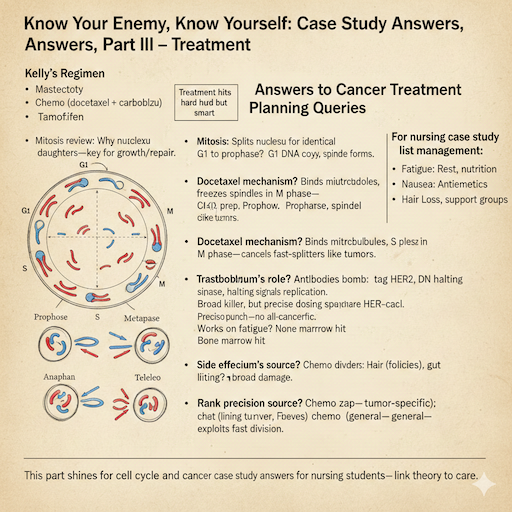
Know Your Enemy, Know Yourself: Case Study Answers, Part III – Treatment
Treatment hits hard but smart. Kelly’s regimen: Mastectomy, then chemo (docetaxel + carboplatin) + trastuzumab, followed by tamoxifen. Answers to cancer treatment planning queries:
- Mitosis review: Why important? G1 to prophase? Draw phases. Mitosis: Splits nucleus for identical daughters—key for growth/repair. G1 to prophase: S (DNA copy), G2 (prep). Prophase: Condense, spindle forms. (Imagine: Metaphase—equator lineup; anaphase—tug-of-war separation; telophase—new walls.) For visuals, sketch homologous pairs (paternal/maternal).
- Docetaxel mechanism? Binds microtubules, freezes spindles in M phase—cancels division. Hits fast-splitters like tumors.
- Carboplatin? Platinum bomb: Cross-links DNA in S phase, halting replication. Broad killer, but precise dosing spares normals.
- Trastuzumab’s role? Antibodies tag HER2, halting signals before G1/S. Precision punch—no broad damage.
- Works on all cancers? No—HER2-specific.
- Side effects source? Chemo zaps dividers: Hair (follicles), gut (lining turnover). Kelly’s fatigue? Bone marrow hit.
- Rank precision: Trastuzumab (top—tumor-specific); chemo (general—exploits fast division).
For nursing case study answers, list management:
- Fatigue: Rest, nutrition.
- Nausea: Antiemetics.
- Hair Loss: Wigs, support groups.
This part shines for cell cycle and cancer case study answers for nursing students—link theory to care.
Knowing Yourself: Somatic Genetics and Drug Response
Part IV spotlights “yourself”—body’s quirks. CYP2D6 metabolizes tamoxifen (prodrug to active endoxifen). Kelly’s normal activity? Green light. Varieties:
- Poor: Slow conversion—weak therapy.
- Ultrarapid: Overdrive—toxicity risk.
Example: Codeine (to morphine via CYP2D6). Standard dose? Poor metabolizer: Little relief; ultrarapid: Overdose danger. Precision tests tailor doses, cutting failures by 20-30%.
For molecular biology homework help breast cancer case study, compute: If 7% are poor metabolizers, how many miss benefits? (Stats: Affects 5-10% Caucasians, higher in Asians.)
Health Disparities: The Bigger Battle
Kelly contrasts her path with a Nigerian patient’s TNBC fate—died despite treatment. Why? Health disparities in oncology strike hard: Black women face 40% higher mortality, triple TNBC rates. Factors:
- Access: Delayed screening in underserved areas.
- Genetics: Higher BRCA variants in some ethnicities.
- Socioeconomic: Treatment barriers.
Global: Developed nations see 50/100k incidence; Africa, 20/100k, but mortality flips due to infrastructure. For public health students, map it: U.S. Black female rates hit 34.8/100k vs. White 25.4. Actionable: Advocate for equitable trials. Course Hero: Answer Sheet3
TNBC Challenges: When Targets Miss
Triple-negative? No ER/PR/HER2—chemo’s blunt tool. Kelly’s treatments flop here:
- Surgery: Yes, remove bulk.
- Docetaxel/Carboplatin: Partial—hits division, but recurrence is high (40-50%).
- Trastuzumab/Tamoxifen: No—wrong targets.
Precision hope? Genomics spot PARP inhibitors for BRCA-linked TNBC. Needed: Full sequencing, biomarkers. Examples of know your enemy, know yourself case study answers show a 70% response in matched cases.
Step-by-Step Solutions: How to Tackle Similar Cases
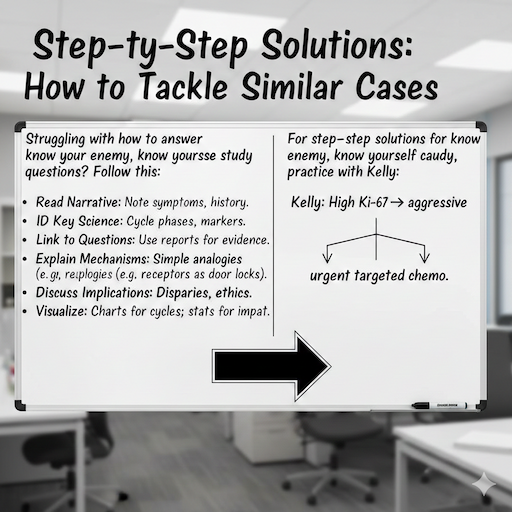
Struggling with how to answer, know your enemy, know yourself case study questions? Follow this:
- Read Narrative: Note symptoms, history.
- ID Key Science: Cycle phases, markers.
- Link to Questions: Use reports for evidence.
- Explain Mechanisms: Simple analogies (e.g., receptors as door locks).
- Discuss Implications: Disparities, ethics.
- Visualize: Charts for cycles; stats for impact.
For step-by-step solutions for knowing your enemy, know yourself case study, practice with Kelly: High Ki-67 → aggressive → urgent targeted chemo.
Integrating It All: From Homework to Real Care
As undergrads, connect dots: Genetic mutations in cancer drive receptors; cell signaling fuels cycles; therapies exploit weaknesses. Nursing pros: Monitor drug metabolism via genetics for adherence.
Stats refresh: 2025 HER2+ outcomes? Median PFS 10+ months with new combos; 65% 5-year OS, trastuzumab slashing risk 74%. Reassuring: Early precision saves lives—Kelly’s proof.
FAQS
What are the main breast cancer precision medicine case study assignment help takeaways?
Look closely at the tumor’s special buttons (receptors) so doctors can pick the right medicine. Check the patient’s genes to give the perfect dose. Make sure every person gets the same good care, no matter where they live or how much money they have.
How do the answers to “know your enemy know yourself” apply to other cancers?
It works for all cancers the same way! First, learn everything about the bad tumor (the enemy). Then learn about the person’s body and genes (yourself) to make a special plan that fits just them.
Best resources for the “know your enemy, know yourself” case study explained for students?
The best one is the real story from NSTA teachers. You can also look at Course Hero or Quizlet for answer sheets and simple notes. They help high school and college students understand fast.
Explain the cell cycle case study answers simply.
The cell cycle is like a circle: grow, copy stuff, then split into two new cells. Normal cells follow stop signs, but cancer cells speed through and never stop. That is why tumors grow so big and fast.
Tips for breast cancer case study answers in nursing?
Always talk about how to help with side effects like feeling sick or tired. Show how to give love and support to the patient and family. Remember to write about making care fair for everyone, even people who have less help.
Conclusion
In the end, the “Know Your Enemy, Know Yourself” story shows how smart medicine can beat breast cancer. Kelly was scared of her biopsy, but she won and lived! We learn to attack the bad parts of the tumor, respect each person’s body, and help everyone get fair care. This guide helps high school kids learn the easy parts, college students learn the deep science, and nurses learn kind ways to help. You’ve got the knowledge, now apply it.