
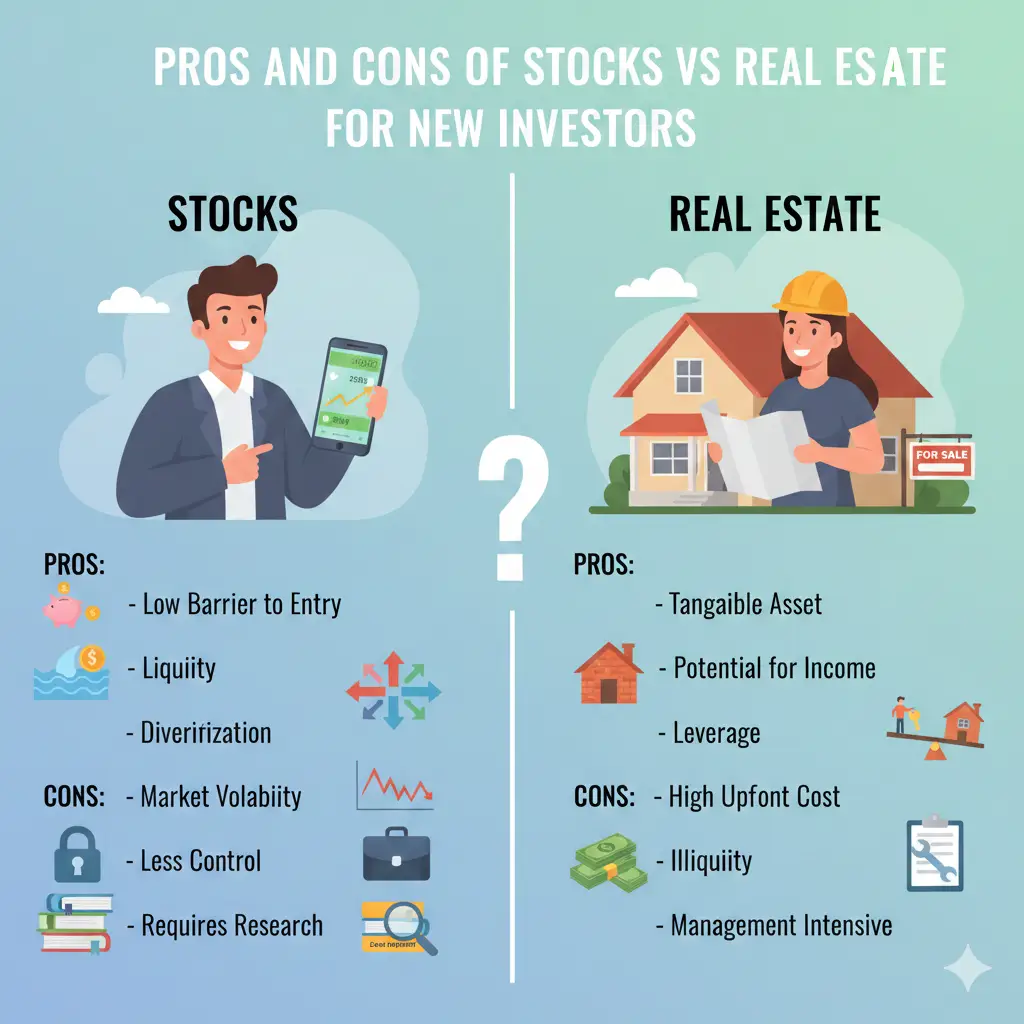
Standing at the crossroads of building your financial future? As a new investor, you face a big choice: dive into the stock market investing world or explore real estate investing. Both paths promise growth, but they come with unique upsides and downsides. In this guide, we break down the pros and cons of stocks vs real estate for new investors in simple terms. We’ll cover key factors like returns, risks, and how much work each takes. Whether you’re a young adult saving for retirement or someone with a full-time job eyeing passive income ideas, this investment comparison helps you decide. By the end, you’ll see why many beginners mix both for a balanced portfolio diversification plan.
Think about it: Stocks let you start small, while real estate demands more cash upfront. But real estate offers steady rental income, and stocks chase capital appreciation. Ready to weigh your options? Let’s jump in.
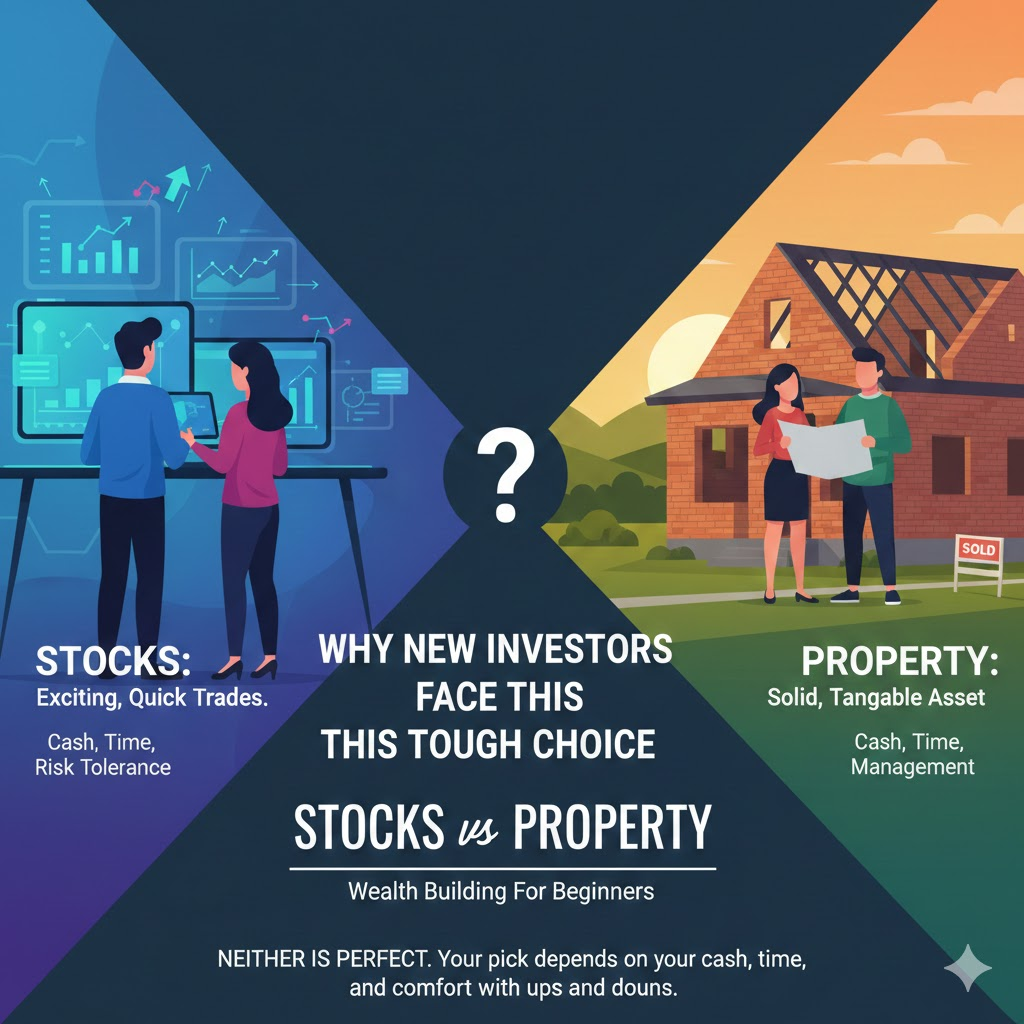
Why New Investors Face This Tough Choice
New to the game? You’re not alone. Many beginners feel torn between stocks vs property because both build wealth building for beginners. Stocks feel exciting with quick trades, but real estate seems solid, like owning a home. The truth? Neither is perfect. Your pick depends on your cash, time, and comfort with ups and downs.
From beginner investing tips we’ve seen, start by asking: Do you want fast access to your money (liquidity), or steady checks from tenants? Stocks win on ease, real estate on tangible assets. A 2024 study from Hartford Funds shows stocks grew a $153,500 investment to over $3.4 million from 1995-2024, while real estate hit $503,800 in the same span. That’s a huge gap in stock market growth, but real estate added rental income along the way.
For those in Tier 1 and Tier 2 countries like the US, UK, or Canada, markets move fast. US home prices averaged $361,263 in 2025, per recent data, making entry tough for newbies. Stocks? You can buy shares for $100. This investment strategies guide aims to reassure: You don’t need millions to start. Focus on what fits your life.
Understanding Stocks for Beginners
Stock market investing means buying shares in companies. Think Apple or Tesla—small pieces of big businesses. For new investors, it’s like joining a team where your money grows as the company does.
How Stocks Work Simply
You open a brokerage account (free apps like Robinhood work great). Pick stocks or funds. Dividend stocks pay you quarterly, like a bonus. Over time, prices rise through capital appreciation.

Historical data shines here. From 1926-2024, the S&P 500 (top US stocks) averaged 10% yearly returns, including dividends. That’s powerful for long-term investment options. A $10,000 start in 1995? Over $3 million today, adjusted for splits. Investopedia (2024) – Reasons to Choose Real Estate or Stocks1
But it’s not magic. Markets dip. In 2022, stocks fell 18%. New investors often panic-sell, losing big. Tip: Buy ETFs for instant portfolio diversification—one fund holds hundreds of stocks.
Pros of Stocks for New Investors
Let’s list the wins. These make stocks the top best investment options for beginners with limited capital.
- Easy Start: Need just $50-100. No big loans.
- High Liquidity: Sell anytime during market hours. Cash in days.
- Low Effort: Check apps weekly. Pros manage funds for you.
- Strong Growth: 10% average beats savings accounts.
- Tax Perks: Use IRAs for tax-free growth.
From Investopedia, stocks let you diversify easily, spreading risk across sectors. Great for risk-conscious folks.
Cons of Stocks for New Investors
Not all sunshine. Market volatility hits hard.
- Big Swings: Prices jump 5% daily. Scary for beginners.
- No Guarantees: Companies fail; shares tank.
- Emotional Traps: Fear sells low, greed buys high.
- Taxes on Wins: Short-term gains are taxed up to 37%.
- No Touch: Can’t “fix” a bad stock like a leaky roof.
Reddit users share: One lost 20% in 2022 but held; it rebounded. Lesson? Long-term vs short-term investment strategies for beginners matter—hold 10+ years.
Diving into Real Estate Basics
Real estate investing? Buy land or buildings. Rentals bring monthly cash; flips sell quickly for profit. For newbies, it’s like owning a business that pays rent.
Real Estate 101 for Starters
Start with a single-family home or condo. Use a mortgage, put 20% down, and borrow the rest. Tenants pay it off while you collect rental income.
Yields? The US average gross rental yield hit 6.51% in Q3 2025. In hot spots like Houston, it’s 9.19%. Add 4-5% yearly appreciation, and total 10-12%.
Historical view: A $27,000 home in 1970? Worth $500,000+ today. But from 1926-2024, real estate averaged 4.3-5.5% yearly, lagging stocks. Reddit r/RealEstate (2023) – Is real estate better than stock2s?
For beginners, try REITs—stocks in property funds. Liquid like stocks, yields like real estate.
Pros of Real Estate for New Investors
Tangible wins appeal to hands-on types seeking the benefits of real estate investing for passive income.
- Steady Cash: Rents cover bills, build equity.
- Leverage Power: Borrow 80%, tenants pay debt.
- Tax Breaks: Deduct interest, depreciate value.
- Inflation Shield: Rents rise with costs.
- Control Factor: Fix it up, pick tenants.
NerdWallet notes: Real estate hedges inflation better than stocks. One Reddit story: A $70k start in 2004 built a $3.5M portfolio by 2024.
Cons of Real Estate for New Investors
The work piles up. Property management drains time.
- High Entry: $50k+ down payment needed.
- Illiquid Trap: Sell? Months, plus 6% fees.
- Maintenance Headaches: Repairs eat profits.
- Tenant Drama: Late pays, evictions cost $30k+.
- Local Risks: Markets crash, like 2008.
Forbes warns: Upfront cash ties you down. Beginners often skip due diligence, buying bad deals.
Head-to-Head: Pros and Cons of Stocks vs Real Estate for New Investors
Time for the showdown. This investment comparison pits them on key battlegrounds. Use this to match your style.
Returns: Growth vs Income
Comparing stock market returns vs real estate appreciation? Stocks lead long-term.
| Aspect | Stocks | Real Estate |
| Avg. Annual Return (1926-2024) | 10% (S&P 500) | 4.3-5.5% |
| Income Type | Dividends (1-2%) | Rents (6.51%) |
| Growth Potential | High (compounding) | Steady (leverage boosts) |
| Example: $10k in 1995 | $3.4M by 2024 | $503k by 2024 |
Data from Hartford Funds. Stocks win for return on investment (ROI), but real estate adds passive income ideas like $1,000/month rents.
For new investors: Stocks for quick growth; real estate for cash flow.
Risk: Volatility vs Stability
Investment risk differs big. Risks of investing in the stock market for beginners? Daily drops. Real estate? Slower but local hits.
- Stocks: High market volatility—18% drop in 2022. But diversified ETFs cut it.
- Real Estate: Lower swings; Case-Shiller Index rose steadily at 5.5% yearly (1992-2024). Risks: Vacancies, repairs.
Investopedia says real estate feels safer as a physical asset. For cautious beginners, real estate eases nerves.
Liquidity: Quick Cash vs Locked In
Need money fast? Liquidity favors stocks.
- Stocks: Sell in seconds; funds clear fast.
- Real Estate: List, stage, close—3-6 months. Fees sting.
Bankrate pros: Stocks suit emergencies. But Reddit tales warn: Illiquid real estate trapped folks in 2008.
Beginner’s tip: Keep stocks for flexibility.
Effort: Hands-Off vs Hands-On
Property management? Real estate’s big con.
- Stocks: Set alerts, buy/hold. 1 hour/month.
- Real Estate: Screen tenants, fix leaks. Or hire managers (10% of rent).
Hartford Funds: Stocks via ETFs need zero sweat. For busy new investors, stocks fit better.
Pros and Cons of Stocks vs Real Estate for New Investors: Accessibility Angle
One huge plus for stocks: Low barrier. Start with pennies via fractional shares. Real estate? Leverage in investing helps, but 3-20% down ($10k+) scares beginners.
From 2smartcrowd.ae insights, small sums in stocks grow via compounding. Real estate needs patience—years to profit.
For those with jobs, stocks mean asset allocation without quitting. Real estate suits if you love deals. Hartford Funds (2024) – Should You Invest in Stocks or Real Estate3?
Tailoring to Your Life: Beginner Tips
No one-size-fits-all. How to choose between real estate and stock market investments? Assess:
- Capital: Under $5k? Stocks.
- Time: Busy? Skip property management.
- Risk: Hate drops? Real estate.
- Goals: Retirement? Stocks. Income now? Rentals.
Tips for new investors deciding between stocks and property:
- Start Small: $100 in Vanguard S&P ETF.
- Educate: Read “The Intelligent Investor” for stocks; “Rich Dad Poor Dad” for real estate.
- Diversify: 70% stocks, 30% REITs.
- Track Trends: Watch real estate market trends like rising US rents (up 3% in 2025).
Should new investors buy stocks or real estate first? Stocks—for ease. Add real estate later.
Example: Sarah, 25, put $2k in stocks. Grew 15% yearly. Later, co-bought a duplex for rent.
Is Real Estate Better Than Stocks for Long-Term Growth?
Is real estate better than stocks for long-term growth? Depends. Stocks averaged 10.39% (1992-2024); real estate, 5.5%. But with leverage, real estate hits 10-15%.
For long-term investment options, stocks compound faster. TIME notes: $1 in stocks 1926? $7,870 today. Real estate? $53. Yet real estate builds intergenerational wealth via equity.
Hybrid win: REITs averaged 12.7% (1972-2023).
Pros and Cons of Investing in Rental Properties vs Stocks
Pros and cons of investing in rental properties vs stocks? Rentals shine in income, stocks in speed.
Rental Pros:
- Monthly paychecks.
- Tax deductions (depreciation saves thousands).
- Forced savings (equity builds).
Rental Cons:
- Vacancy risk (1-2 months empty? Lost $2k).
- Upkeep (roof? $10k hit).
- Market ties (local slump hurts).
Stocks counter: No roofs, but watch market volatility.
I Will Teach You To Be Rich says: Rentals for cash flow, stocks for growth.
Building a Balanced Approach
Smart new investors blend. Portfolio diversification cuts risks. 60% stocks, 20% REITs, 20% direct real estate.
Why? Stocks handle volatility; real estate steadies. Hartford Funds: Mix yields 8-9% with less swing.
Steps:
- Fund emergency cash (3-6 months).
- Max retirement accounts (stocks/ETFs).
- Save for a down payment.
- Consult advisor.
Common Mistakes and How to Dodge Them
Beginners trip up. Avoid:
- Chasing Hype: Skip meme stocks or flip seminars.
- Ignoring Fees: Broker commissions add up; use low-cost.
- No Plan: Set asset allocation—rebalance yearly.
- Panic Moves: Hold through dips.
NerdWallet: Educate first.
Real Stories from New Investors
Reddit thread: “Is real estate investing better than stock?” One user: Started stocks at 22, hit $50k by 30. Switched to duplex—now $800/month net.
Another: Stocks crashed my confidence; real estate’s tangibility rebuilt it.
These show: Both work with patience.
Future Outlook: Trends to Watch
Real estate market trends? US rents up 4% in 2025; yields 6.51%. Stock market growth? AI boosts S&P to new highs.
For beginners: Remote work favors rentals; tech drives stocks.
FAQs
What is the main difference between stocks and real estate for beginners?
Stocks are like buying tiny pieces of companies and can grow fast with little money. Real estate is owning houses or buildings for rental income, but it needs more cash to start. Both help you build money, but stocks are easier and faster to sell.
Are stocks better than real estate for quick money?
Stocks can go up or down fast, so you might sell and get cash in days. Real estate takes months to sell and costs extra fees. If you need money soon, stocks are the better choice for beginners.
How much money do I need to start with stocks?
You can start with just $50 or $100 using phone apps like Robinhood. Buy little pieces of big companies or easy funds that hold many. No big loans needed, perfect for young people or small savers!
What are the biggest risks with real estate?
Houses cost a lot to buy, and fixing broken things like roofs can be expensive. If no one rents, you lose money, and selling takes time. But it gives steady rent and can grow in value over the years.
Do stocks pay me money like rent does?
Some stocks give “dividends” like bonus cash every few months. But it’s not as regular as rent checks from a house. REITs (like stock houses) mix both and pay rent money without the work.
Conclusion
Wrapping up the pros and cons of stocks vs real estate for new investors, both shine for wealth building for beginners. Stocks offer easy entry, high growth, and liquidity, but watch volatility. Real estate delivers steady income, tax perks, and stability, yet demands capital and effort. No clear winner; it fits your life. Start with stocks if cash-tight, add real estate for balance. Remember: Consistent investing beats timing markets. Diversify, learn, and grow patiently. What’s your first move, a stock app or a property hunt?
References
- Investopedia (2024) – Reasons to Choose Real Estate or Stocks – Easy explanations about rent money, ups and downs, and beginner tips. ↩︎
- Reddit r/RealEstate (2023) – Is real estate better than stocks? – Real stories from everyday people about the work and money in both. ↩︎
- Hartford Funds (2024) – Should You Invest in Stocks or Real Estate? – Great charts that show how stocks and real estate grew over many years. ↩︎