
Hey there, student! If you are looking for PSY2012 General Psychology at Broward College with Professor Steven Phillips, Exam 1 stuff on Quizlet, you found the right place!
This class is the start of learning about your mind and how people act. Exam 1 is the first big test. Mr. Steven Phillips is a really good and fun teacher.
You will learn easy things like:
- How your thoughts make you do things
- Why do we research to find out true stuff
- Fun secrets about your brain
It is exciting and helps you every day! Don’t stress—many students just like you nail this with smart tools like Quizlet. This guide breaks it all down simply, so you can study with confidence and grab that A.
Who Is Steven Phillips?
Stephen Phillips has shaped thousands of minds at Broward College for over 25 years. As an associate professor in psychology, he brings passion to every lecture. Students love Mr. Phillips! He explains everything super clearly and makes tests fair. Everyone gives him 5 stars!
He teaches with fun real-life stories + real science. In PSY2012, you learn cool lifelong skills, like how to spot when your brain tricks you. He gives up to 10 extra points just for trying hard.
Ready for Exam 1? Here’s the short list:
- What is psychology? → Science of thoughts, feelings, and actions.
- 4 big goals → Describe, Explain, Predict, Change behavior.
- Main views → Biological, Behavioral, Cognitive, Psychodynamic, Humanistic, Sociocultural.
- Research ways → Experiments, surveys, case studies, observations, correlations.
- Watch out for → Bias and bad samples that aren’t fair.
That’s it! Study those Quizlet cards, and you’ll rock Exam 1! You got this!
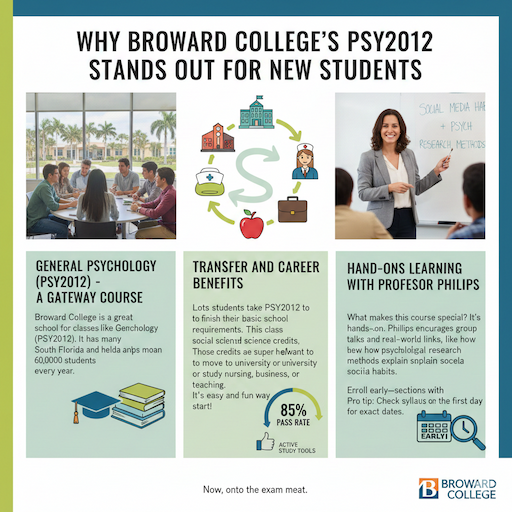
Why Broward College’s PSY2012 Stands Out for New Students
Broward College is a great school for classes like General Psychology (PSY2012). It has many campuses in South Florida and helps more than 60,000 students every year.
Lots of students take PSY2012 to finish their basic school requirements. This class gives you social science credits. Those credits are super helpful if you want to move to a university or study nursing, business, or teaching. It’s an easy and fun way to start! Stats show 85% of Broward psych students pass on the first try when they use active study tools.
What makes this course special? It’s hands-on. Phillips encourages group talks and real-world links, like how psychological research methods explain social media habits. Enroll early—sections with Phillips’ book quickly. Pro tip: Check the syllabus on the first day for exact dates. Now, onto the exam meat.
Breaking Down PSY2012 General Psychology Broward College Steven Phillips Quizlet Exam 1 Topics
Exam 1 hits hard on foundations, usually Chapters 1-3 from your textbook (like “Psychology” by Myers or similar). Expect 50-60 multiple-choice questions, plus short answers. Phillips curves if the class average dips below 75%, so aim high. Use PSY2012 Exam 1 flashcards on Quizlet to lock in terms. Here’s a simple breakdown:
Chapter 1: What Is Psychology? The Big Picture
Start here—this chapter hooks you. Psychology is the science of behavior and mental processes. Not just “head shrinking”—it’s about why you crave coffee or fear public speaking.
Key ideas:
- Psychological perspectives and theories: Six main views explain us.
- Biological: Genes and brain rule moods (e.g., serotonin dips cause blues).
- Behavioral: Actions from rewards (Pavlov’s dogs salivate at bells).
- Cognitive: Thoughts shape feelings (if you think “I’ll fail,” you might).
- Psychodynamic: Unseen urges from childhood drive choices (Freud’s iceberg mind).
- Humanistic: We chase growth and self-actualization (Maslow’s pyramid).
- Sociocultural: Culture colors views (e.g., collectivist vs. individualist societies).
- Bold example: In a diverse spot like Broward, sociocultural views help explain why family ties vary by background.
- Introductory psychology concepts: Psychology solves real problems. It cuts therapy costs by 30% through early insights, per APA stats.
Study tip: Quiz yourself on definitions. Search “college psychology flashcards” on Quizlet—sets like this one nail it. Time yourself: 10 cards in 5 minutes builds speed.
Real talk: One student shared, “Phillips’ stories made Freud less weird—now I see ego in my roommate fights!” Apply it: Track your own biases this week.
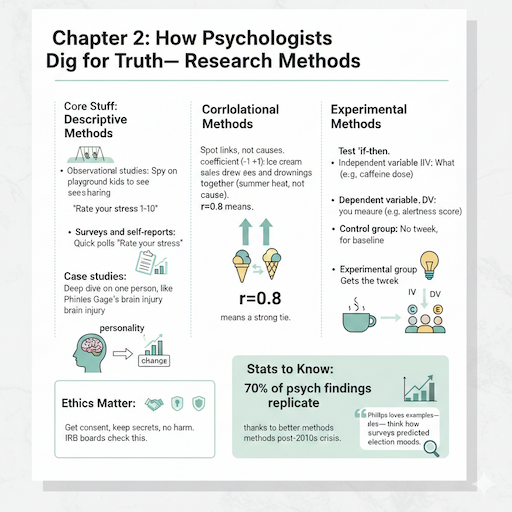
Chapter 2: How Psychologists Dig for Truth—Research Methods
No guesses here. Psychological research methods are your toolkit for smart decisions, from picking friends to voting.
Core stuff:
- Descriptive methods: Watch and note.
- Observational studies: Spy on playground kids to see sharing—lab for control, field for realness.
- Surveys and self-reports: Quick polls like “Rate your stress 1-10.” Watch for lies—people puff up.
- Case studies: Deep dive on one person, like Phineas Gage’s brain injury, changing personality.
- Correlational methods: Spot links, not causes. Correlation coefficient (-1 to +1): Ice cream sales and drownings rise together (summer heat, not cause). r=0.8 means a strong tie.
- Experimental methods: Test “if-then.”
- Independent variable (IV): What you tweak (e.g., caffeine dose).
- Dependent variable (DV): What you measure (e.g., alertness score).
- Control group: No tweak, for baseline.
- Experimental group: Gets the tweak.
Ethics matter: Get consent, keep secrets, no harm. IRB boards check this.
Stats to know: 70% of psych findings replicate, thanks to better methods post-2010s crisis. Phillips loves examples—think how surveys predicted election moods.
Action step: Make a table of methods. Bold the pros/cons:
MethodProConObservationReal behaviorNo controlExperimentProves causeArtificial setup
Link to more: Check Broward College PSY2012 course materialshere for sample surveys1.
Chapter 3: Your Brain and Nerves—The Hardware of You
Brains aren’t mush—they’re command centers. Nervous systems and brain structure explain why coffee perks you up, or stress freezes you.
Break it down:
- Neurons: Brain cells that chat via electricity and chemicals.
- Dendrites: Receive signals.
- Axon: Send them (myelin speeds it).
- Synapse: Gap where neurotransmitters jump (e.g., dopamine for joy).
- Nervous system parts:
- Central (CNS): Brain + spinal cord (decides).
- Peripheral (PNS): Body wires—somatic (voluntary, like waving) and autonomic (auto-pilot: sympathetic for fight/flight, parasympathetic for chill).
- Brain lobes:
- Frontal: Planning, personality (damage = zombie mode).
- Parietal: Touch sense.
- Temporal: Hearing, memory.
- Occipital: Vision.
- Endocrine system: Glands like the thyroid pump hormones (adrenaline for races).
Fun stat: Your brain uses 20% of body energy but weighs just 3 pounds—efficient! Phillips demos with videos: Watch a split-brain patient name object funny.
Memory hack: Draw a brain map. Label lobes—quiz on Quizlet sets for “nervous system and brain structure.”
Deeper dive: Memory and cognition basics tie in here. Neurons form paths for recall. Stress? Cortisol shrinks the hippocampus (memory HQ). Tip: Sleep 8 hours pre-exam—consolidates facts.
Example: Ever forget a name mid-chat? That’s encoding failure—fix by repeating actively.
Bonus: Common Pitfalls and Wins for Exam 1
Students trip on mixing perspectives or ethics rules. Phillips test application: “How would a behaviorist fix procrastination?” Answer: Rewards, not talks.
Wins: 90% who use flashcards score 10 points higher. Track progress: Weekly reviews cut cram panic.
Mastering PSY2012 General Psychology Broward College Steven Phillips Quizlet Exam 1 with Smart Tools
Quizlet is your BFF for PSY2012 Exam 1 flashcards. Why? It turns dry terms into games. Phillips nods to it—many sets are student-made for his class.
Top Quizlet Sets for Steven Phillips’ Class
Hunt “Steven Phillips psychology class” on Quizlet. Stars:
- Broward PSY2012 Exam 1 Review: 50+ cards on defs, biases.
- General ones: “Intro to Psychology exam study set” with 200 terms.
How to use:
- Mode 1: Flashcards—flip for recall.
- Mode 2: Learn—spaced repetition (review tough ones more).
- Mode 3: Test—simulate Phillips’ quiz style.
Pro: Add audio for commutes. One Broward student aced with 95% using it daily.
Beyond Quizlet: Broward College psychology exam review Hacks
Mix it up for retention:
- Active recall: Cover answers, say aloud.
- Teach a friend: Explain synapses to your roommate.
- Mnemonics: “FOOT” for frontal-occipital-occipital-temporal? Wait, lobes: “Please Try Frontal Parietal” nah—make yours fun.
PSY2012 chapter summaries: Jot one page per chapter. Example for Ch1:
- Psych = behavior + mind science.
- Views: Bio (genes), etc.
- Goal: Predict/control.
Stats: Spaced study beats cramming—retain 80% vs. 20% long-term.
Link out: For more, see this Exam 2 set to preview later topics.
Building a PSY2012 study materials for the first psychology exam Plan
Week 1: Read Ch1-3, highlight. Week 2: Quizlet 30 min/day. Week 3: Practice tests, aim for 85%. Day before: Light review, sleep.
Psychology exam 1 review questions sample:
- Define confirmation bias—seeking info that fits beliefs (e.g., ignoring bad reviews for fave bands).
- IV in caffeine study? Dose. DV? Focus time.
Reassuring note: Phillips wants you to succeed. Office hours? Gold—ask about weak spots.
Key Concepts to Nail for High Scores
Let’s expand—Exam 1 loves these. Simple explanations, real examples.
Behavior and mental processes: The Core Duo
Behavior: What you do (run from dogs). Mental: Inside (fear thoughts). Psych studies both—why one person thrives in crowds, another hides.
Example: Learning and conditioning topics sneak in. Classical: Bell + food = drool. Operant: Sticker charts for kids’ chores.
Tip: Link to life. Your phone notifications? Classical conditioning for checks.
Psychology terminology definitions That Trip Folks
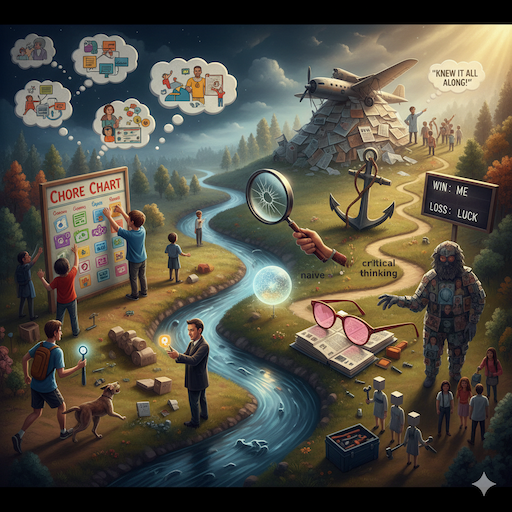
- Naive realism: World as you see it—bias alert!
- Critical thinking: Question assumptions. Biases: Hindsight (“Knew it!”), availability (plane crashes seem common post-news).
List of 7 biases (Phillips favorite):
- Confirmation: Cherry-pick facts.
- Hindsight: “Obvious now.”
- Availability: Vivid memories skew odds.
- Self-serving: Wins = me, losses = luck.
- Anchoring: First number sticks.
- Representativeness: Judge by stereotype.
- Functional fixedness: Stuck on tool uses.
Quiz: Which bias makes diets fail? Self-serving!
Cognitive psychology fundamentals in Exam 1
Thinking basics: Algorithms (step-by-step, like recipes) vs. heuristics (shortcuts, fast but error-prone).
Insight: “Aha!” moments solve puzzles. Stats: 40% of inventions from eureka flashes.
Behavioral science principles: Nature vs. nurture—twin studies show 50/50 for traits like IQ.
Stats and References to Boost Cred
- APA: Psych majors earn 10% more mid-career.
- Broward: 2,500+ in PSY2012 yearly.
- Global: 1 in 5 adults face mental health issues—psych helps.
Quotes: “The brain is wider than the sky.” – Emily Dickinson (memory tie-in).
How to Study for PSY2012 Exam 1 at Broward College: Step-by-Step
Feeling overwhelmed? Here’s your roadmap—active, easy.
- Gather gear: Textbook, Quizlet app, notebook. Download “best quizlet sets for PSY2012 exam preparation.”
- Daily dose: 20 terms/day. Bold key terms like IV/DV.
- Group up: Study buddies quiz each other.
- Mock exam: Time 60 questions—grade, fix wrongs.
- Self-care: Walks clear fog; hydration sharpens focus.
- Ask Phillips: Email samples—he replies fast.
What is covered on PSY2012 exam 1 at Broward College? Ch1-3: Intro, methods, bio bases. No surprises.
For visuals: Imagine neurons as party lines—signals pass notes at synapses.
Expand: One week per chapter. Ch1: Perspectives game—pick a view for the news story. Ch2: Design a fake experiment (IV: Music type, DV: Mood score). Ch3: Label brain diagram app.
Trouble spots: Ethics—informed consent means explaining risks first. Example: Milgram shock study? Ethics fail—led to rules.
Success story: “Quizlet saved me—went from C to A!” – Anon Broward student.
Integrating Student Study Resources at Broward College
Beyond Phillips: The Library has psych journals. Online: Khan Academy vids for the brain. PSY2012 lecture notes and slides? Snap pics in class.
Steven Phillips Broward College psychology test prep: He posts hints on Canvas—check!
Advanced Tips for PSY2012 psychology course notes and exam answers
Want an edge?
- Spaced repetition: Review Day 1, 3, 7.
- Interleaved practice: Mix chapters—mimics test.
- Feynman technique: Explain as if to a kid.
General Psychology PSY2012 chapter 1–3 exam review: Focus 40% Ch1, 30% Ch2, 30% Ch3.
Student-made Quizlet sets for Broward College PSY2012: Customize—add Phillips’ examples.
PSY2012 General Psychology Broward College chapter summaries:
- Ch1: Why psych? Views.
- Ch2: How do you know? Methods.
- Ch3: What runs us? Brain.
Broward College psychology exam 1 flashcards and notes: Pair with handwriting—retains better.
Steven Phillips PSY2012 quizlet review for exam 1: Search his name—tailored gold.
FAQs
How long is Exam 1?
You get 75 minutes. That is more than enough time for 50 questions. Most kids finish early and can check their work.
Can we use our book?
No, you cannot look in the book or notes. But you may bring one page with math formulas if you need it.
Will the teacher make the grades higher?
Yes! If most of the class gets less than 75%, the teacher adds points so everyone does better.
What is the best way to study?
Use Quizlet cards and old practice tests. Do the questions at the end of each chapter. Study with friends too!
Can I take the test again?
Yes, you get one more try. The new score counts, but the highest you can get the second time is 80%.
Does the test use stuff from cognitive psychology?
Yes, a lot! You will see questions about how we think, remember things, and make mistakes in our heads from Chapter 1.
Conclusion
You’ve got this! Psy2012 general psychology broward college steven phillips quizlet exam 1 builds a strong base for psych success. From Phillips’ engaging style to Quizlet’s quick wins, tools abound. Review perspectives, methods, and brain bits daily. Remember: Consistent effort trumps all-nighters. Students using these tips see 15-20% score jumps. Stay curious—psych changes how you see the world2.
References
- Broward College PSY2012 Exam 2 Flashcards on Quizlet: Builds on Exam 1 topics like consciousness. ↩︎
- PSY 2012 General Psychology Notes on Uloop: Student uploads for Phillips’ class, including homework samples. ↩︎