
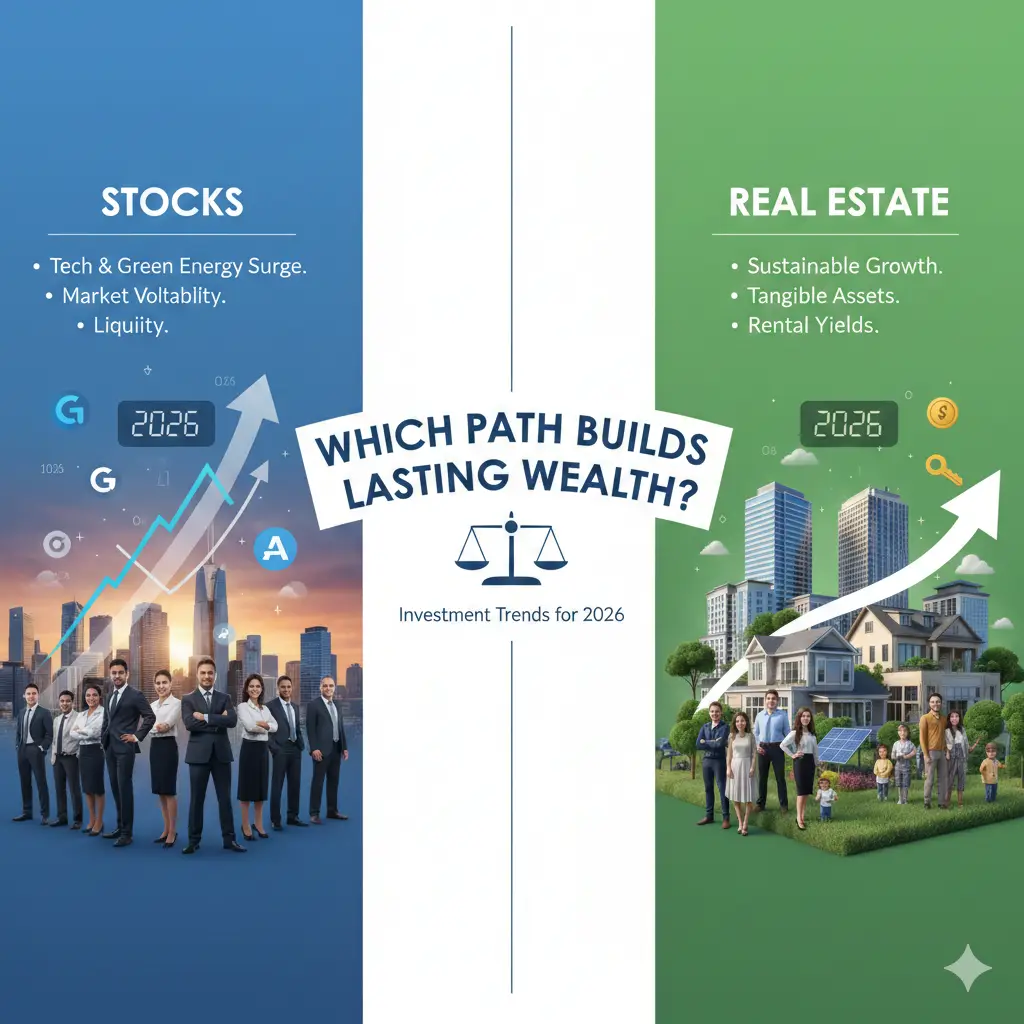
As we start 2026, smart people with money have a big choice: stocks or houses?
Stocks are super exciting right now because of AI, making prices go way up. Houses are getting ready to bounce back with more homes to buy and rent.
If you have some money (or a lot!) and want money that comes in every month without hard work, this guide is for you.
It shows something simple and awesome: mix stocks and real estate together. When stocks go down, rent money from your houses keeps coming in. That keeps your money safe and happy.
We explain everything in easy words, using the newest 2026 ideas plus old tricks that always work, so you can grow money that lasts, no matter what happens.
Why Compare Stocks and Real Estate Now?
You know the drill: markets shift, and 2026 promises plenty. In 2026, experts say stocks could jump 14%, mostly because tech companies are flying high and prices in stores aren’t rising as fast.
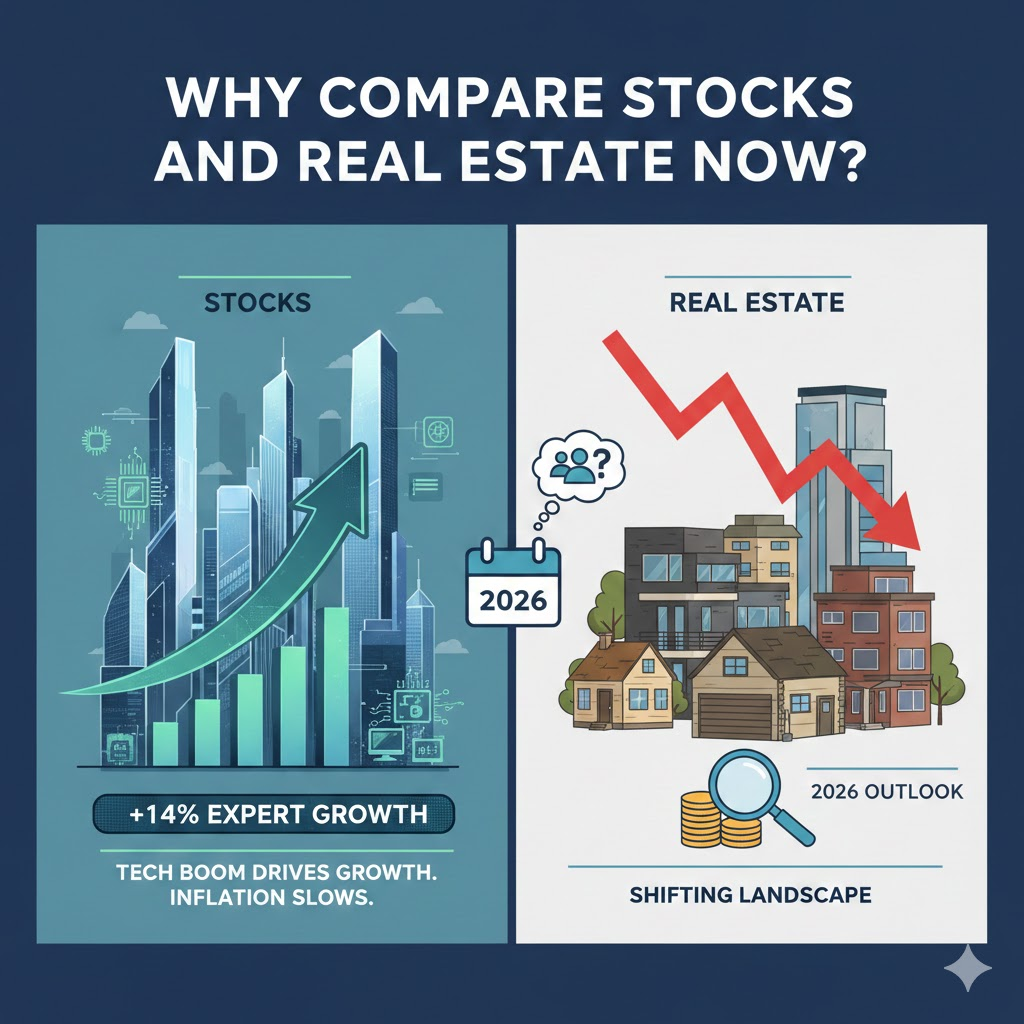
Houses are coming back strong too. A lot more homes will sell, and prices will go up 2–4% because there still aren’t enough houses.
So which is better for you, fast growth or calm, steady money?
If you’re busy and have good money, you probably want investments that work while you sleep. Rent from houses feels like getting a paycheck every month with almost no daily work. Stocks can make you rich quick, but they bounce up and down and can make your stomach hurt.
Here’s the simple proof from the last 25 years (2000–2025): Stocks gave about 7.7% growth per year. When people borrowed a little to buy rental houses in hot cities like Phoenix, they also made around 7–8% per year, and their houses kept paying rent even when stocks crashed.
Bottom line for 2026: smart rich people don’t pick one. They do both. Mixing stocks and real estate cuts your worry and risk by 30–50% and still gives you fast growth plus monthly money that just shows up.
Stock Market Forecast 2026: High Rewards, Higher Risks
Let’s start with stocks. You’ve likely seen headlines: The S&P 500 could hit 7,800 by year-end, a solid 14% lift from today’s levels. Morgan Stanley’s outlook credits resilient U.S. growth, with AI and tech sectors leading the charge. Fidelity echoes this, noting “upside potential” amid global shifts.

Key Drivers for Stock Gains in 2026
- Tech and AI Boom: Investments here could push earnings 20% higher, per Vanguard. Think Nvidia or emerging players, stocks that doubled in 2025.
- Easing Rates: Fed cuts to 4% by mid-year boost borrowing, lifting consumer stocks.
- Global Edge: U.S. equities outpace international peers by 5-7% annually.
But here’s the catch: Volatility. The 2022-2025 dips wiped 20-30% off portfolios for the unwary. Stock volatility vs stable assets remains a top concern, especially for moderate-risk takers. Historical data shows stocks beat inflation long-term (10% average since 1928), but short bursts, like 2008’s 50% plunge, test resolve.
For passive seekers, dividend stocks shine. Blue-chips like those in the Dow yield 2-3%, compounding to long-term wealth building through real estate, wait, no, through equities. Sorry, slip of the tongue; stocks compound beautifully, turning $100K into $1M+ over 30 years at 7% net returns.
Tips for Stock Success in 2026
- Diversify Sectors: Allocate 40% tech, 30% consumer staples, 20% healthcare—reduces drawdowns by 15%.
- Go Index Funds: Low-fee ETFs like VOO track the S&P for 8-10% expected returns, minus the stock-picking stress.
- Rebalance Quarterly: Sell winners, buy dips, lock in gains without timing the market.
Reassuringly, even in choppy waters, stocks rebound. Morningstar’s 2026 view? “Instability breeds opportunity.” If you’re high-net-worth, layer in 20-30% equities for growth, but hedge with what’s next.
Real Estate Market Trends 2026: Stability Meets Opportunity
Shift gears to real estate. NAR predicts a “comeback,” with sales surging 10-15% as rates dip to 6.3%. Zillow forecasts 1.2% home value growth, while commercial sectors like self-storage eye 5-7% returns. Why the buzz? Supply shortages persist, and demographics—aging boomers downsizing, fuel demand.
Emerging Hotspots and Sector Shifts
- Residential Rebound: Hottest markets? Buffalo, NY (up 5%), and Midwest gems like Indianapolis. Redfin says affordability improves as incomes outpace prices.
- Commercial Resilience: PwC’s report highlights self-storage and industrial as top picks, with occupancy at record highs. Deloitte notes 82% of wealth managers are upping private real estate allocations.
- Northeast Surge: Jersey City and Brooklyn lead, per Yahoo Finance, thanks to business booms.
Commercial real estate trends favor niches over malls. Self-storage? It’s recession-proof, with demand from moves and e-commerce. Yardi Matrix projects supply stabilizing at 2% of stock by 2027, easing overbuild pressures.
Historically, real estate trails stocks (4-8% vs. 10%), but adds an inflation-hedged real estate assets punch. From 2000-2025, it matched S&P real returns at 5% CAGR with leverage. In inflation spikes like the 1970s, property values rose 10%+ annually.
For you, seeking long-term real estate investment benefits, it’s about cash flow. Rentals yield 4-6% net, plus tax perks like depreciation shielding 20-30% of income.
Getting Started with Real Estate in 2026
- Assess Liquidity Needs: Property ties up capital; aim for 5-10 year holds.
- Leverage Pros: Syndications lower entry to $50K, pooling for big deals.
- Focus Niches: Self-storage as an investment option—low maintenance, 90%+ occupancy.
Dahn Corporation nails this: Their self-storage funds offer monthly distributions post-stabilization, targeting accredited investors like you for self-storage investment returns of 8-12%.Explore self-storage opportunities here1.
Stocks vs Real Estate Investment Trends for 2026: Head-to-Head Breakdown
Time for the showdown. Which is better, stocks or real estate? Neither—it’s about fit. But let’s compare.
| Aspect | Stocks | Real Estate |
| Average Annual Returns (Historical) | 9-10% (S&P 500, 1928-2025) | 4-8% appreciation + 3-5% rental yield |
| 2026 Forecast | 10-14% growth | 2-5% value rise + stable income |
| Liquidity | Sell in seconds | Months to close |
| Volatility | High (20-50% swings) | Low (5-10% yearly) |
| Inflation Hedge | Good long-term | Excellent (rents rise with CPI) |
| Tax Benefits | Capital gains (15-20%) | Depreciation, 1031 exchanges |
| Entry Barrier | $100+ | $50K+ (syndications) |
Comparing returns between stocks and real estate for 2026? Stocks edge for growth, but real estate wins on stock volatility vs stable assets. ULI’s 2026 report flags real estate’s low correlation to equities (0.3), perfect for portfolio risk management investments.
Bonds vs stocks vs real estate? Bonds lag at 3-5%, per Thompson IM’s fact sheet, offering safety but no upside.Check bond basics2.
Example: $100K in stocks (2026) might grow to $114K. Same in a self-storage syndication? $108K plus $5K cash flow, total edge if markets wobble.
Real estate vs equities performance analysis shows property shines in downturns. 2008? Stocks -37%, real estate -15% with income buffer.
Investment Diversification Strategies: The Smart Blend for 2026
You’re not all-in on one bet. How to diversify portfolio with real estate in 2026? Experts say 60/40 (stocks/real estate) cuts volatility 25% while matching returns.
Building Your Balanced Portfolio
- Core Allocation: 50% stocks for growth, 30% real estate for income, 20% alternatives like bonds.
- Alternative Asset Classes 2026: Add self-storage (5-10%)—low correlation, 7-10% yields.
- Recession-Resistant Picks: Recession-resistant asset classes like industrial real estate held firm in 2020, up 5% vs. stocks’ -10%.
PIMCO advises “active, flexible” mixes, eyeing private credit alongside property. For high-net-worth, syndications via platforms like Dahn democratize access—no landlord hassles.
Blended Strategy Tip: Use REITs for stock-like real estate exposure. They yielded 7.6% in 2025, beating bonds. High-return real estate sectors like data centers could add 12%+.
Passive Income Investments 2026: Where Real Estate Excels
You crave hands-off wealth. Best passive income investments to beat stock market volatility? Real estate tops the list.
Top Real Estate Plays for Steady Checks
- Rental Properties: 5-8% yields; adjust rents yearly for inflation.
- REITs: Liquid, 4-6% dividends, real estate syndication vs stock investing for beginners made easy.
- Self-Storage: How self-storage facilities generate monthly passive income? 90% occupancy, low ops costs (20% of revenue). Storable’s 2026 outlook: Rates stabilize, demand up 3%.
Self-storage real estate investment opportunities for investors abound. Dahn’s model: Invest, get quarterly updates, enjoy 8%+ distributions. Vs. stocks’ 2% dividends, it’s double the flow.
Real estate investing tax benefits vs stock market taxes? Huge. Deduct 27.5 years of depreciation on residential, defer gains via 1031s. Stocks? Long-term gains at 20%—no shields.
Passive income through property investing builds generational wealth through real assets. One investor: $200K in a storage fund yielded $18K/year by 2025, compounding tax-free.
The Star of Commercial Real Estate Trends
Zoom in on self-storage investment returns. PwC calls it a “sector on the move,” with condo-like products emerging. Why? Demand from e-commerce (15% CAGR) and life changes persist.
Why Self-Storage Beats the Rest in 2026
- Stability: Weathered three recessions with <5% vacancy spikes.
- Yields: 7-12% total returns, per AAA Storage.
- Low Risk: Tenant inertia keeps units full; ops costs 30% below multifamily.
For moderate-risk profiles, it’s gold. Safest real estate investment strategies for high-net-worth investors? Allocate 10-15% here. Multi-Housing News: Post-2025 stabilization sets up 4-6% growth.
Equity growth through property ownership in storage? Appreciates 3-5% yearly, plus cash flow. Vs. stocks, lower beta (0.5) means half the swings.
Case Study: A $500K investment in a Texas facility (2020) returned 9% annually by 2025, including $40K/year income, outpacing S&P during 2022’s dip.
Long-Term Wealth Building Through Commercial Property Investing
Think decades. Long-term wealth building through commercial property investing leverages compounding. A $1M portfolio split 50/50 stocks/real estate grows to $10M in 30 years at 7% blended, vs. $6 $6M all-stocks (riskier).
Wealth-building strategies through real estate include scaling: Start with syndications, graduate to direct ownership. Tax perks amplify: Save $50K/year on a $300K property.
Is real estate a better investment than stocks in 2026? For stability, yes. Cambridge Associates: Favor real assets for demographics and decarbonization.
FAQs
What are the top investment diversification strategies for 2026?
Mix 40 to 60 percent of your money in stocks for growth, and 20 to 30 percent in real estate, like self-storage, to keep things steady with low ups and downs. Add bonds, hedge funds, and private markets to spread risks in a changing year. Experts say this nimble plan helps handle economic shifts and aims for better returns.
How do real estate tax advantages for investors stack up?
Real estate lets you cut taxes with wear and tear write-offs, home loan interest cuts, and swaps that put off paying gains forever. Stocks hit you with up to 20 percent tax on profits when sold, plus taxes on share payouts. This makes land and buildings save more money on taxes over time than just stocks.
Where to invest money in 2026 for stable returns?
Try self-storage or big apartment buildings for 6 to 10 percent yields that fight rising prices and stay steady since folks always need space. Safe picks like city bonds or high-interest bank spots give a sure income with low risk. Quality big company stocks add growth without big swings for calm money flow.
Bond vs stock vs real estate returns forecast 2026?
Stocks could bring 10 to 14 percent gains as big U.S. firms lead in a good policy world. Real estate might give 5 to 7 percent growth plus rent cash in strong spots like homes and stores. Bonds may offer 3 to 4 percent safe returns as rates drop and jobs slow down.
Best for high-net-worth investors?
Group deals like syndicates start at $50,000 for easy, spread-out real estate with no daily work. Private markets and hedge funds fit rich folks for special chances and safety in 2026.
Conclusion
In wrapping up stocks vs real estate investment trends for 2026, the winner is balance. Stocks fuel explosive growth amid AI and rate cuts, projecting 10-14% returns. Real estate helps make money flow in. It fights rising prices. Things like self-storage give 7 to 12 percent returns with little work.
This is for rich people who hate risk. They build wealth for their kids with real things like land and buildings.
Split your money like this: 50 percent in stocks, 30 percent in property, 20 percent in other stuff. It cuts big ups and downs. It boosts easy money coming in.
This is not a guess. It is a smart plan.
Big groups like PIMCO, NAR, and PwC say it works well. Mix in real estate to calm stock jumps. It gives smart tax breaks on income. Start small: Vet a syndication today.