
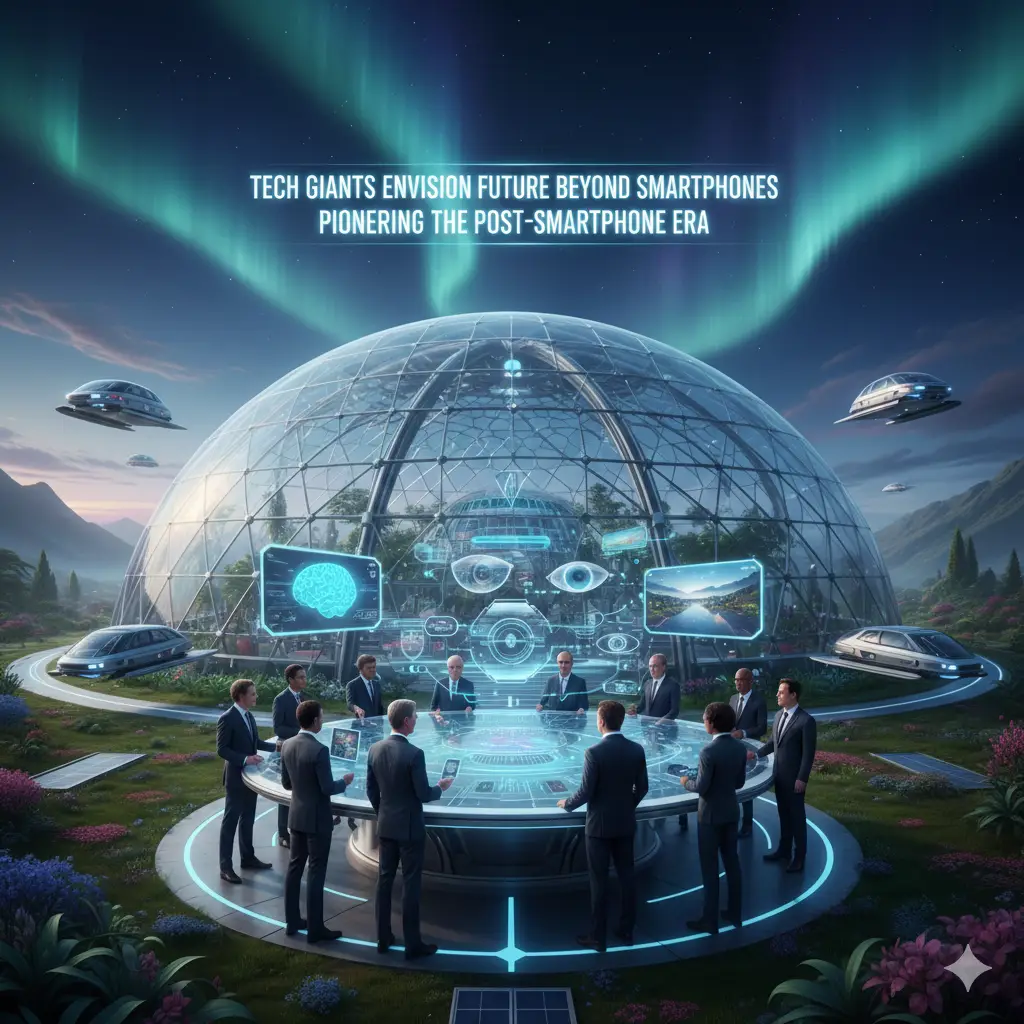
Big tech companies dream of a future where we don’t need smartphones all the time. They want tech that feels like magic – invisible and super smart! For many years, smartphones have been our best friends. We use them for work, games, and talking to people. Almost everyone has one – more than 6.8 billion people in 2025! But now, phones are not as exciting. People are not buying new ones as much. In 2024, sales went down a little bit (3.4% less). Bosses at Apple, Meta, and Google say: “Time for something new!”
They are making:
- Special glasses that put pictures and words right in front of your eyes (augmented reality).
- Watches and rings that know what your body is doing.
- Smart helpers (AI) that guess what you want before you ask.
This new world will be hands-free. You can have meetings with holograms (like 3D ghosts). Maybe one day, you can control things just by thinking! Tech leaders say this will be the next big thing. It could be worth 3 trillion dollars by 2030! If you love tech or want a job in it, learning about this now is smart. Big changes are coming – and they will be fun! Tech Giants Beyond Smartphones: Interviews1
Why Tech Giants Envision Future Beyond Smartphones
Tech giants envision a future beyond smartphones because the current model hits a wall. Innovation slows as hardware matures. Users crave less screen time—average daily use hit 7 hours in 2025, linking to burnout and privacy woes. A Deloitte survey shows 62% of consumers want “screenless” options for tasks like navigation or fitness tracking. Enter the post-smartphone era, where tech embeds into life, not pockets.
Market Saturation and Economic Pressures
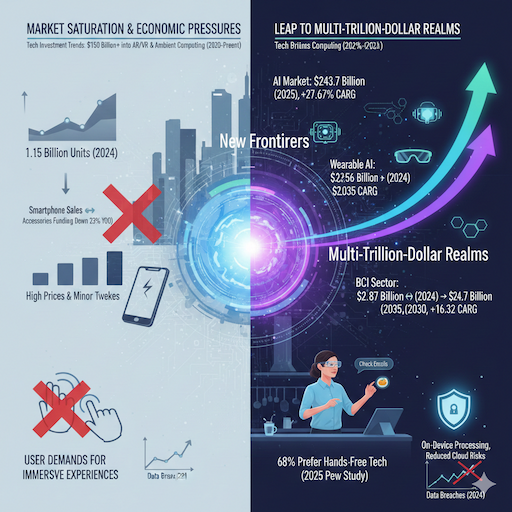
Smartphone sales plateaued at 1.15 billion units in 2024, down from peaks, due to high prices and minor tweaks. Accessories funding dropped 23% year-over-year. Giants pivot to escape this rut. They pour billions into new frontiers, eyeing explosive growth. Tech investment trends show $150 billion+ funneled into AR/VR adoption rates and ambient computing since 2020. This isn’t just survival; it’s a leap to multi-trillion-dollar realms.
Consider the numbers:
- AI market: Hits $243.7 billion by end-2025, growing 27.67% annually.
- Wearable AI: From $23.56 billion in 2024 to $303.59 billion by 2035.
- BCI sector: $2.87 billion in 2024, surging to $24.7 billion by 2030 at 16.32% CAGR.
These stats reassure investors: the payoff dwarfs smartphone slumps. For strategists, it’s a signal to realign portfolios toward emerging technologies beyond mobile phones.
User Demands for Immersive Experiences
People tire of swiping. They seek immersive user experience that feels natural. A 2025 Pew study finds 68% prefer hands-free tech for multitasking, like cooking while checking emails via voice. Human-computer interaction evolves from touch to gesture, voice, and even thought. This appeals to early adopters who geek out on previews, like Meta’s AR demos at Connect 2025.
Privacy fuels the fire, too. With data breaches up 20% in 2024, users demand on-device processing. Ambient systems process locally, cutting cloud risks. Business leaders note this builds trust, key to enterprise adoption.
The Dawn of Digital Transformation in Tech
Tech is changing super fast! AI is becoming part of everything we do every day.
Big companies like Google say that by 2027, a new kind of computer called “spatial computing” will be everywhere. It mixes the real world with computer magic so you can’t tell where one ends and the other starts. This is not just pretend stories – it is happening now! They are already making the first ones. If you want a job in tech, learning about this stuff will help you a lot. In interviews, talk about augmented reality (like magic glasses) and wearable devices (like smart watches or rings). It will make you look smart and ready for the future!
Breakthrough Technologies Driving the Shift
Tech giants build on core innovations. Each promises to eclipse smartphones by offering context-aware, always-on access. Let’s break them down simply.
Augmented Reality Devices: Overlaying the Digital World
Augmented reality devices top the list. These lightweight glasses project info onto your view—directions on streets, recipes mid-cook. Apple’s Vision Pro, launched 2024, sold 200,000 units fast, despite $3,499 price. But the real game-changer? Affordable models incoming.
Meta leads with Ray-Ban smart glasses, over 1 million sold by mid-2025. Updated with AI, they whisper reminders or translate speech live. Google’s Project Astra integrates Gemini AI for real-time queries via glasses. Shipments? AR glasses hit 87 million by 2028.
Benefits for Users:
- Hands-free navigation: No more pulling out phones while driving.
- Enhanced learning: Students overlay 3D models in class.
- Work boosts: Architects visualize builds on-site.
For pros, tip: In interviews, discuss how AR/VR adoption rates in retail—$7.95 billion market by 2025—drive e-commerce. Bold move: Prototype a simple AR app using free tools like Unity.
Challenges? Battery life and social awkwardness—34% feel odd wearing them publicly. Giants address this with solid-state batteries, promising all-day use by 2027.
Virtual Reality Headsets: Immersive Escapes and Workspaces
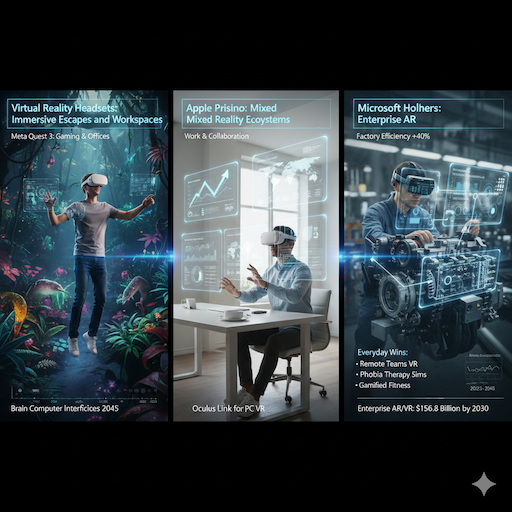
Virtual reality headsets create full dives into digital realms. Beyond gaming, they host virtual offices, slashing travel costs. Meta’s Quest 3, with 50.8% market share in Q1 2025, grew 18.1% year-over-year.
Apple enters with Vision Pro’s mixed reality (MR) blend—mixed reality ecosystems overlay virtual on real. Microsoft’s HoloLens shines in factories, cutting errors 40% via holograms. XR shipments? Up 10% in 2024, eyeing 38.6% CAGR to 2029.
Everyday Wins:
- Remote teams collaborate in shared VR rooms.
- Therapists treat phobias via safe simulations.
- Fitness apps gamify workouts in fantasy worlds.
Early adopters, try Oculus Link for PC VR—start small, build immersion skills. Strategists: Note enterprise AR/VR’s $156.8 billion by 2030. Brain Computer Interfaces 2025-2045
Wearable Technology: Your Body as the Interface
Wearable technology shrinks devices to skin-close. Smart rings like Oura track sleep with 95% accuracy; watches like Apple Watch detect falls, saving lives.
Google’s Fitbit evolves into AI hubs, predicting health dips. Wearable technology market? Part of the $303 billion AI wearables boom by 2035. Samsung’s Galaxy Ring adds gesture controls—wave to skip songs.
Pro Tips for Adoption:
- Health tracking: Pair with apps for personalized plans.
- Productivity: Use for focus timers via haptics.
- Career edge: Highlight gesture-based control in resumes for UX roles.
Investors eye future consumer electronics here—74% of VCs fund wearables in 2025 portfolios.
AI-Powered Assistants: The Proactive Brain
AI-powered assistants go beyond Siri. They learn habits, act independently. OpenAI’s Operator model books flights sans input. Google’s Gemini handles multi-step tasks like “Plan my week.”
Ambient versions embed in homes—lights dim on mood via sensors. Market? AI drives 6-10% revenue gains for 70% of Fortune 500.
How to Leverage:
- Daily: Set “proactive mode” for reminders.
- Work: Integrate with tools for auto-reports.
- Learning: Ask for breakdowns of complex topics.
For students: Study AI and spatial computing shaping the next tech era—key for tech interviews.
Brain-Computer Interfaces (BCI): Thought to Action
Brain-computer interfaces (BCI) link minds directly to machines. Neuralink’s N1 implant, with 1,024 electrodes, achieves 99.2% accuracy in thought control. First human trials in 2024 helped paralyzed users game and tweet.
Synchron’s stent-based BCI raised $75 million. The role of brain-computer interfaces in future tech? From memory boosts to creativity amps. Market: $1.8 billion invested in 2024, up 156%. Future Beyond Smartphones: Tech’s Next Leap2
Ethical Steps Forward:
- Prioritize consent—74% worry about privacy.
- Start non-invasive: EEG headsets for meditation.
- Discuss in convos: How BCI aids accessibility.
VCs pour in; it’s a $24.7 billion play by 2030.
Ambient Computing and Holographic Interfaces
Ambient computing makes tech invisible—sensors in walls adjust temps on entry. Microsoft’s Azure powers smart offices; OpenAI prototypes reconfigure rooms.
Holographic interfaces project 3D images—think Star Wars calls. Mojo Vision’s contact lenses test retinal displays. What comes after smartphones in consumer technology? This seamless web.
Integration Guide:
- Home: Link bulbs to voice AI.
- Office: Use for collaborative holograms.
- Future-proof: Learn IoT basics via free courses.

How Top Companies Are Preparing for a Post-Smartphone Future
Each giant carves a path. Let’s spotlight strategies.
Apple’s Seamless Ecosystem Play
Apple invests $8.3 billion yearly in spatial tech. Vision Pro integrates with iPhone, but rumors swirl of “Apple Glass” in 2026—lightweight AR at $499. Tim Cook: “It’s not about replacing phones; it’s expanding horizons.” For devs, this means SwiftUI for XR apps.
Actionable Insight: Build iOS extensions for wearables—boosts resumes.
Meta’s All-In on Metaverse and AI
Meta’s $50 billion Reality Labs bet yields Hypernova glasses—holographic AI companions. Zuckerberg eyes 13 million AR shipments by 2030. Partnerships with EssilorLuxottica amp fashion appeal.
Tip for Innovators: Experiment with Meta’s Spark AR for quick prototypes.
Google’s Open XR Ecosystem
Google’s $5.7 billion R&D births Android XR with Samsung. Project Astra uses glasses for gesture AI. CEO Sundar Pichai: “AI will make tech feel magical.” Acquisitions like North bolster wearables.
Career Hack: Certify in Google Cloud AI—hot for strategist roles.
Microsoft’s Enterprise Focus
$3.2 billion fuels HoloLens 3 for industrial MR. Azure AI enables ambient offices. Satya Nadella stresses “empowering every person.”
Business Angle: Pitch HoloLens for training—cuts costs 30%.
Emerging Players: Neuralink and OpenAI
Neuralink’s Elon Musk targets 200 million users by 2030. OpenAI’s $3.4 billion hardware push includes robotics AI.
For Students: Follow Neuralink trials—great essay fodder.
Impact on Industries and Daily Life
This shift ripples wide.
Revolutionizing Work and Productivity
Top companies investing in post-smartphone innovations like AR cut remote silos. Virtual meetings feel real; AI agents handle admin. PwC predicts 45% productivity jumps by 2030.
Daily Workflow Tips:
- Adopt voice notes over typing.
- Use AR for quick scans—e.g., product specs.
- Train on virtual and mixed reality gadgets for everyday use.
Transforming Education and Healthcare
Students don VR for history dives; med schools simulate surgeries. Career skills needed for future tech innovations include XR design.
In health, wearables spot issues early—Apple Watch saved 1,000+ lives via AFib alerts. Entertainment and Social Shifts.Holographic concerts? Meta tests them. Social apps go spatial—chat in shared worlds. Engagement Boost: 40% more time in immersive media, per Nielsen.
Challenges and Roadblocks Ahead
No leap lacks hurdles. Battery woes persist—89% prioritize longevity. Privacy? 74% fear BCI data leaks. Social norms: 34% shun visible wearables.
Overcoming Them:
- Innovate sustainably: Energy-harvesting fabrics.
- Build ethics: Consent-first designs.
- Educate: Workshops on new interfaces.
Reassurance: Giants iterate fast—Vision Pro v2 drops eye strain 45%. Tech Giants Envision Future Beyond Smartphones3
Preparing Your Career for the Post-Smartphone Wave
For industry pros and students, this era demands upskilling. How tech giants are preparing for a post-smartphone future? By hiring multimodal experts.
Interview Prep List:
- Research roadmaps—e.g., Google’s XR.
- Practice screen-free pitches: Voice-record responses.
- Highlight projects: Build a simple AI agent.
- Discuss ethics: Privacy in ambient systems.
- Network: Attend CES 2026 for trends.
Verve Copilot-style tools simulate scenarios—try free versions. Business stakeholders: Track investment opportunities in next-gen computing via Crunchbase.
FAQs
Why do big tech companies want new stuff after smartphones now?
Almost everyone has a smartphone already. New phones are not much different, so people don’t buy them as much. Everyone wants tech that is easy and fun – not just staring at a small screen all day. Big companies are spending tons of money (more than 150 billion dollars!) on new magic glasses and smart helpers to make life happier.
What are the cool new things instead of smartphones?
The best new ones are special glasses that put pictures right in your eyes (called AR glasses), smart watches that know what you are doing, and brain tools where you think to make things happen. These mix real-world with computer fun. Soon you can wave, talk, or think to play, chat, or work – no phone needed! It feels like magic.
How does this change jobs in tech?
Many new jobs are coming fast! We need people to make sure AI is kind and fair, and people to build fun computer worlds. These jobs pay a lot of money. If you want a tech job, learn AI or magic glasses now. Take easy classes online. Big companies like Apple and Meta want to hire you!
Are these magic glasses and headsets ready for everyone?
Yes! More people are getting them every day. In 2025, many new ones came out, and sales went way up. Prices are coming down – soon, good ones will cost only about 300 dollars. With fun games and easy apps, kids and grown-ups will love them just like phones.
When will this new tech be the main thing we use?
It is starting right now in 2025 and 2026. People who love new toys try them first. By 2028, most people will use them every day. Experts say more than 200 million people will have them by 2030. Smartphones will feel old and boring soon. The future is super fun – get ready!
Conclusion
Big tech companies dream of a future where tech helps us without bugging us all the time. It should make life freer and better – not pull us away from real people and fun.
New cool things are coming:
- Magic glasses that put words and pictures right in front of your eyes (called augmented reality or AR).
- Brain helpers (called brain-computer interfaces or BCI) that let you control stuff just by thinking!
These new ideas will help us feel closer to friends and get things done faster. We’ve seen $150B+ bets yield prototypes today, with markets exploding tomorrow. For enthusiasts, it’s excitement; for pros, opportunity; for leaders, strategy.
In summary, the post-smartphone era arrives via bold investments and user-centric designs. It redefines human-computer interaction, making digital life ambient and intuitive. As barriers fall, so do limits on what’s possible. What excites you most about this future—AR glasses for travel or AI companions for daily ease? Share in the comments!