

The world of learning has changed fast. In 2022, the elearning market nearly $400 billion in value showed just how big online education had become. This huge number came from more people and companies turning to digital tools for training and classes. Experts say the market hit $399.3 billion that year. It marked a big shift. People wanted flexible ways to learn skills, from job training to school courses. This growth touched everyone, from big businesses to single students. As we look back, it’s clear this boom set the stage for even bigger changes ahead.
Think about it. Before 2020, online learning was nice to have. Then, a global event pushed it to must-have status. By 2022, companies spent billions on digital learning growth to keep workers sharp. Schools added online options to reach more kids. And everyday folks grabbed courses on their phones. This article dives deep into that moment. We’ll cover stats, trends, and tips. You’ll see why leaders in corporate training online and beyond can’t ignore it.
What Made the elearning market nearly $400 billion 2022?
Let’s start with the basics. The elearning market nearly $400 billion 2022 figure wasn’t just a guess. It came from real data on sales of courses, software, and tools. Reports show the total value reached $399.3 billion. That’s up from smaller numbers just a few years before. Why the jump? Simple: more users and better tech.
First, count the players. Over 1 billion people used online learning platforms by then. That’s one in eight folks worldwide. In the U.S. alone, 17.3 million signed up for sites like Coursera. Companies added it to train teams. Schools went hybrid. Everyone wanted skills that fit busy lives.
Second, tech made it easy. Fast internet, cheap devices, and apps let learning happen anywhere. Mobile learning adoption soared. People finished courses 45% faster on phones. No more sitting in stiff chairs. Just tap and go.
But let’s break it down by group. Who drove this elearning revenue 2022? We’ll look at key audiences next.
Corporate and Enterprise Learning Leaders: The Big Spenders
If you’re in HR or L&D (Learning & Development), this market is your playground. In 2022, corporate elearning statistics painted a bright picture. Businesses dropped $245.5 billion on training that year. Why? Upskilling workers saved money and boosted output.
Picture this: A tech firm needs to teach 1,000 staff about new software. Old way? Fly them to a hotel for days. Cost? Thousands per head. New way? Online modules. Cost? Pennies. Plus, workers learn at their pace. Studies show online training and courses cut costs by 50% while raising retention by 70%.
Key stats for you:
- 98% of companies used or planned elearning adoption rates by 2022.
- 63% of U.S. workers took a training class that year.
- Every $1 spent on online learning returned $30 in gains, like at IBM.
Training and development solutions focused on compliance, onboarding, and skills. For example, banks used virtual classroom trends for safe, quick rule updates. No travel risks. Just log in from the office.
Tips for leaders:
- Pick the right LMS. Look for ones with mobile access. In 2022, the learning management system (LMS) market hit $20 billion. Top picks integrated AI for personal paths.
- Start small. Test with one team. Track completion rates. Adjust based on feedback.
- Measure ROI. Use quizzes and surveys. See if skills stick six months later.
- Go micro. Short bursts work best. 80% of workers love microlearning, which ups engagement.
This group poured cash into corporate elearning platforms market share. Leaders like LinkedIn Learning and Udemy for Business grabbed big slices. Why? They offered ready content on hot topics like data analysis and leadership.
But challenges? Not all. Some firms worried about tech gaps. Older workers needed extra help. Solution? Blend online with in-person chats. That hybrid mix became gold in 2022.
Now, expand to schools. Educators faced their own wins and hurdles.

Educators and Academic Institutions: Reaching Far and Wide
Universities and K-12 schools jumped in, too. By 2022, 98% of colleges offered online courses. The virtual learning market grew as remote students rose. Why? Flexibility for busy parents and far-off towns.
Take higher ed. Distance learning statistics showed 63% of students picked online for ease. Programs in nursing or business went digital. Institutions saved on rooms and reached global crowds. One U.S. uni added 10,000 remote learners in a year.
For K-12, it was about access. In rural Asia, government apps brought lessons to kids without buses. Student online engagement jumped 35% with fun tools like games.
E-learning trends 2022 included hybrid setups. Half classes online, half in seats. This mix cut dropouts by 20%. Tools? Platforms like Canvas or Moodle. They tracked progress and sent alerts to teachers.
Examples in action:
- A UK school used digital education tools for math. Scores rose 15% as kids practiced daily.
- In Australia, universities built online course platforms for indigenous groups. Enrollment doubled.
For coordinators and planners:
- Focus on inclusion. Add subtitles and voice options. 75% of users want this.
- Use data. See which lessons click. Tweak weak spots.
- Partner up. Link with edtech firms for fresh content.
This sector added $103.8 billion to the pot in 2023, but roots were in 2022’s boom. It proved online education market forecast could touch billions more.
Shifting gears, let’s see solo users.
Individual Learners: Fueling Bottom-Up Demand
You might be here—a worker eyeing a promotion or a parent learning guitar. In 2022, folks like you drove skill development programs. Subscriptions to sites like MasterClass or Khan Academy spiked.
Stats tell the tale:
- 74% of U.S. adults called themselves lifelong learners.
- 49% finished an online course that year.
- Upskilled workers earned $8,000 more yearly.
Why join? Time crunch. A course takes hours, not weeks. Professional development courses covered coding, marketing, and even cooking. Platforms made it cheap—$10 a month for unlimited.
Real stories:
- Sarah, a marketer in Canada, took SEO classes. Landed a raise in three months.
- Tom in India switched careers via free coding bootcamps. Now he’s a dev.
Tips to thrive:
- Set goals. Pick one skill. Track weekly progress.
- Mix formats. Videos for overviews, quizzes for tests.
- Join communities. Forums share tips and motivate.
- Certify it. Badges prove your wins to bosses.
This crowd grew the global elearning market by sheer numbers. They tested trends that big firms later copied.
EdTech Builders and Entrepreneurs: Building the Future
Got an idea for an app? 2022 was prime time. With the edtech market size at nearly $400 billion, creators eyed gold. Think authoring tools or niche LMS.
Key insights:
- The LMS market grew 16.4% yearly.
- AI tools boomed at a 45% CAGR.
- Gamification upped scores by 35%.
Startups like Duolingo thrived on fun lessons. Others built VR sims for safe practice. Funding? VCs poured in, seeing the online learning industry size double soon.
Steps to launch:
- Validate need. Survey 100 users. See pain points.
- Build MVP. Simple version first. Test fast.
- Monetize smart. Freemium draws crowds, subs keep cash.
- Scale global. Target English first, then localize.
These innovators shaped digital learning growth. Their tools made the market sticky.
Investors and Analysts: Spotting the Next Big Bet
For VCs, 2022 screamed opportunity. The elearning market nearly $400 billion 2022 lured deals. M&A hit records as firms bought content libraries.
Forecasts:
- Hit $1 trillion by 2032 at 14% CAGR.
- Asia led with 21% growth.
- AR/VR to $142 billion by 2031.
Watch trends like AI personalization—57% efficiency boost. Or mobile, at $60 billion.
Tips:
- Dig reports. Check Statista’s e-learning data for baselines1.
- Track users. Growth in sign-ups signals winners.
- Bet on niches. Corporate compliance or K-12 STEM.
This intel guides smart plays in a hot sector.
Key Trends Shaping the 2022 Boom
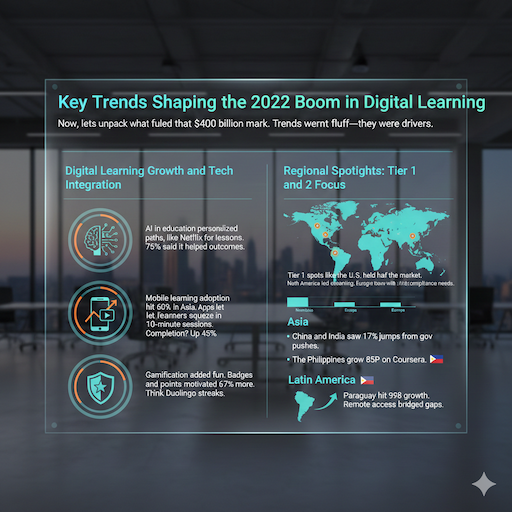
Now, let’s unpack what fueled that $400 billion mark. Trends weren’t fluff—they were drivers.
Digital Learning Growth and Tech Integration
Tech led the charge. AI in education personalized paths, like Netflix for lessons. 75% said it helped outcomes.
Mobile learning adoption hit 60% in Asia. Apps let learners squeeze in 10-minute sessions. Completion? Up 45%.
Gamification added fun. Badges and points motivated 67% more. Think Duolingo streaks.
Regional Spotlights: Tier 1 and 2 Focus
Tier 1 spots like the U.S. held half the market. North America led corporate elearning. Europe followed with strict compliance needs.
Asia. China and India saw 17% jumps from gov pushes. The Philippines grew 85% on Coursera.
Latin America? Paraguay hit 98% growth. Remote access bridged gaps.
Challenges and Wins in Corporate Training Online
Not all smooth. Internet lags hit poor areas. Fix? Offline modes in apps.
Wins? Cost drops. Firms saved 50% on travel. Engagement rose with short videos.
Case: A bank cut onboarding from weeks to days. New hires are productive faster.
Forecasts: What’s Next After 2022?
The global elearning market projected growth 2022-2030 looks wild. From $399 billion, expect $848 billion by 2030. CAGR? 17.5%.
Online education market forecast hits $1 trillion by 2032. Drivers: AI, VR, and more users.
By sector:
- Corporate: $462 billion by 2027.
- Mobile: $184 billion by 2028.
Top trends in digital learning and edtech 2022 carry on. Microlearning, personalization— they’ll dominate.
For best learning management systems for enterprises 2022, picks like Docebo shone. They scaled for thousands.
Impact of virtual learning on corporate training budgets? Positive. More spend, better results.
In ed? Elearning adoption rates in higher education 2022 at 94%. Online skill development platforms market trends point to hybrid wins.
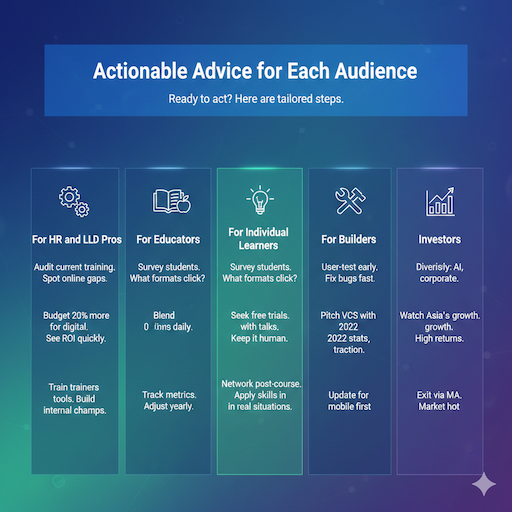
Actionable Advice for Each Audience
Ready to act? Here are tailored steps.
For HR and L&D Pros
- Audit current training. Spot online gaps.
- Budget 20% more for digital. See ROI quickly.
- Train trainers on tools. Build internal champs.
For Educators
- Survey students. What formats click?
- Blend tech with talks. Keep it human.
- Track metrics. Adjust yearly.
For Individual Learners
- Dedicate 30 mins daily. Build a habit.
- Seek free trials. Test platforms.
- Network post-course. Apply skills in real situations.
For Builders
- User-test early. Fix bugs fast.
- Pitch VCs with 2022 stats. Show traction.
- Update for mobile first.
For Investors
- Diversify: AI, mobile, corporate.
- Watch Asia’s growth. High returns.
- Exit via M&A. Market hot.
Quotes from Experts
“Online learning isn’t the future—it’s now. The $400 billion proves demand.” – Devlin Peck, oneLearning market insights2.
“Stats show eLearning boosts productivity 30x.” – iSpring team, viatheir stats blog3.
These voices echo the shift.
FAQs
What was the size of the eLearning market in 2022?
The global eLearning market reached nearly $400 billion in 2022, with experts reporting a value of $399.3 billion.
Why did the eLearning market grow so much in 2022?
More people and companies needed flexible learning. Fast internet, cheap phones, and better apps made it easy. The big changes from 2020 made online learning a must-have.
What is the biggest benefit of corporate eLearning?
It saves money (up to 50% less than in-person training) and helps workers remember more (up to 70% better retention).
What are the main trends that drove eLearning growth in 2022?
Mobile learning, AI for personal lessons, gamification (like badges and points), and short microlearning sessions were the top trends.
How can I start using eLearning if I am an individual learner?
Pick one skill, set aside 30 minutes a day, try free trials on platforms like Coursera or Khan Academy, and join communities for support.
Conclusion
We’ve covered a lot. From corporate budgets to student screens, the elearning market nearly $400 billion 2022 was a turning point. It blended tech, need, and scale. Growth came from real pains solved—cost cuts, access gains, skill boosts.
As we eye 2030, stay nimble. Adopt AI, go mobile, measure wins. Whether you’re leading a team, teaching a class, or learning solo, online tools empower.
In summary, that 2022 milestone wasn’t end—it’s start. The market’s path promises more innovation, more reach, more impact. What’s your next step in this digital wave?