
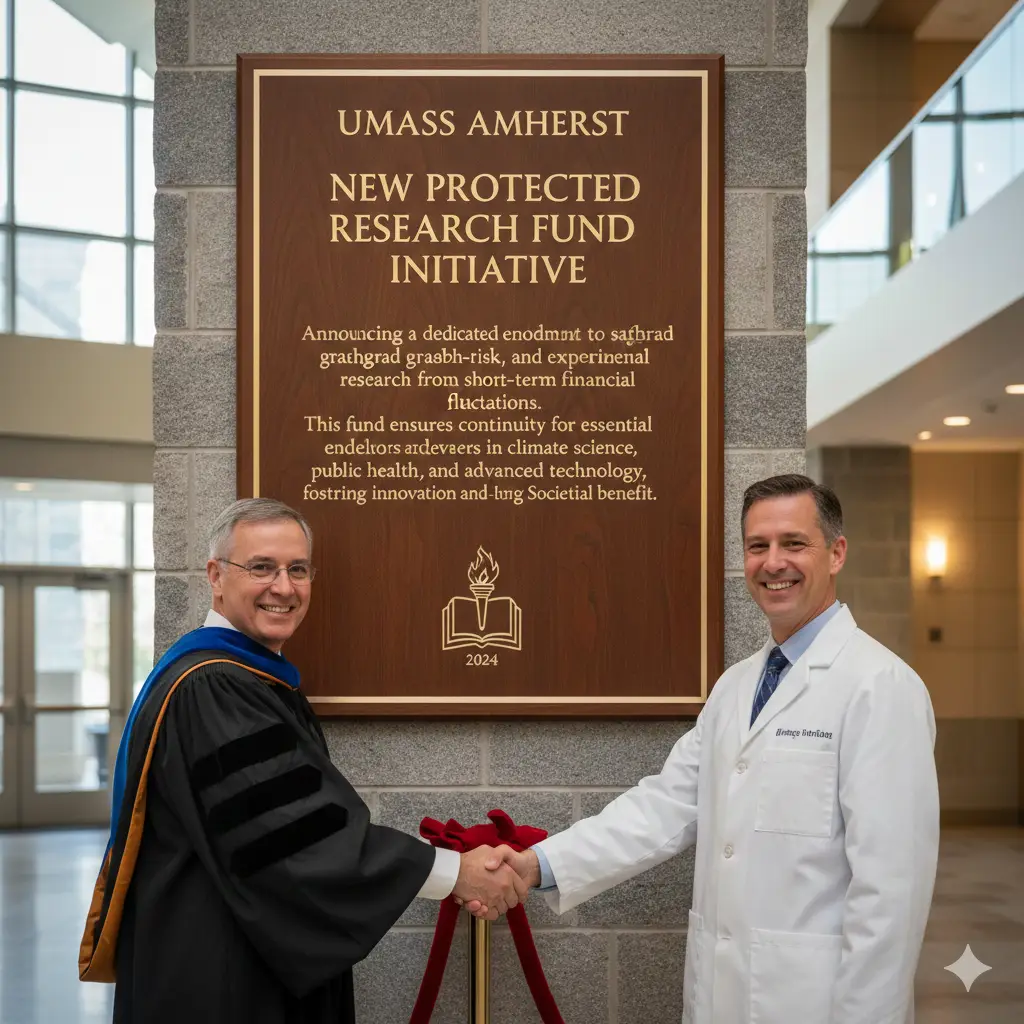
The announcement highlights a commitment to the campus community. With over $150 million in annual federal research dollars at stake, the fund steps in to cover gaps. This helps prevent layoffs, project halts, and lost opportunities. For faculty leading these efforts, it means continuing groundbreaking work without interruption. Graduate students and postdocs can focus on their studies rather than worry about stipends. Research staff gain stability in their roles. Even administrators play a key part by providing matching contributions.
This article explores the fund’s details, from its creation to application steps. It breaks down benefits for key groups and offers insights into broader impacts. Whether you’re a principal investigator or a department chair, understanding this resource can help navigate challenging times.
Background on UMass Amherst Research Landscape
The University of Massachusetts Amherst stands as a powerhouse in academic research. This school started long ago in 1863. Back then, it was just a small college to teach farming. Now it is a very big public university. It does lots of important research that helps the whole world. More than 30,000 students go there. The teachers work hard to learn new things and share them.
Their research covers many cool topics. They make special cancer treatments just for one person. They build robots to help doctors and nurses. They also find new ways to use clean energy so we can help the Earth.
Some scientists study tiny parts of life, like genes and molecules. They use smart computer ideas that copy nature. Other projects help make things fairer. They look at how climate change hurts different groups of people. They use facts and data to make things better.
There are also projects to help kids and families who need extra support. They work to give everyone a good chance to learn. Special groups pay for this important work.
UMass Amherst is a place where big ideas turn into real help for people!
Statistics underscore the scale. In recent years, the university’s research expenditures have climbed steadily. System-wide, UMass hit a record $813 million in 2023, with a heavy emphasis on STEM fields at 93% of that total. In the school year 2025, UMass Amherst got more than $180 million just from the U.S. government. This big money helps pay for thousands of jobs and makes the whole state of Massachusetts stronger. Research money like this creates about 81,300 jobs and brings in $16 billion to help the economy.
But this government money is not always safe. New rules in 2025 made things shaky. Under the Trump team, many schools lost billions of dollars because of checks about things like antisemitism or special programs.
UMass Amherst lost $29 million in research money. Because of this, the school had to cut its budget by 3 to 5%. These cuts slow down new ideas that could help make better medicines or cool new technology.
People who know a lot are worried. Professor Paul Katz, who leads the biology department, said, “Everyone is scared about what will happen to research and schools in the future.” He explained that stopping basic science work hurts big discoveries, like in brain studies.
Across the whole country, cuts to groups like NIH and NSF could take away $10 to $16 billion from the economy every year. For UMass, it means they have to use money just to keep going instead of growing. They even had to wait for fixing buildings and other important things.
Even with these hard times, UMass keeps doing great work. Kind people gave $4 million to help keep important studies going. In 2024, twelve teachers got special school money for projects about AI, fairness, and other cool topics. This foundation sets the stage for emergency measures like ResCoE.
Why Federal Funding Interruptions Matter
Federal grants form the backbone of university research. They enable large-scale projects that private funding might overlook. At UMass Amherst, these dollars support everything from lab equipment to personnel salaries. When interruptions occur, the fallout is swift.
Consider the impact of federal grant interruptions on academic research. Projects grind to a halt, data collection stops, and collaborations dissolve. Graduate students risk losing stipends, forcing them to seek other work or drop out. Postdocs face visa issues, complicating international talent retention. Research staff encounter layoffs, disrupting family stability.
Economically, the stakes are high. Massachusetts thrives on innovation, with research driving job creation and income. Cuts threaten this ecosystem. Nationally, disruptions lead to financial instability, with some institutions reporting 10-25% funding declines. In 2025, the Trump team stopped almost $6 billion from going to nine big schools. They held the money until the schools agreed to make some changes.
UMass Amherst was one of the schools that felt this. It was not the only one in trouble.
The Department of Education started looking closely at how schools handle unfair treatment and discrimination on campus. This check puts more pressure on schools and could mean even more money gets held back.
To fight back, UMass Amherst worked together with leaders from the state of Massachusetts. They got a special court order (called a temporary restraining order) to protect one important grant so the money could keep coming.
But big worries are still there. Some people who work for the government lost their jobs. There are also new rules that limit how much extra money schools can get for things like buildings and supplies (called indirect costs).
This graphic shows the cascading effects, from delayed discoveries to economic losses. For UMass, protecting projects means safeguarding the state’s competitive edge.
Introducing UMass Amherst announces new research fund to protect some projects
To counter these threats, UMass leadership launched the emergency research fund UMass. Announced in March 2025 by Provost Fouad Abd-El-Khalick and Vice Chancellor Mike Malone, ResCoE provides temporary matching support. Extended through December 31, 2025, it draws from diverted campus resources.
The fund’s core goal: Ensure university research continuity fund during shortfalls. It covers salaries, stipends, and essential expenses for affected projects. By requiring a one-to-one match from departments, it encourages shared responsibility.
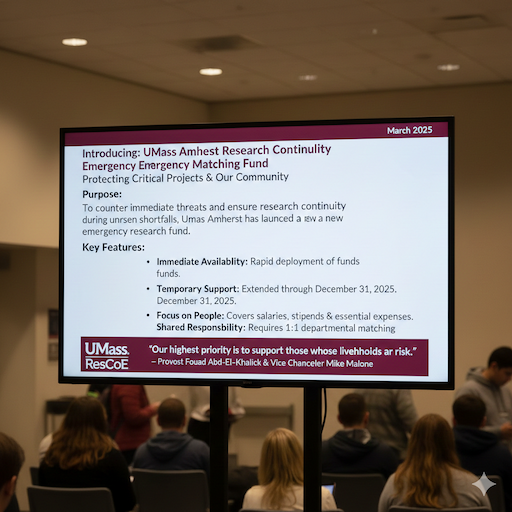
Key features include:
- Immediate availability: Funds are released quickly to bridge gaps.
- Temporary nature: Designed as a stopgap, not permanent.
- Focus on people: Prioritises livelihoods over equipment.
This approach reassures the community. As the announcement states, “Our highest priority is to support those whose livelihoods are at risk.” It acknowledges anxieties and commits to transparency. Announcing the UMass Amherst Research Continuity Emergency Matching Fund1
Eligibility Criteria for the Fund
Not every project qualifies for ResCoE. Eligibility ties directly to federal actions. Here’s a breakdown:
- Active federal grants: Must involve current contracts terminated or interrupted by the government.
- Specific uses: Funds apply to base salaries of postdocs, staff, and faculty; graduate stipends and tuition; and limited research costs with justification.
- No broad applications: Ineligible for anticipated cuts or non-federal issues.
Priorities favour groups like graduate students and postdocs, whose graduate student research funding depends on grants. This ensures postdoctoral funding continuity amid uncertainties.
If your project fits, check the official criteria. The university monitors federal developments to adjust as needed.
How to Apply for ResCoE Funding
Applying is straightforward but requires preparation. Follow these bold steps for success:
- Review eligibility: Confirm your grant’s interruption status.
- Gather approvals: Secure sign-off from PIs, department heads, and deans.
- Prepare matching plan: Identify sources for the one-to-one match, like RTF funds.
- Submit the form: Use the online intake form from the provost’s office.
- Provide details: Include budget breakdowns and justifications.
- Contact support: Reach Laura Vandenberg or Deb Gould for questions.
The process emphasises collaboration. Departments must commit matching dollars, fostering teamwork. Once approved, funds are disbursed promptly.
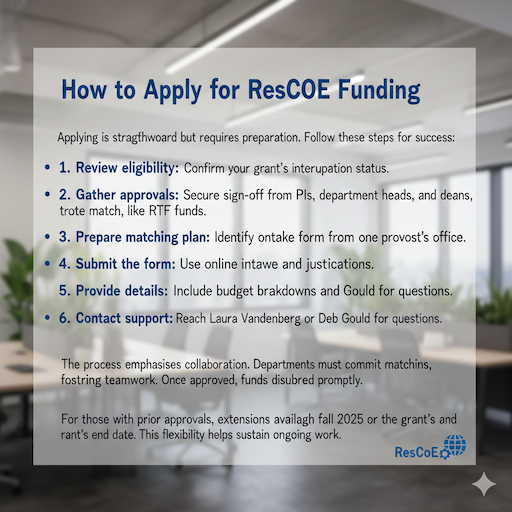
For those with prior approvals, extensions are available through fall 2025 or the grant’s end date. This flexibility helps sustain ongoing work.
Benefits for UMass Amherst Faculty and Principal Investigators
Faculty and PIs lead the charge in research. ResCoE offers them principal investigator grant support to maintain momentum.
It prevents project cancellations, allowing continued data analysis and publications. This protects careers, as funding gaps can derail tenure tracks or grant renewals.
One example: A biology PI facing a neuroscience grant cut can use ResCoE to keep lab operations running. This ensures team stability and upholds commitments.
Overall, it reassures PIs that the university backs their efforts during turbulent times.
Support for Graduate Students and Postdoctoral Researchers
These groups often bear the brunt of cuts. ResCoE prioritises protecting graduate student and postdoc salaries during grant interruptions.
Graduate students gain secure stipends and tuition waivers, letting them focus on their theses. Postdocs avoid visa disruptions, crucial for international scholars.
Quotes from affected individuals highlight relief: “It’s a shame we need this, but it’s great the university stepped up.” This support maintains funding for research staff and postdocs, preserving talent pipelines.
Advantages for Research Staff and Technical Personnel
Staff provide essential technical expertise. The fund covers their salaries, preventing layoffs.
This stability keeps labs functional, from maintaining equipment to data management. In fields like chemistry or physics, their roles are irreplaceable. Announcing the UMass Amherst Research Continuity Emergency (ResCoE) Matching Fund2
By including them, ResCoE ensures university programs to protect staff and researchers from grant loss.
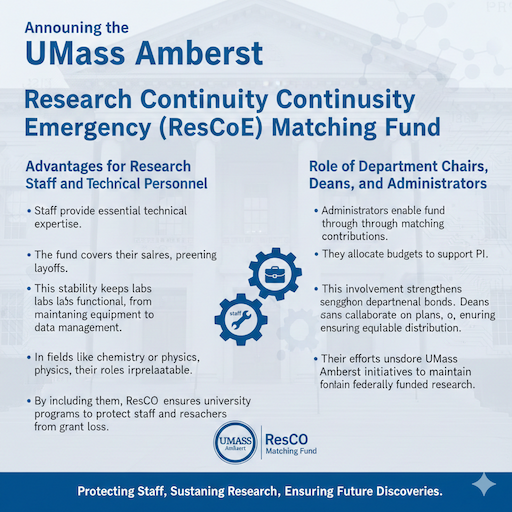
Role of Department Chairs, Deans, and Administrators
Administrators enable the fund through matching contributions. They allocate budgets to support PIs.
This involvement strengthens departmental bonds. Deans collaborate on plans, ensuring equitable distribution.
Their efforts underscore UMass Amherst initiatives to maintain federally funded research.
Broader University Community and Local Impact
Beyond core groups, the fund raises awareness campus-wide. Students learn about research resilience, while staff appreciate transparency.
Locally, it signals UMass’s role in Massachusetts’ economy. Emergency financial support for academic research in Massachusetts bolsters community trust. UMass Amherst Launches New Research Fund Amid Concerns of Federal Cuts3
Public stakeholders, including taxpayers, see how the university responds to federal changes, fostering support.
Similar Initiatives at Other Universities
UMass isn’t pioneering this alone. UC Berkeley launched a 2025 Emergency Research Fund for terminated awards. UConn’s EMERGE program offers short-term aid for interrupted funding.
These models share goals of continuity, showing a national trend in emergency matching funds for university research projects.
FAQs
What is the ResCoE fund?
The ResCoE fund is a special emergency program at UMass Amherst. It gives extra money to help keep important research going when federal funding gets stopped or cut. The school matches money to protect projects and the people working on them.
Who can apply?
Principal Investigators (PIs) can apply if they have federal grants. This includes grants that are still active or ones that got ended early because of funding problems. The main focus is on helping the researchers and staff who are affected by the cuts.
How much matching is needed?
The school will match the money one-to-one from its own funds. That means for every dollar the department or other internal sources give, the university gives one more dollar. This doubles the help for the research projects.
When does it end?
The ResCoE fund program ends on December 31, 2025. It might change if there are new updates or decisions. Right now, that is the last day to use this special help.
Where to learn more?
Go to the Provost’s website at UMass Amherst to see the full announcement. There, you can read all the details and rules about the ResCoE fund. It is the best place to get the latest information and how to apply.
Conclusion
In summary, UMass Amherst made a new special fund called ResCoE. It helps keep some important research projects going when money from the government gets stopped or cut. This fund is a smart and quick way to fight the big uncertainties with federal money. It protects the jobs of the people who do the research. It also keeps new ideas and discoveries alive. Everyone at the school works together as a team to make this happen. By saving these research projects, UMass Amherst remains one of the best places for new learning and big discoveries!
What steps will you take to explore this fund for your work?