
Track invoices and payments received as related but separate records. An invoice tells you what a client owes under the invoice terms. A payment record tells you what was paid, when it was processed, and how much cash ultimately became available. Matching the two explains outstanding balances without treating every bank deposit as a new sale.
This guide focuses on reconciliation: partial payments, fees, timing, and corrections. If you need to build spreadsheet columns and formulas from scratch, start with the freelancer income tracker guide. Every client and transaction below is fictional. The examples illustrate bookkeeping controls and cash planning rather than reporting actual business results.
Maintain an invoice view and a cash view
The invoice view answers who owes money, how much remains, and which agreed due date applies. The cash view answers how much was received, what fees or refunds reduced it, and when the net amount reached an accessible account. Neither view replaces the other.
| Invoice record | Payment record | Why the distinction matters |
|---|---|---|
| Invoice number and client | Invoice reference on payment | Links each receipt to the right receivable |
| Invoice issue and due dates | Payment and bank-settlement dates | Separates contract timing from available cash |
| Invoice total | Gross payment, fee, and net deposit | Explains why the bank amount can be smaller |
| Credits or approved adjustments | Refunds and chargebacks | Prevents stale balances after a correction |
| Outstanding amount | Payment status | Distinguishes unpaid from pending settlement |
Give each transaction a unique reference. Client names alone are unreliable when a repeat client has several open invoices. If a payment covers multiple invoices, split the allocation in your reconciliation schedule while preserving the single actual bank transaction.
Use separate formulas for receivables and deposits
Outstanding invoice balance = invoice total − approved credits − payments applied. The payments applied are generally the amounts credited against the client's obligation, not automatically the smaller net bank deposit after a processor fee.
Net settlement = gross payment − processor fees − other settlement deductions. Check the processor statement for the actual deductions. A single net deposit may bundle multiple customer transactions, fees, or adjustments, so do not guess the split from the bank amount alone.
These are reconciliation formulas. The correct accounting treatment of deposits, credits, refunds, and fee expenses depends on the arrangement and accounting method. Do not use the cash-planning label “received” as a substitute for determining when income must be recognized for tax purposes.
Worked example: partial payment with a fee
A fictional freelance writer issues invoice W-104 for $1,200. The client makes a $400 partial payment. In this illustration, a processor deducts an actual $12 fee and later sends $388 to the bank.
| Item | Amount | Effect |
|---|---|---|
| Original invoice | $1,200 | Starting amount owed |
| Gross client payment | $400 | Reduces amount owed by $400 |
| Processor fee | $12 | Explains settlement difference |
| Net bank deposit | $388 | Cash reaching the bank |
| Remaining invoice balance | $800 | $1,200 minus $400 |
Subtracting only $388 from the invoice would incorrectly show $812 still owed, assuming the client has fulfilled $400 of the agreed obligation and the freelancer bears the fee. The missing $12 is a fee reconciliation issue, not another $12 to collect from the client. Different contract or surcharge arrangements require their own treatment.
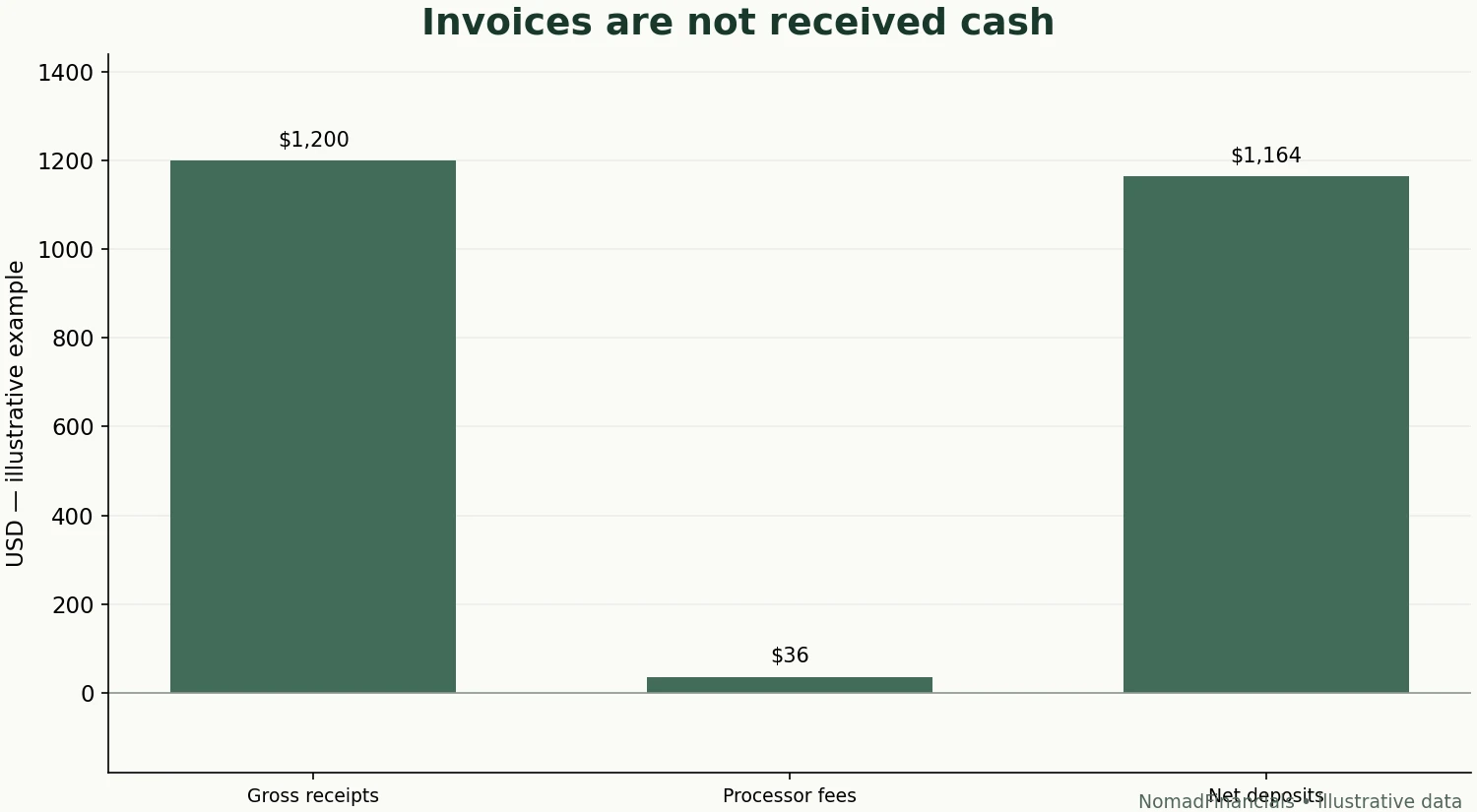
If the remaining $800 is paid later and a separate $24 fee applies, the second bank deposit is $776. Across both payments, gross receipts are $1,200, fees are $36, and bank deposits are $1,164. The invoice is fully settled: $1,200 − $400 − $800 = $0.
Keep settlement timing visible
Suppose the processor marks the first $400 paid on October 8, but the $388 bank deposit becomes available on October 10. The client-payment status and the available-cash date answer different questions. A bill due on October 9 cannot safely rely on that October 10 bank settlement unless some other accessible balance covers it.
For a cash forecast, put the net accessible receipt on the expected availability date and label any uncertainty. For your accounting records, use the dates and treatment appropriate to your accounting method. A cash-flow calendar makes the practical gap visible without rewriting the invoice issue date.
Do not count the processor receipt and subsequent bank transfer as two client payments. They are stages of the same underlying receipt. If you track both accounts, record the movement between them as a transfer with matching references.
Handle bundled and split payments
A client may send $1,000 covering $650 on invoice A and $350 on invoice B. Your bank shows one receipt, while the invoice ledger needs two allocations. The sum of allocations should equal the gross payment: $650 + $350 = $1,000. Any unallocated difference needs investigation.
For the opposite situation, one $1,000 invoice may be paid through two methods: $300 by bank transfer and $700 through a processor. Keep two payment references linked to the same invoice. Mark it settled only when the applied payments and any approved credits reconcile to the amount owed.
Do not force a match merely because two amounts look similar. Ask for remittance information when needed. A short note such as “client confirmed allocation by email on October 12” is more useful than silently choosing the oldest invoice and hoping the client agrees.
Document credits, refunds, and overpayments
If an agreed $100 credit reduces a $1,200 invoice, the adjusted amount is $1,100 before payments. Preserve the original invoice reference and the credit documentation. Editing the original amount without an audit trail makes later reconciliation harder.
If a client overpays, identify the excess rather than calling it extra earnings by default. It may need a refund or a documented application to a future invoice. If a processor reverses a payment or applies a chargeback, the bank movement, invoice status, and related records all need review.
A correction should explain what changed, why, when, and who confirmed it. Keep source documents where you can retrieve them. Tax and accounting questions about the transaction should be resolved separately from the immediate job of making the cash and invoice records agree.
Run a four-step weekly reconciliation
- Export or inspect invoices, payment records, and relevant account statements for the same period.
- Match each gross payment to its invoice allocation and identify partial or unapplied receipts.
- Reconcile gross payments to net deposits using actual fees, refunds, and settlement records.
- Update outstanding balances and move expected receipt dates in the cash forecast where necessary.
End with an exceptions list: unidentified deposits, overdue balances, missing fees, and pending settlements. Give each item an owner action and review date. A short list of unresolved differences is more trustworthy than a tidy sheet containing invented matches.
Use the weekly money routine to keep this review manageable. When an invoice is genuinely late, move to the late-payment cash plan instead of leaving its original expected date untouched.
Frequently asked questions
Should I budget from invoices sent or cash received?
For bills you must pay, distinguish accessible cash from expected receipts. Invoices belong in the forecast and receivables record, but an unpaid invoice does not itself fund a bank payment.
Is the payment processor fee a client underpayment?
Not automatically. If the client satisfied the agreed gross amount and you bear the fee, the fee explains the smaller settlement. Check the contract and processor records before requesting more money.
Can I delete an incorrect payment row?
Correct errors in a way that preserves a clear record, particularly after a period has been reconciled. Use documented reversals or corrections as appropriate for your system instead of losing the explanation for changed balances.