
A freelancer cash flow calendar answers a question that a monthly income total cannot: will the money be available on the day a bill needs to be paid? A profitable project can still create a difficult week when the client pays after rent, software renewals, and essential household spending.
Start with the money available now, place expected receipts and planned payments on actual dates, and calculate the balance after every event. Keep uncertain receipts visible without treating them as money already received. The useful result is the lowest projected balance before the next payment arrives.
Example note: The freelancer and transactions below are fictional, realistic planning illustrations in US dollars. They are not a customer case study or a prediction of your results. Figures exclude tax calculations unless specifically described.
What a cash flow calendar does differently
A budget gives amounts a purpose. A calendar adds timing. You might have enough income for the month overall but still need to rearrange a discretionary purchase because the cash arrives on the 18th and the purchase is scheduled for the 10th. That timing problem can disappear inside a single monthly total.
A calendar also differs from a weekly freelancer cash flow forecast. The forecast helps compare several weeks and alternative scenarios. The calendar is the day-by-day operating view: what happens next, on which date, and what balance remains? Use both when bills cluster around a few dates.
Step 1: choose an honest starting balance
Record a dated opening balance from the account you are planning. If that account also holds money already set aside for a known obligation, decide how you will display it. One option is to show the full bank balance and list the reserved amount separately. Another is to start with available operating cash after excluding the reserve. Label your choice and use it consistently.
Do not subtract a reserve from the opening balance and also enter the same reserve transfer as an expense. That counts the same money twice. Similarly, a transfer between your own accounts changes the location of cash, not the combined total. An account-specific calendar can show the transfer; an all-account calendar should eliminate the internal movement.
Step 2: record these fields for each event
| Field | What to enter |
|---|---|
| Date | Expected bank-availability date or scheduled payment date |
| Description | Client receipt, bill, owner transfer, or planned purchase |
| Cash in / cash out | Use separate columns with positive amounts |
| Status | Planned, confirmed, received, paid, or delayed |
| Running balance | Previous balance + cash in − cash out |
| Next action | Confirm date, review purchase, or follow up |
An invoice due date is not always the bank-availability date. A payment may require processing, and a client may not yet have approved it. Your invoice and payment reconciliation should preserve both dates so the calendar does not quietly turn an unpaid invoice into spendable cash.
Worked example: a positive month with a tight first week
Imagine a freelance designer begins October with $1,800 of available operating cash. These are the events in the first half of the month. For simplicity, each receipt is shown net of any processing charges; a real ledger should retain gross receipts and fees separately when applicable.
| Date | Event | In | Out | Balance |
|---|---|---|---|---|
| Oct 1 | Opening available cash | — | — | $1,800 |
| Oct 2 | Workspace and software | — | $250 | $1,550 |
| Oct 3 | Planned household transfer | — | $1,000 | $550 |
| Oct 6 | Client A payment | $1,600 | — | $2,150 |
| Oct 8 | Equipment service | — | $400 | $1,750 |
| Oct 12 | Client B payment | $900 | — | $2,650 |
| Oct 15 | Planned household transfer | — | $1,000 | $1,650 |
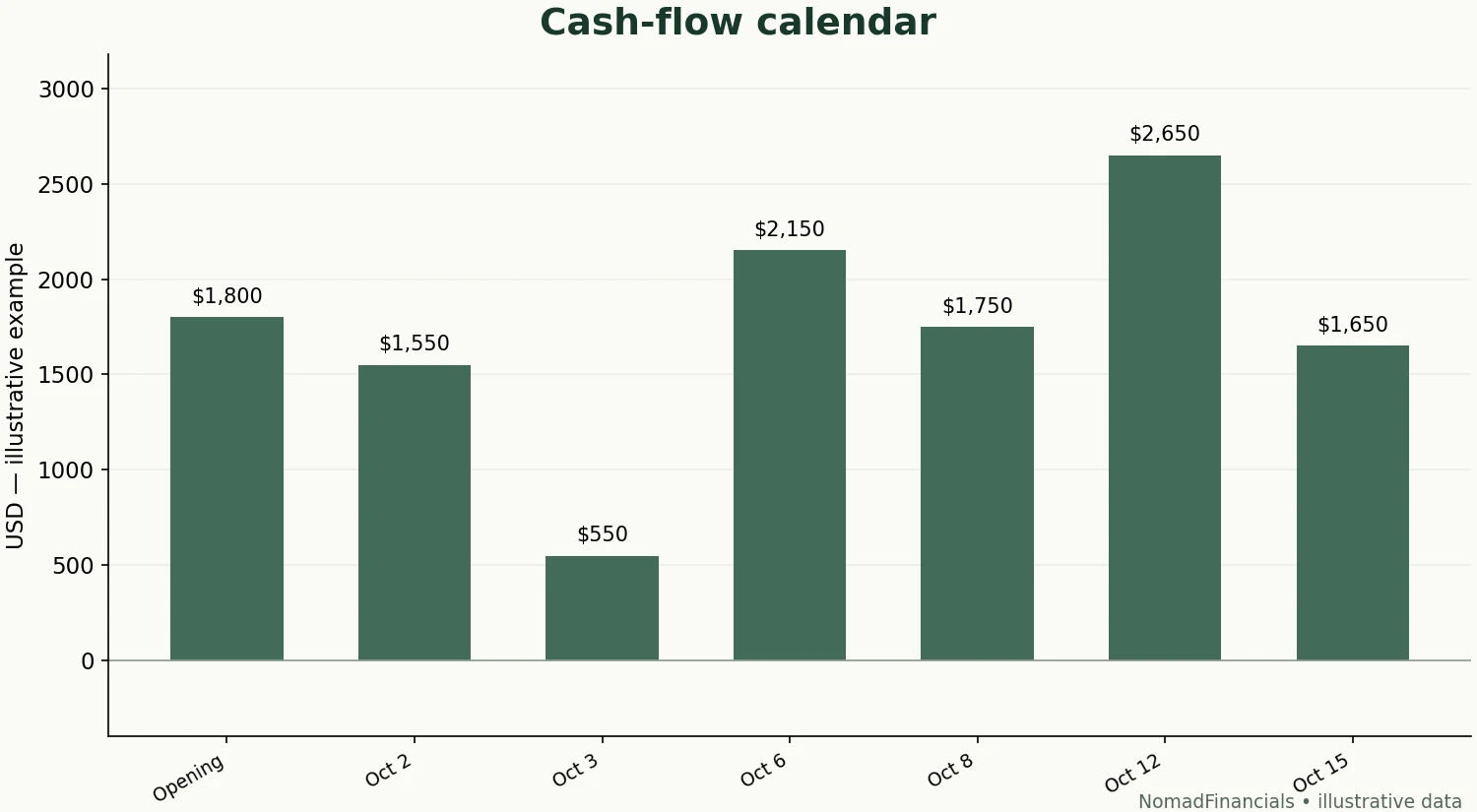
The arithmetic is $1,800 + $2,500 − $2,650 = $1,650. However, the lowest displayed balance is $550 on October 3. That lower figure matters more for near-term decisions than the $2,500 in total expected receipts. It shows how little room exists before Client A pays.
Step 3: test one payment arriving late
Move Client A's $1,600 from October 6 to October 13, while leaving other events unchanged. The October 8 balance becomes $150: opening cash of $1,800 minus $250, $1,000, and $400. Client B's October 12 receipt then raises the balance to $1,050, followed by Client A's payment to $2,650. The final balance remains $1,650, but the journey becomes considerably tighter.
Suppose the designer chooses a planning floor of $300 for this example. This is a personal scenario assumption, not a universal recommendation. The delayed case falls $150 below that floor. The decision could be to postpone a nonessential part of the equipment work, reduce the planned transfer if household needs allow, or confirm the client's payment processing date. None of those actions creates extra income; each changes timing or spending.
For a wider delay or reduced-income scenario, use the late client payment budgeting guide. Avoid assuming that an unconfirmed payment will arrive simply because an essential bill is approaching.
Keep the calendar useful without adding clutter
Use one row for each dated event that could change a decision. Small routine spending can be grouped into realistic weekly allowances, but do not hide a large annual renewal inside an average monthly number if the actual payment is approaching. Add that renewal on the date cash leaves the account.
Color can help, but status should also appear in text so the calendar remains understandable in grayscale and to readers who cannot distinguish colors. For example, label a receipt “confirmed, not received” rather than relying on green shading. Keep actual events separate from a delayed-payment scenario rather than overwriting history.
Update it during a short weekly review
- Match the starting balance to the bank and list pending transactions.
- Replace planned dates and amounts with actual receipts and payments.
- Move delayed receipts forward only when you have new information.
- Add upcoming bills and renewals that were missing.
- Review the next low point and write one action with a due date.
A weekly money routine keeps this review repeatable. During a particularly tight week, a brief additional check may help; constant refreshing cannot make an uncertain payment certain.
Common errors that make the calendar look safer than it is
The largest error is entering every invoice as immediate cash. Others include counting transfers as revenue, forgetting processing fees, omitting scheduled withdrawals, and treating an available credit limit as money owned. A credit facility has repayment costs and conditions and should never silently fill a spreadsheet shortfall.
Another error is combining business and household cash without showing essential household obligations. You can plan them together or separately, but the transfer between them needs a clear place. See planning owner transfers with irregular freelance income for a consistent approach.
Key takeaways
- Use bank-availability dates rather than assuming invoice dates equal cash dates.
- Review the lowest projected balance as well as the ending balance.
- Keep a delayed-payment version alongside the base calendar.
- Write an action when the projection becomes tight; do not merely change the numbers.
Frequently asked questions
Can I create a freelancer cash flow calendar in Google Sheets?
Yes. Date, description, inflow, outflow, status, and running balance columns are enough to start. Sort by date, check the order of same-day events, and reconcile the balance with actual transactions regularly.
Should I include unpaid invoices?
Include them as expected events with clear status and realistic dates. They belong in planning, but they should not increase actual available cash until payment becomes available.
How far ahead should the calendar go?
Start with the next month and extend it far enough to include upcoming large obligations. A weekly forecast can cover a longer planning horizon while the calendar handles near-term dates.
Sources and scope
The CFPB's Your Money, Your Goals toolkit includes bill-calendar and cash-flow planning resources. The examples and calculations here are original educational illustrations, not individualized financial advice.