
A freelancer slow-month budget is a temporary plan for a period when less work is expected to produce less cash. Start with a conservative estimate of receipts, list essential outflows, calculate the gap, and choose specific changes before the gap turns into missed payments.
A slow month is different from a late-payment month. In a late-payment month, money may already be owed for completed work. In a slow month, the work itself may not be booked. A follow-up email cannot collect revenue from a project that does not exist. This guide uses fictional scenarios with realistic arithmetic, not actual customer results.
Identify the type and length of slowdown
Write down what changed: seasonal demand, a completed retainer, a client budget freeze, illness, or a thinner pipeline. Separate completed unpaid work, signed upcoming work, and speculative opportunities. Treating all three as equally reliable makes a weak month look safer than it is.
Choose a planning window long enough to see recovery assumptions. Four weeks can expose the immediate gap; a longer freelancer cash-flow forecast can show whether the supposed recovery merely shifts the shortfall into the next month. Label each expected receipt with its basis and date.
Compare a base case with a downside case. A base case can include confirmed work expected to settle during the window. A downside case might delay a material payment or remove an unconfirmed project. Neither scenario is a prediction; it is a way to make decisions under uncertainty.
Separate accessible cash from assigned cash
List actual liquid cash and subtract amounts already assigned to taxes, commitments, or other protected purposes. Do not call an entire account balance your runway if a large part belongs to upcoming obligations.
For illustration, Alex, a fictional freelance developer, has $5,000 in the business account. Of that, $1,200 is assigned to taxes and $600 to a committed annual cost. The cash considered for this slow-month plan is $5,000 − $1,200 − $600 = $3,200. If Alex decides to cancel or delay the annual purchase, that is a separate documented decision, not an automatic release of the money.
The income buffer and emergency fund guide explains why different reserves have different jobs. A recurring predictable slow season should eventually be built into the ordinary annual plan rather than repeatedly described as an unexpected emergency.
Build essential, adjustable, and deferred lists
Essential costs keep basic living needs and necessary operations functioning. Adjustable costs can potentially be reduced, but only after checking contracts and consequences. Deferred costs can move without creating a worse problem. The category depends on your situation, not the name of the expense.
| Category | Examples to review | Decision needed |
|---|---|---|
| Essential | Housing, basic food, necessary utilities, required business systems | Confirm amount and actual due date |
| Adjustable | Optional software tiers, discretionary owner spending, nonessential advertising tests | Check whether savings start this month |
| Deferred | Uncommitted equipment upgrades, optional courses, cosmetic site work | Choose a new review date |
| Protected obligation | Money already assigned to taxes or binding commitments | Keep separate; resolve any change properly |
Do not count a saving until it changes an actual payment. Canceling an annual subscription that has already been paid may improve next year's budget but produce no cash this month. Similarly, stopping a service can create cancellation charges or disrupt work that still earns revenue.
Calculate the first gap
Alex expects $2,400 in confirmed net cash receipts during the next month. Planned outflows are $2,200 in essential personal transfers, $650 in essential business costs, $300 in flexible business spending, and $250 in optional equipment saving. Total planned outflows are $3,400.
Receipt shortfall = planned outflows − expected receipts = $3,400 − $2,400 = $1,000. This means the month would consume $1,000 of opening available cash before considering any date-specific low point.
| Plan item | Original | Revised | Current-month reduction |
|---|---|---|---|
| Essential personal transfer | $2,200 | $2,200 | $0 |
| Essential business costs | $650 | $650 | $0 |
| Flexible business spending | $300 | $100 | $200 |
| Optional equipment saving | $250 | $0 | $250 |
| Total | $3,400 | $2,950 | $450 |
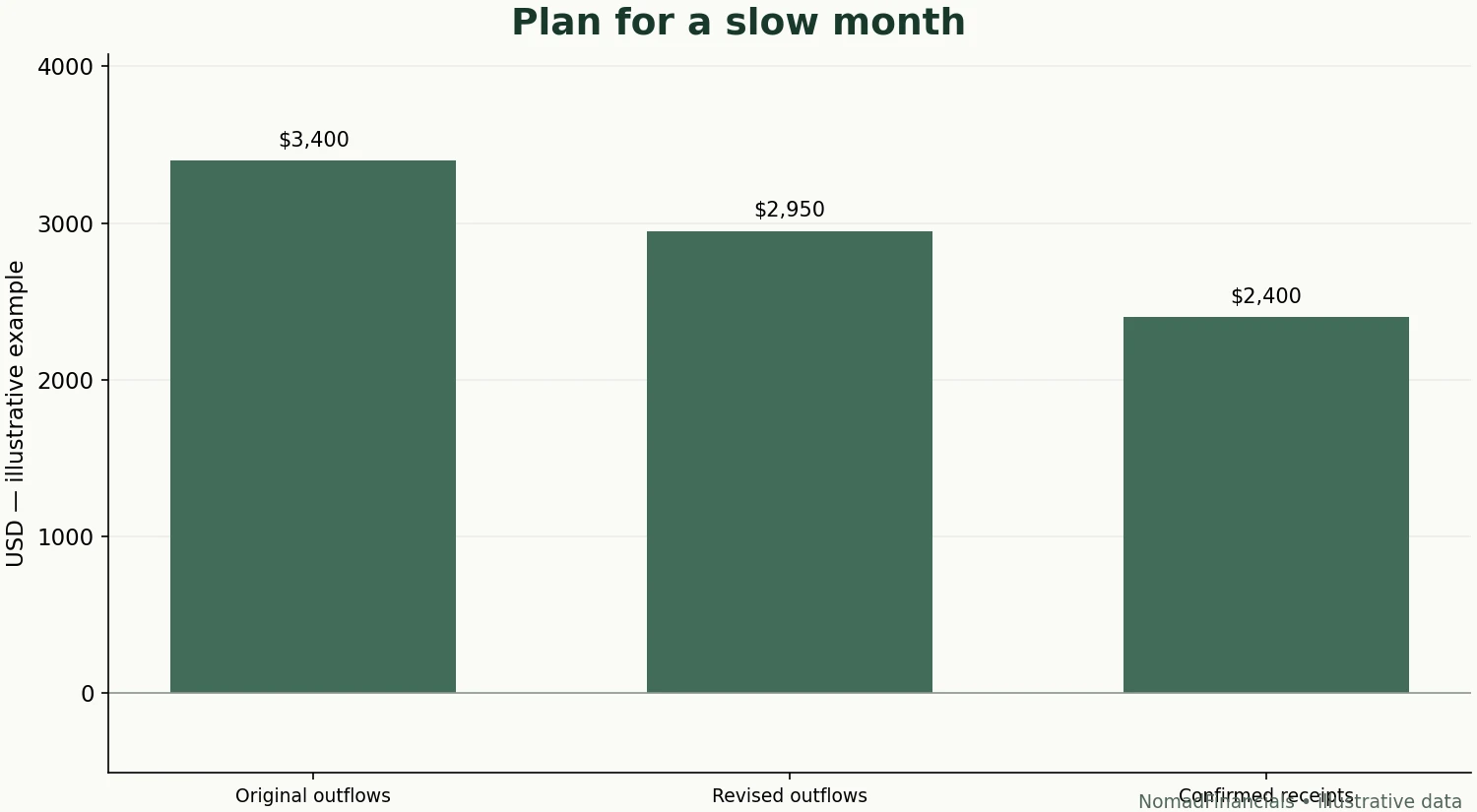
After the changes, the gap is $2,950 − $2,400 = $550. Alex's available opening cash would decline from $3,200 to $2,650 over the month if the assumptions hold. That is manageable within the example balance, but the money is still being consumed. It does not mean the business has solved the underlying revenue problem.
Check the dates, not only the monthly total
Suppose $1,500 of Alex's receipts arrive in the final week. A monthly summary may look comfortable while early bills create pressure. Put each material payment and receipt in the cash-flow calendar and inspect the lowest projected balance.
Then test the downside case. If that $1,500 arrives next month instead, this month's receipts become $900. With the revised $2,950 outflow plan, cash consumption becomes $2,050. Starting with $3,200 leaves $1,150 at month end, before any additional changes. The downside case gives Alex a reason to act earlier rather than assuming the final-week receipt is guaranteed.
If the delayed receipt is owed for completed work, maintain a separate late-payment action plan. That plan handles collection and timing; this slow-month plan still needs to address the reduced pipeline.
Connect revenue actions to realistic cash dates
Choose actions you can complete and measure: follow up with past clients about a specific service, request scope confirmation for an existing proposal, finish an already contracted milestone, or schedule targeted outreach. Record the next action and expected decision date rather than writing “find more clients” on every review.
Do not count a proposal as money in the bank. If a small project could bring $800 next month, show it as a separate opportunity until its scope, agreement, delivery requirements, and payment schedule support a more definite forecast. Consider the work needed to deliver it; gross revenue without the related costs can exaggerate its benefit.
A rushed discount also deserves arithmetic. A $1,000 project discounted to $800 reduces revenue by $200. If unavoidable delivery costs remain $300, the amount before other overhead falls from $700 to $500. Faster cash may have value, but the smaller contribution should be visible before accepting the terms.
Set review triggers and a recovery sequence
Review the plan weekly while the slowdown continues. Update actual receipts, actual savings, and the next low-balance date. Trigger a deeper review if a key project is canceled, a confirmed receipt moves, or available cash approaches the operating floor you selected.
When work improves, avoid immediately restoring every paused expense. First confirm outstanding obligations, then decide how to rebuild used reserves and resume worthwhile planned costs. If the optional equipment fund paused for two months at $250 per month, the missed contributions total $500. Recalculate the target date instead of pretending those contributions happened.
Frequently asked questions
Should I stop every business subscription?
No automatic rule fits every business. Check which tools are necessary for current paying work, whether cancellation creates costs, and when a reduction would actually release cash. Prioritize real current-month savings.
How long can I operate during a slow period?
A dated forecast is more reliable than a single runway division when receipts and bills vary. A rough cash-consumption calculation can help, but repeat it under different receipt assumptions and do not treat a fractional result as a guaranteed survival date.
When should I return to my normal budget?
Use evidence of repeatable receipts and a forecast that supports the restored costs. One strong payment can clear a backlog without fixing the next month's pipeline. Restore spending intentionally and keep reviewing the low point.