
A freelancer cash flow forecast estimates how much cash will remain at the end of each future period. It helps you see a possible shortfall early enough to review spending, follow up on payments, or reconsider a planned owner transfer.
It is not a sales target, a profit statement, or a promise that a client will pay. The useful forecast separates assumptions from actual transactions and shows what changes when an assumption fails. Start with weekly periods if monthly totals hide the timing of your larger bills.
Example note: All scenarios below are fictional US-dollar illustrations. They are designed to show the mechanics of forecasting rather than actual business results or a recommended minimum cash balance.
Forecast, calendar, and tracker: three separate jobs
An income tracker records invoices and receipts. A cash flow calendar arranges payments on dates. A weekly forecast summarizes future periods and compares assumptions. These tools should agree on actual cash but do not need to duplicate every detail.
For example, the calendar may show rent on Monday and a client receipt on Friday. A weekly forecast can show a positive Friday closing balance while missing Monday's temporary shortfall. Use the calendar to inspect weeks that look tight or have large early payments.
Choose a practical planning horizon
Begin with six weeks if that is the period for which you can assemble reasonably useful information. Extend to 13 weeks when upcoming renewals, project milestones, or slower collection cycles make that useful. A longer forecast does not become more accurate simply because it has more columns.
Keep later periods appropriately cautious. A signed project with an agreed milestone is different from a proposal that has not been accepted. You can include possible work in a separate scenario, but a base plan that depends on winning every proposal conceals uncertainty.
Set up the forecast rows
| Row | What belongs there |
|---|---|
| Opening available cash | Prior week's closing balance, using a consistent scope |
| Client cash receipts | Expected available payments, not merely invoices issued |
| Other external receipts | Separately labeled sources, without treating borrowing as sales |
| Business outflows | Actual expected payment timing for business costs |
| Owner transfers | Planned cash moving to household use |
| Other obligations | Known payments included in the forecast's scope |
| Closing available cash | Opening cash + receipts − outflows |
Document how reserved money is handled. If opening available cash excludes funds already assigned to another obligation, do not count that exclusion again as a new outflow. Transfers between accounts inside the same forecast scope should not increase or reduce combined cash.
Worked example: a six-week freelance forecast
A fictional consultant starts with $2,400 of available cash. Business payments and household transfers are combined in the outflow column below for readability. In a working file, keep them on separate rows so you can see which decisions affect the balance.
| Week | Opening | Receipts | Outflows | Closing |
|---|---|---|---|---|
| 1 | $2,400 | $800 | $1,200 | $2,000 |
| 2 | $2,000 | $1,600 | $1,500 | $2,100 |
| 3 | $2,100 | $0 | $1,100 | $1,000 |
| 4 | $1,000 | $2,200 | $1,400 | $1,800 |
| 5 | $1,800 | $700 | $1,300 | $1,200 |
| 6 | $1,200 | $1,500 | $1,200 | $1,500 |
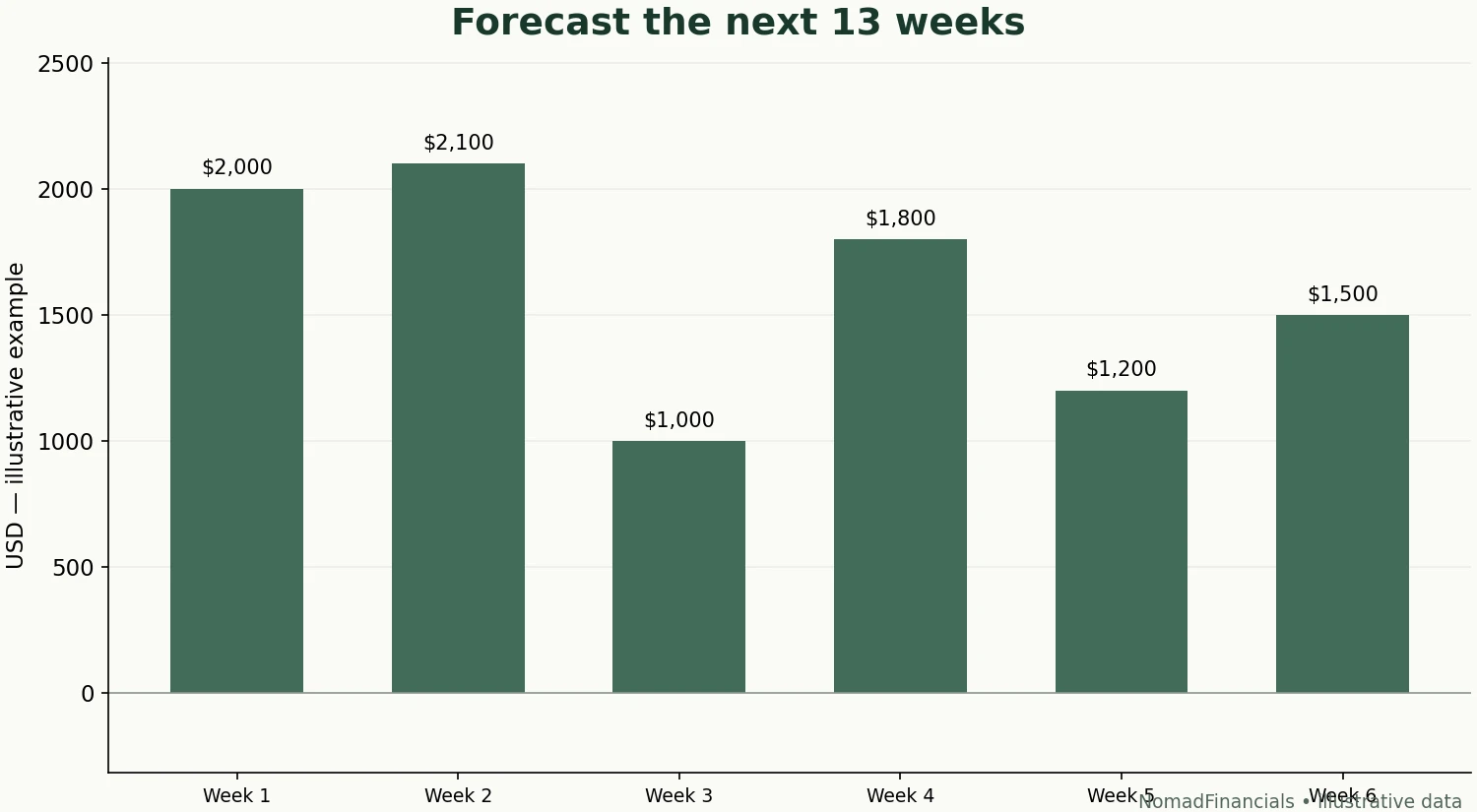
Total expected receipts are $6,800. Total outflows are $7,700. Closing cash falls by $900, from $2,400 to $1,500. The lowest weekly closing balance is $1,000 in week 3. The overall decline matters even though none of the weekly closings is negative.
The core control is $2,400 + $6,800 − $7,700 = $1,500. If the spreadsheet's final column does not agree with that calculation, check duplicated rows, missing expenses, and formulas that fail to carry one week's closing balance into the next week's opening balance.
Stress test: move one receipt by two weeks
Now assume the $1,600 receipt expected in week 2 becomes available in week 4 instead. All other assumptions remain unchanged. Week 1 closes at $2,000. Week 2 closes at $500, and week 3 closes at negative $600. Week 4 receives both $2,200 and the delayed $1,600, bringing closing cash back to $1,800.
| Week | Base closing cash | Delayed closing cash |
|---|---|---|
| 1 | $2,000 | $2,000 |
| 2 | $2,100 | $500 |
| 3 | $1,000 | −$600 |
| 4 | $1,800 | $1,800 |
| 5 | $1,200 | $1,200 |
| 6 | $1,500 | $1,500 |
The final balance is unchanged because the same payment still arrives within the six-week window. Nevertheless, the delayed case has a funding gap in week 3. A negative projection does not mean the account can actually spend below zero. It signals that the current plan cannot proceed as written without another legitimate change.
If the consultant chooses a $500 planning floor for this illustration, the week 3 gap to that floor is $1,100: $500 − (−$600). That figure describes this scenario, not a universal buffer target. Review feasible actions before the week arrives; do not assume that borrowing or a client promise automatically closes the gap.
Turn the projection into decisions
Review which payments are essential, contractual, flexible, or not yet committed. An optional $350 purchase postponed beyond week 3 would improve the delayed week 3 closing balance from negative $600 to negative $250. It helps but does not fully close the gap. Showing that remaining deficit prevents a partial solution from looking complete.
A second action might change a household transfer only if essential household needs still remain covered. Another might be confirming whether a genuine invoice approval issue can be resolved. Keep actions separate from assumptions: “asked client about payment” is not the same as “payment received.” The late-payment budgeting guide offers a short-term prioritization process.
Improve forecast quality with an assumptions log
Beside each major receipt, note the source of the expected date: contractual due date, client-confirmed processing date, or an estimate from prior behavior. Record why a date changed. Over time, you may discover that certain clients consistently require a longer planning interval than their stated terms suggest.
Do not assign a probability and multiply every invoice by it unless you understand what that produces. Half of a $2,000 payment does not necessarily arrive in a low-confidence week. A separate delayed or missing-payment scenario is often easier to act on than a smooth probability-weighted total.
Update actuals and roll forward weekly
- Replace the completed week's estimates with actual receipts and payments.
- Reconcile its closing balance to the account scope used.
- Explain significant differences between estimate and actual.
- Update remaining dates using new information.
- Add a new week at the far end of the forecast.
Include this in your weekly money routine. Preserve a dated version before updating if you want to learn whether timing or spending estimates are improving. Rewriting every past estimate removes that learning opportunity.
Key takeaways
- Forecast cash availability, not only invoices or booked work.
- Check the lowest period and intraweek timing, not only the final balance.
- Test delayed receipts separately from the base case.
- Document actions and update actuals instead of repeatedly shifting assumptions.
Frequently asked questions
Is a 13-week cash flow forecast necessary for every freelancer?
No. It can help when cash cycles and obligations extend over several months. Start with a horizon you can maintain and extend it when the additional periods improve decisions.
Should I include unsigned projects?
Keep them in a separately labeled opportunity scenario rather than depending on them for essential payments. A proposal is not an available receipt or a guaranteed contract.
Why can the final balance look fine while the plan fails?
A payment arriving late can create an earlier shortfall even if it restores the final balance. Weekly and daily timing expose that problem.
Source and scope
The CFPB toolkit includes cash-flow budgeting resources. This forecast structure, scenarios, and calculations are original educational examples rather than personalized financial advice.