
An income buffer covers a predictable gap between receiving freelance payments and paying ordinary bills. An emergency fund covers an unexpected disruption or expense. Both can be cash reserves, but assigning them different jobs helps you understand how much protection you actually have.
A freelancer can have a profitable quarter and still run short of cash on rent day. That timing problem differs from losing the ability to work for several weeks. This guide shows how to size a working buffer, protect emergency savings, and rebuild each after using it. All dollar examples below are fictional illustrations, not client results or universal savings recommendations.
Give each reserve a different job
| Reserve | Primary job | Example use | What it does not cover |
|---|---|---|---|
| Income buffer | Smooth normal cash timing | Pay regular bills before a confirmed client payment clears | A permanently unprofitable business |
| Emergency fund | Handle an unexpected financial shock | Urgent personal repairs or an unexpected interruption to work | Predictable annual renewals |
| Sinking fund | Save for a known future cost | Replace a laptop on a planned schedule | Every ordinary monthly bill |
| Tax reserve | Hold cash assigned to tax obligations | Pay an estimated tax amount based on your situation | Routine owner spending |
These labels are planning conventions. You do not necessarily need four bank accounts. Separate spreadsheet balances can work if you reconcile them to actual available cash. What matters is that the same dollar does not appear in two categories.
Calculate the buffer from your lowest projected balance
Start with cleared, unassigned operating cash. List the actual dates of essential business payments and the personal transfer your budget requires. Add expected receipts on realistic settlement dates. If a receipt is uncertain, run a second forecast with that receipt delayed or removed.
Timing-gap amount = the absolute value of the lowest negative projected balance. If your lowest balance is positive, the forecast does not show a timing gap under those assumptions. That does not prove you have enough emergency savings.
Consider Maya, a fictional freelance designer. She starts a four-week period with $1,000 available after protecting other reserves. Her weekly cash schedule is:
| Week | Cash received | Planned outflows | Closing cash without extra buffer |
|---|---|---|---|
| 1 | $0 | $1,400 | −$400 |
| 2 | $600 | $800 | −$600 |
| 3 | $2,500 | $900 | $1,000 |
| 4 | $1,200 | $700 | $1,500 |
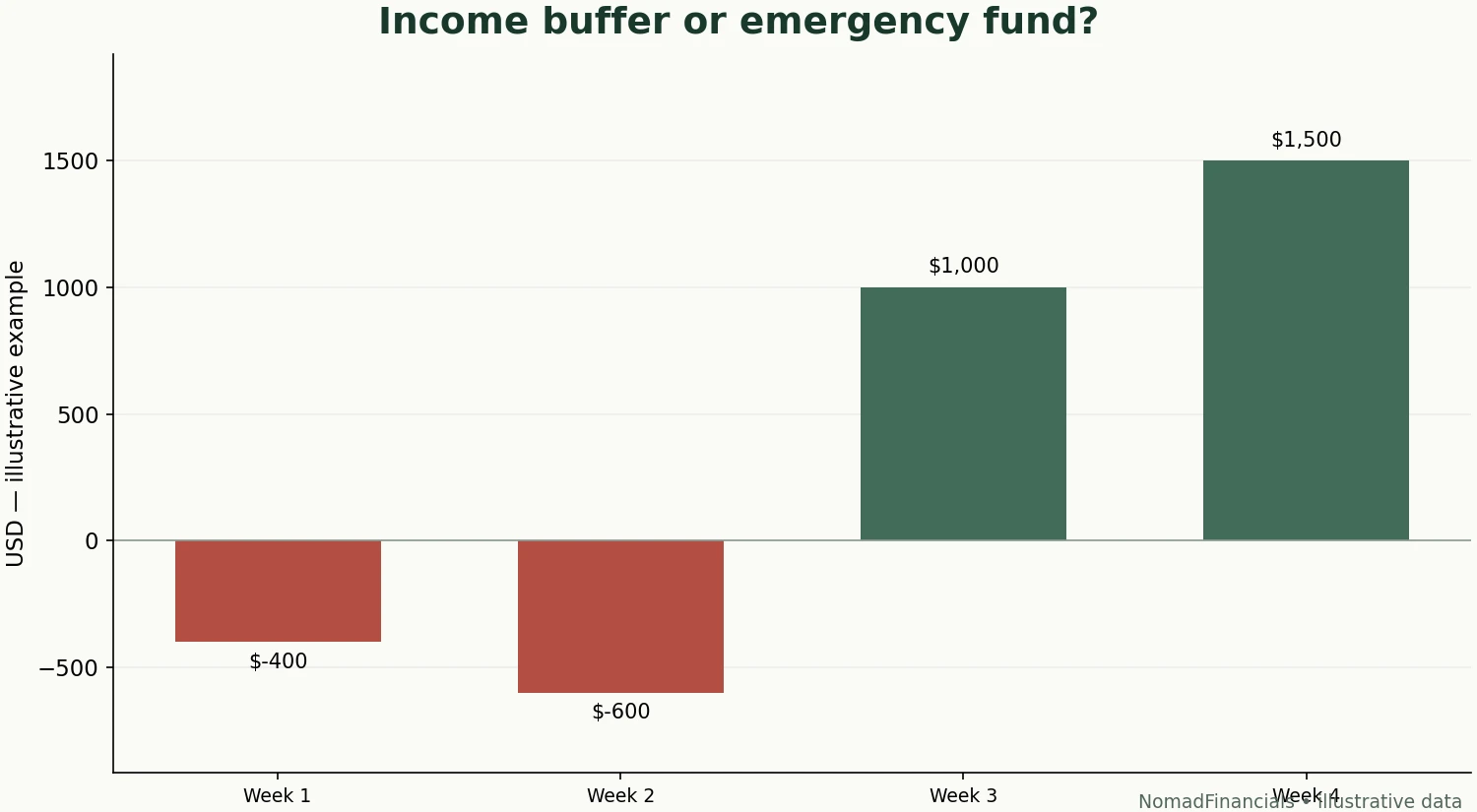
The lowest projected balance is negative $600. Adding a $600 timing buffer would bring that low point to zero. Maya might choose an additional margin because receipts can move, but the example does not prescribe an amount. The end-of-period balance alone hides the week-two shortfall.
Use a freelancer cash-flow calendar when the exact day matters. A weekly model is easier to maintain, but it can hide a Monday payment due before a Friday receipt in the same week.
Set the emergency target using a different question
Ask what an interruption would cost rather than how long invoices normally take to clear. Write down essential personal spending, essential business costs that would continue, accessible replacement income, and costs you could actually stop. Do not assume every subscription or lease can disappear immediately.
Suppose Maya identifies $2,100 in essential personal monthly costs and $400 in unavoidable business costs during an interruption. Her combined essential outflow is $2,500. For illustration, she chooses to model three months: $2,500 × 3 = $7,500. Three months is her scenario assumption, not an appropriate target for every freelancer.
A second household income, dependents, insurance deductibles, client concentration, and the time needed to replace work all change the decision. Test a shorter and longer interruption. If emergency cash would also need to replace a major item, show that cost separately instead of quietly assuming it fits the monthly total.
Check the total before calling money available
Imagine an account contains $10,000. Its ledger assigns $2,000 to taxes, $1,200 to annual expenses, $1,000 to the income buffer, and $4,500 to emergency savings. That leaves $1,300 unassigned:
$10,000 − $2,000 − $1,200 − $1,000 − $4,500 = $1,300.
Calling the whole $10,000 an emergency fund would overstate protection. Calling the $1,000 buffer available for a new purchase would undermine the cash schedule. If part of the money sits in a payment processor, confirm withdrawal timing and whether holds or refunds could reduce it.
You can use one reconciled worksheet with columns for opening reserve, additions, approved withdrawals, and closing reserve. The sum of all reserve balances plus unassigned money should equal the actual cash represented by that worksheet. Separate accounts still need this check because transfers are easy to duplicate.
Build the reserve that addresses your immediate risk
If bills routinely arrive a week before reliable receipts, the working buffer solves an observable timing problem. If cash timing is comfortable but one emergency would force expensive borrowing, emergency protection may deserve attention. When both are weak, start with small, explicitly assigned amounts and review the tradeoff rather than trying to reach a large headline target immediately.
Do not move tax money into the buffer simply because it has not been paid out yet. Tax amounts depend on the individual situation; the IRS self-employed individuals tax center explains estimated-tax obligations and calculation resources. No flat reserve percentage in this example substitutes for that calculation.
For predictable equipment replacements, build freelancer sinking funds. For lower expected work next month, prepare a slow-month budget. Repeatedly draining an emergency fund for those costs is a signal that the regular plan needs changing.
Write a withdrawal and refill rule
A usable rule identifies the trigger, maximum transfer, and next review. Maya might permit the buffer to cover listed essentials when a confirmed receipt moves, then direct the next available surplus back to it before increasing discretionary owner transfers. That makes the action traceable instead of turning reserves into a general spending account.
For an emergency withdrawal, record the event and revised balance. Recalculate the rebuilding contribution against realistic receipts. If Maya uses $900 and can set aside $150 in each of six months, $150 × 6 rebuilds $900. If cash falls short one month, revise the schedule; do not label an unfunded transfer as saved.
Check balances during a weekly money review. Watch for a buffer that never refills. That pattern can mean underpriced work, rising costs, or an owner transfer the business cannot sustain, rather than a larger timing reserve being the only answer.
Frequently asked questions
Can one savings account hold both reserves?
Yes, provided your ledger assigns separate amounts and reconciles to the account. Check access, transfer delays, fees, and account terms before relying on the cash for a near-term bill.
Is one month of revenue a useful buffer target?
Revenue alone does not show payment timing or required outflows. A dated forecast exposes the gap more directly. A revenue-based target can be a rough comparison, but it should not replace the cash calculation.
What if I cannot fund either reserve yet?
Start by identifying the next essential shortfall and making a dated action plan. Review optional spending and realistic incoming work. Small contributions can still improve the position, but a worksheet cannot create money that has not arrived.