
To pay yourself with irregular freelance income, begin with cash the business has actually received, subtract obligations and protected reserves, and test a repeatable personal transfer against upcoming cash-flow dates. A large invoice or a strong average month does not automatically support a larger regular transfer.
This guide is a cash-planning framework for freelancers, particularly owner-operated sole proprietorships. A personal owner transfer is not the same as employee payroll. Entity structure and tax treatment can change the correct process, so someone with a corporation, payroll obligations, partners, or special circumstances needs an entity-appropriate process. Every scenario below is fictional and educational.
Separate revenue, profit, and available cash
Revenue describes business activity under the accounting method used. Profit accounts for applicable expenses. Available cash is what remains liquid after considering payment timing and money already assigned. These three numbers can differ substantially.
Suppose you send a $5,000 invoice but receive nothing this week. That invoice can be important in your records and forecast, yet it does not create spendable bank cash. Conversely, a payment this week might settle work completed last month. Use your invoice and payment reconciliation to see which is which.
A transfer from a business account into your personal account also does not, by itself, tell you the business's taxable profit. Keep business records and the cash plan connected, but do not treat a budgeting formula as a tax calculation.
Calculate the personal spending floor
Start with essential household spending that must be covered by freelance money. Include actual housing, utilities, food, transportation, insurance, and minimum required payments as relevant. Subtract dependable household contributions already allocated to those same bills. Do not subtract a partner's entire income if it already pays other household obligations.
For illustration, Lena's essential monthly personal spending is $2,800. Another dependable household contribution covers $600 of those expenses. Her freelance-funded essential amount is $2,800 − $600 = $2,200. She separately lists $300 of flexible personal spending, creating a desired transfer of $2,500.
The essential floor is a decision aid. It does not mean optional spending is forbidden or that every reader should use Lena's numbers. It shows what would need to change if the business could support only $2,200 rather than $2,500.
Calculate what receipts can actually support
Use a consistent review period. For each month, list collected client payments, business operating outflows, the amount assigned to taxes based on your situation, and other necessary reserve contributions. Keep amounts already protected in opening cash separate so you do not subtract the same reserve twice.
Lena's fictional three-month record looks like this. The tax amounts are example inputs chosen for the scenario; they are not prescribed percentages or estimates for a reader.
| Month | Cash collected | Operating costs | Tax allocation | Other reserve additions | Remaining before personal transfer |
|---|---|---|---|---|---|
| A | $4,800 | $900 | $800 | $300 | $2,800 |
| B | $6,200 | $1,100 | $1,200 | $300 | $3,600 |
| C | $3,900 | $900 | $650 | $300 | $2,050 |
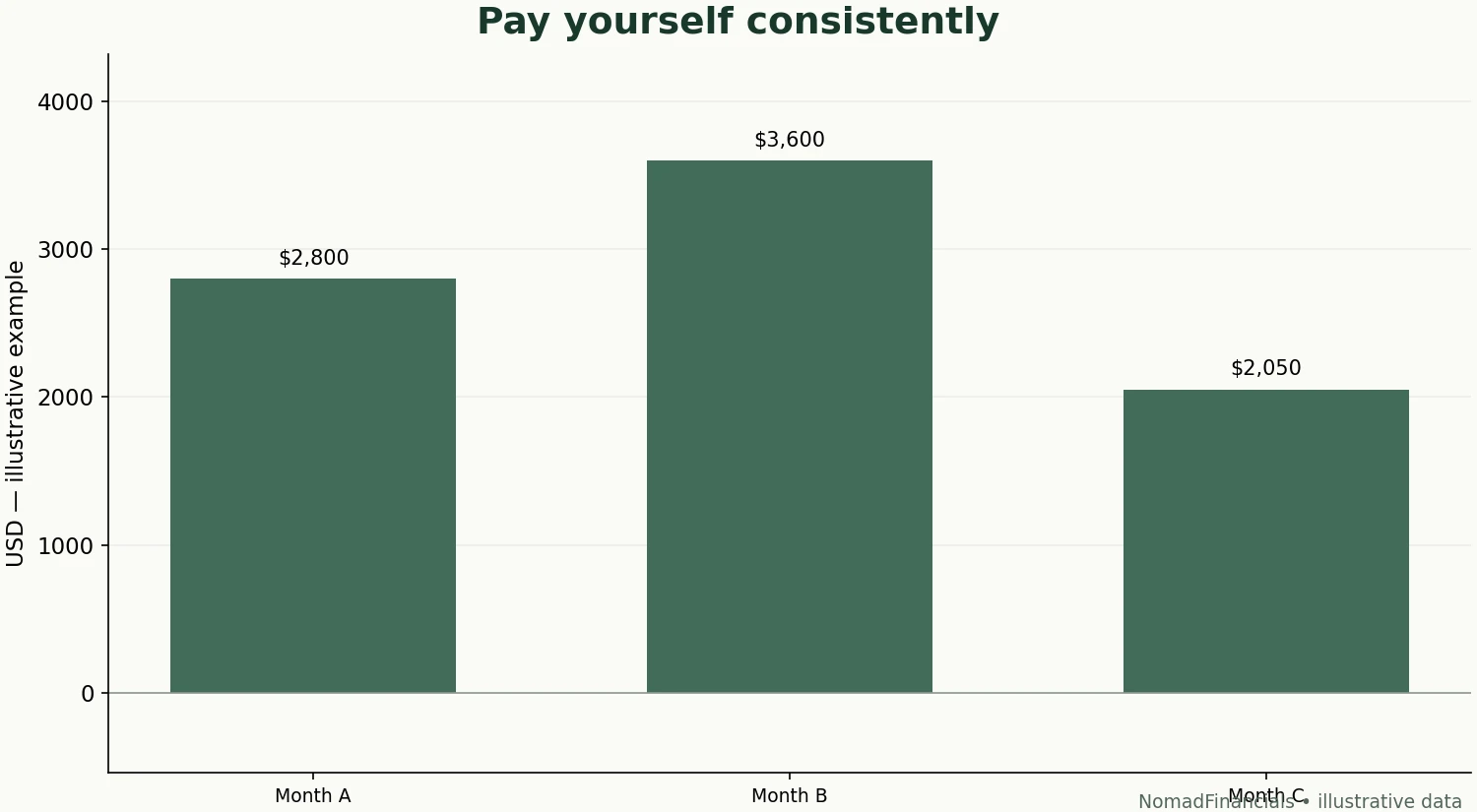
The average remaining amount is ($2,800 + $3,600 + $2,050) ÷ 3 = $2,816.67, rounded to cents. But the lowest month supports only $2,050 before drawing on an existing income buffer. A $2,500 transfer in that month would require $450 from somewhere else.
Three months is a short illustration, not enough history to establish the pattern of a seasonal business. Use a longer record when available, note unusual projects, and compare the next few months with history rather than assuming an average will repeat.
Choose an amount and schedule together
A monthly transfer of $2,500 could be scheduled as two $1,250 transfers. Check that cash is available on both dates. Alternatively, Lena might begin with a lower base transfer and consider a separate discretionary transfer only after the forecast and reserve targets support it.
Do not confuse twice monthly with every two weeks. Twice monthly creates 24 transfers per year. Every two weeks normally creates 26. To distribute $30,000 annually, twice-monthly transfers are $30,000 ÷ 24 = $1,250. A 26-payment schedule is approximately $1,153.85 each, with a rounding adjustment. Paying $1,250 every two weeks would total $32,500, not $30,000.
Label the schedule clearly in your calendar and personal budget. If rent falls before the next transfer date, an apparently adequate annual amount can still leave a short-term gap. The cash-flow calendar guide explains how to check the exact dates.
Run a pre-transfer cash check
Before moving money, confirm cleared cash, unpaid essential business bills, tax-reserve balances, committed sinking funds, and the operating floor you intend to protect. Then project what happens until the next reliable receipt.
Assume Lena has $7,400 in total business cash. Of this, $1,600 is already assigned to taxes, $700 to annual expenses, $1,200 to upcoming operating bills, and $1,000 to her chosen income buffer. Current unassigned cash is $7,400 − $1,600 − $700 − $1,200 − $1,000 = $2,900.
A $1,250 scheduled personal transfer would leave $1,650 unassigned at that moment. That calculation is only the first check: a newly discovered $2,000 contractor bill due before the next receipt would change the decision. Use a forward-looking forecast instead of relying solely on today's balance.
Handle strong and weak months consistently
In a strong month, avoid permanently raising the base transfer before checking whether the extra work repeats. A one-time project might fund a depleted buffer, a known annual cost, or a deliberately chosen one-time personal transfer. Record the allocation rather than letting a larger balance decide for you.
In a weak month, distinguish temporary timing from a structural shortfall. If work is completed and payment is merely delayed, the late-client-payment budget is the more relevant plan. If fewer jobs are booked, use a slow-month budget and revisit spending and sales assumptions.
Watch the buffer over multiple months. A $450 withdrawal followed by a $700 refill can fit an intentional smoothing plan. Repeated withdrawals without refills suggest that the base transfer exceeds capacity. The answer may require changing costs, pricing, workload, or personal spending rather than calling every month exceptional.
Keep tax calculations outside the shortcut
The IRS self-employed individuals tax center describes self-employment and income-tax obligations and points to estimated-tax resources. Determine the relevant amount for your circumstances rather than using the example allocations above as a tax rate.
Record each owner transfer with its date, amount, and purpose in the appropriate books. A simple cash worksheet can help explain decisions, but it should not replace accounting records or entity-specific payroll procedures. When the business structure changes, review the payment process instead of carrying forward an old owner-draw routine automatically.
Frequently asked questions
Should I pay myself the same amount every month?
A stable amount can simplify a household budget if the business and reserves can support it. If the forecast cannot support the amount, stability on paper is misleading. A smaller base with reviewed additional transfers may fit some situations better.
Can I transfer a fixed percentage of each payment?
You can model that approach, but a percentage does not know when rent or a contractor bill is due. Check the resulting dates and balances, protect assigned cash, and revise the percentage when the business changes.
Does a business account balance show my take-home pay?
No. It may include money needed for expenses, taxes, refunds, or other obligations. Calculate available cash and assess the upcoming schedule before treating any balance as personal spending money.