
Sinking funds let freelancers spread a known future expense across the time available before it is due. Instead of treating an annual software renewal or planned laptop replacement as a surprise, you assign cash to that purpose in advance.
The useful question is not “What percentage of income should every freelancer save?” It is “How much remains to fund, how many contribution dates are left, and can my forecast support those transfers?” This guide uses fictional US-dollar examples to answer those questions. The examples are planning exercises, not actual customer stories or advice that every reader should follow.
Choose costs that are predictable enough to plan
Good candidates have a reasonably identifiable cost and date: an annual license renewal, professional membership, scheduled equipment replacement, or a planned period away from billable work. The amount can be an estimate if you label it and review it. Avoid mixing this list with cash reserved for taxes or an unexpected personal emergency.
| Possible fund | Planning basis | Review question |
|---|---|---|
| Annual software | Renewal notice and payment date | Will I renew, downgrade, or cancel? |
| Equipment | Replacement estimate and intended date | Can the current equipment serve longer? |
| Professional membership | Next renewal amount | Does it still support paid work? |
| Time off | Expected cash shortfall while away | Will other receipts still arrive? |
| Insurance renewal | Current quote or clearly marked estimate | Has the premium or payment plan changed? |
Annual costs are not automatically necessary costs. Before creating a fund, decide whether the item deserves renewal. Saving steadily for a tool nobody uses is still unnecessary spending.
Use the remaining-cost formula
Required contribution = (target cost − cash already assigned) ÷ remaining contribution periods. Use actual dates. A purchase due at the beginning of June cannot rely on a transfer scheduled at the end of June.
If a $720 software renewal is twelve contribution dates away and nothing is saved, the monthly amount is $720 ÷ 12 = $60. If you discover that renewal only four contribution dates before it is due, the amount becomes $720 ÷ 4 = $180. Dividing by twelve would make the plan look affordable while leaving it underfunded.
For an equipment fund, suppose the estimated replacement cost is $1,800, you have already assigned $300, and there are ten monthly transfers before purchase. The remaining amount is $1,500; $1,500 ÷ 10 = $150 per transfer. Keep the $300 out of other available-spending calculations.
A worked example for three funds
Jordan, a fictional freelance editor, wants a simple plan with three purposes. The equipment target is an estimate; the two annual renewals are assumed known for this illustration.
| Fund | Target | Already assigned | Transfers left | Per transfer |
|---|---|---|---|---|
| Software renewal | $720 | $0 | 12 | $60 |
| Equipment replacement | $1,800 | $300 | 10 | $150 |
| Professional membership | $240 | $0 | 6 | $40 |
| Current monthly total | $250 |
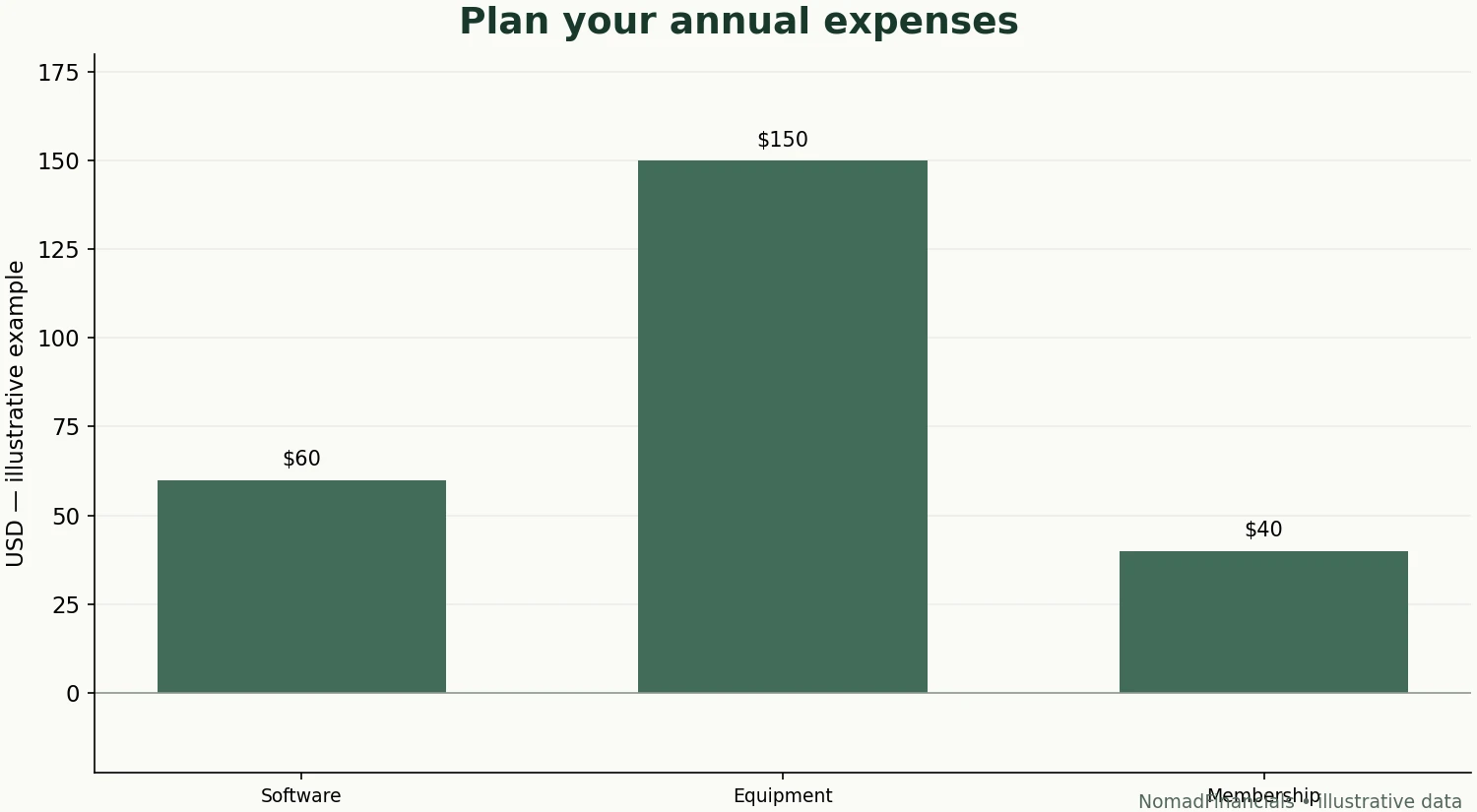
That $250 is a proposed assignment of cash, not proof that Jordan can afford it. Add it to the cash-flow forecast alongside ordinary bills and planned personal transfers. If it drives a future balance below the chosen operating floor, change the purchase, contribution, or timing before moving the money.
After the membership is paid, its old $40 contribution should not vanish into general spending by accident. Recalculate the next renewal schedule. With twelve future contribution dates and the same $240 price, the next cycle would require $20 per month, leaving $20 for another deliberate purpose.
Adapt the plan to irregular receipts
A fixed monthly target and an irregular receipt schedule can coexist. The monthly target describes progress required, while transfers happen only when actual cash permits. On payment day, confirm essential obligations and protected reserves before assigning surplus to sinking funds.
Suppose Jordan can contribute only $100 in month one instead of the planned $250. The $150 shortfall remains visible. If the original plan has nine equal contribution dates left for that portion, catching up requires another $150 ÷ 9 = $16.67 per date, with a small final adjustment for rounding. Alternatively, Jordan can postpone equipment replacement or reduce its target.
Do not automatically spread a shortfall across every fund. A contractually committed renewal due next month has a different urgency from an optional upgrade ten months away. Document the choice so that a busy week does not turn a deliberate delay into a forgotten bill.
Calculate time-off savings from the cash gap
Time off deserves its own estimate because lost billable revenue is not always the same as cash needed. Some clients may pay completed work while you are away. Some business costs continue; some discretionary costs can stop. Forecast the period rather than multiplying your best weekly invoice total.
Assume a planned break creates $1,400 of essential personal spending and $200 of continuing business outflows. Confirmed receipts during the break total $600. The modeled gap is $1,400 + $200 − $600 = $1,000. With $200 already assigned and eight contribution dates remaining, the contribution is ($1,000 − $200) ÷ 8 = $100.
Use conservative receipt assumptions. A proposal sent to a prospect is not confirmed cash. If the $600 is uncertain, create a second scenario without it. See how the gap changes before committing to travel or other nonrefundable expenses.
Keep one ledger that reconciles to cash
Your fund ledger needs a name, target, due date, opening balance, additions, withdrawals, and current balance. A balance formula is straightforward: opening balance plus actual additions minus actual withdrawals. Future planned transfers should live in separate columns so they do not inflate today's savings.
For example, an equipment balance of $300 plus an actual $150 transfer equals $450. Scheduling three more $150 transfers does not make the current balance $900. It makes the projected balance $900 if those transfers happen.
You may use separate accounts or labeled balances within one account. Either way, total all fund balances and compare them with the money actually held for those purposes. A transfer between your own accounts is not new freelance revenue. If your income sheet counts it as a client payment, fix that duplication first.
Review the plan before the renewal window closes
Schedule a short monthly check and a longer review before major deadlines. Look for price changes, auto-renewal dates, forgotten cancellation notice periods, and purchases that no longer fit the business. Refresh an equipment estimate as the intended purchase approaches rather than pretending a year-old price is certain.
Include the next deadlines in your weekly freelancer money routine. Compare sinking-fund balances with your income buffer and emergency fund so each dollar has one job. During a slow month, pause optional contributions explicitly instead of silently spending restricted cash.
Frequently asked questions
Is a sinking fund the same as a business expense?
No. Assigning your own cash to a fund is a planning action. Paying for an item is a separate transaction, and its accounting or tax treatment depends on the circumstances. A savings label does not determine deductibility.
Should I put every annual cost in one fund?
A combined annual-cost fund can work, but keep an itemized schedule underneath it. Otherwise an early renewal can consume money needed for a later one and leave the total looking misleadingly healthy.
What if the deadline is too close to fund?
Show the actual shortfall, then investigate cancellation, a different purchase, a later date, or other available cash. Do not make a full-year division look like a solution when only two payment opportunities remain.